

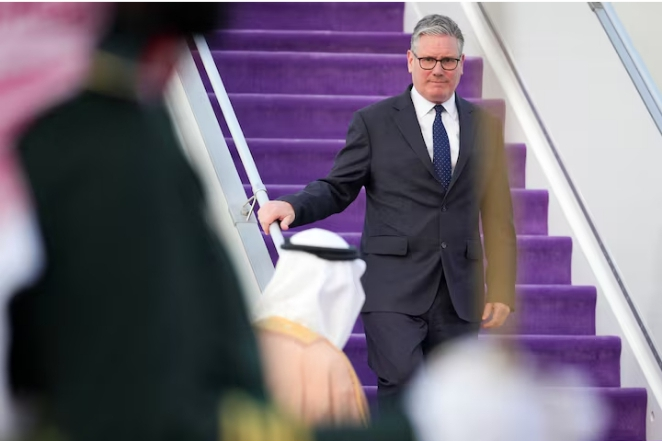
The UK Iran conflict new path is now at the heart of Britain’s strategic rethink, as Prime Minister Keir Starmer declares the Iran war a defining turning point that will reshape the country’s UK economic resilience, defence priorities, and global positioning in an increasingly unstable world marked by rising geopolitical instability.
Writing after weeks of disruption triggered by the conflict, Starmer framed the crisis as a “line in the sand,” arguing that Britain must abandon attempts to return to pre-2008 stability and instead adapt to a new era defined by volatility and recurring shocks.
The six-week war, which saw a ceasefire announced by U.S. President Donald Trump, has already rattled global energy markets, particularly due to disruptions around the Strait of Hormuz—now widely described as a Strait of Hormuz disruption with direct effects on global supply chains.
Despite the ceasefire, uncertainty lingers as Iran has yet to fully lift its blockade, prolonging supply disruptions and intensifying inflation pressures UK households are already beginning to feel.

A Turning Point After Years of Crisis
Starmer’s argument rests on a broader narrative: Britain has endured nearly two decades of continuous shocks, from the global financial crisis to Brexit, the COVID-19 pandemic, and Russia’s invasion of Ukraine.
In his view, the Iran conflict is not an isolated event but the latest in a chain of disruptions forcing a fundamental rethink of national strategy and long-term UK economic resilience.
Rather than restoring past conditions, he emphasized building a more resilient Britain—one capable of withstanding economic shocks, securing energy independence, and strengthening defence capabilities tied to future defence spending UK priorities.
This shift reflects a growing recognition that global instability is no longer temporary but structural, reinforcing the reality of ongoing geopolitical instability rather than short-term crisis cycles.
Economic Pressure Meets Political Reality
The immediate domestic impact of the crisis is already visible, with rising fuel prices expected to feed into broader inflation pressures UK households and businesses.
For Starmer, this creates both a challenge and an opportunity—testing his leadership while offering a chance to redefine his government’s economic agenda around UK economic resilience rather than short-term stabilization.
Since taking office in 2024, he has struggled to fully implement reforms amid tight public finances and internal party tensions.
Recent polling setbacks, including competition from Nigel Farage and the Reform UK movement, have added pressure to demonstrate decisive leadership and reinforce a clearer foreign policy independence stance.
Balancing Foreign Policy and Public Opinion
One of Starmer’s most notable decisions has been his refusal to join U.S. military action against Iran—a move that has drawn criticism from Washington but gained support among British voters.
Read also:Trump Iran war powers clash: Republicans block Congressional push as impeachment talk grows
This approach signals a more defined foreign policy independence posture, prioritizing national interest and domestic stability over automatic alignment with allies.
At the same time, it reflects a careful balancing act: maintaining strong transatlantic ties while responding to a public increasingly wary of foreign military entanglements.
Defence, Energy, and a New Strategic Direction
Central to the UK Iran conflict new path is a renewed focus on three pillars: energy security, military strength, and long-term UK economic resilience.
The disruption in global oil supplies has exposed vulnerabilities in Britain’s energy dependence, reinforcing calls for an energy crisis Britain strategy focused on diversification and domestic capacity building.
On defence, the government is expected to reassess defence spending, aligning capabilities with a world defined by rapid escalation risks, hybrid threats, and sustained geopolitical instability.
Economically, the emphasis is shifting toward stability and adaptability—ensuring that Britain can absorb external shocks without prolonged disruption.
Fresh Perspectives: Beyond Immediate Policy Shifts
The UK Iran conflict new path also raises deeper questions about Britain’s long-term strategic identity in a rapidly changing world.
Some analysts argue this moment could accelerate a shift toward an energy crisis response driven by renewables, reducing exposure to geopolitical chokepoints like the Strait of Hormuz altogether.
Others suggest Britain may redefine its global role—not as a reflexive military partner to the United States, but as a more selective power balancing diplomacy, deterrence, and foreign policy independence.
There is also a growing view that crises like the Iran conflict could reshape domestic expectations, pushing governments to prioritize resilience over growth alone and deepen UK economic resilience.
However, skeptics warn that ambition may outpace execution. Without sustained investment and political stability, calls for transformation risk becoming rhetorical rather than structural.
Global Implications of a British Reset
Britain’s response to the Iran conflict also carries broader implications for its role on the global stage.
A more self-reliant and strategically focused UK could reshape alliances, influence NATO dynamics, and redefine its position between the United States and European partners.
At the same time, the crisis highlights how regional conflicts—particularly in the Middle East—continue to drive geopolitical instability with global economic consequences.
For policymakers, the lesson is clear: distant conflicts are no longer distant in their impact.
A Defining Moment for Britain’s Future
The UK Iran conflict new path ultimately represents more than a policy adjustment—it signals a shift in mindset.
Starmer’s message is that Britain must stop reacting to crises and start preparing for a world where disruption is constant, reinforcing the need for sustained UK economic resilience and strategic clarity.
Whether this vision translates into concrete policy success remains to be seen, but the stakes are high.
How Britain responds now could shape its economic strength, global influence, and national resilience for decades to come.