The Trump, Xi and Putin Shenzhen summit has brought the leaders of the United States, China and Russia together for an unprecedented trilateral meeting, with the war in Ukraine, nuclear arms control and global security among the major issues discussed.
US President Donald Trump, Chinese President Xi Jinping and Russian President Vladimir Putin met on Thursday, November 19, 2026, in the southern Chinese city of Shenzhen on the sidelines of the Asia-Pacific Economic Cooperation (APEC) summit.
The historic gathering brought together the leaders of the world’s three major nuclear powers for direct discussions on international security and their countries’ relationships.
Trump described the meeting as an opportunity to make history, while Putin highlighted areas of shared interest in resolving regional conflicts, including the war in Ukraine.
Xi, who presided over the meeting according to Chinese state media, emphasised the importance of cooperation among major powers, warning that confrontation between them could create international instability.
The meeting lasted approximately one hour and 20 minutes. However, none of the three presidents made an immediate joint public statement after the discussions, and Trump subsequently departed China for the United States.
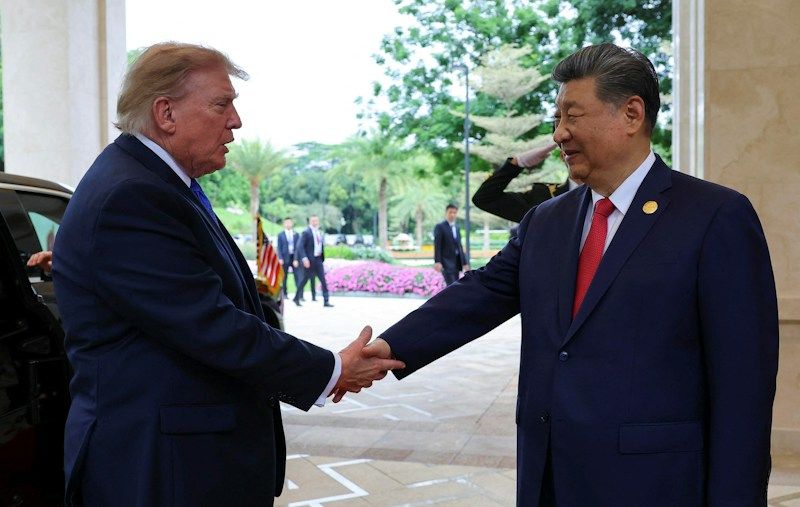
Leaders agree on nuclear risk reduction and energy cooperation
One of the major outcomes was a joint declaration published by Chinese state media and subsequently released by Russia.
Described as a peace declaration, the document outlined areas of cooperation between the three countries, particularly nuclear security, energy supplies and reform of international institutions.
The leaders reaffirmed their position that nuclear war must never be fought, stressing the importance of preventing nuclear proliferation and reducing nuclear risks.
The declaration stated that the three countries would conduct dialogue on reducing nuclear dangers and preventing the spread of nuclear weapons.
They also committed to working towards reform of the United Nations to make the organisation more effective in addressing global challenges and maintaining international peace and security.
Another significant aspect concerned energy cooperation.
According to the declaration, the three countries planned to increase the production and supply of refined petroleum products for the benefit of nations around the world.
They also reaffirmed the importance of maintaining stable energy flows.
The agreement represents an important diplomatic development, although the declaration did not provide a detailed implementation timetable for the proposed commitments.
Putin describes discussions as frank and useful
Following the meeting, Putin addressed journalists in Shenzhen and described his discussions with Trump and Xi as open, frank and useful.
He said the three leaders discussed several international issues, including reform of the United Nations, security concerns and nuclear non-proliferation.
Putin also suggested that relations between Russia and the United States could improve, adding that the Trump administration’s approach towards Moscow gave him reason for optimism.
He said Trump appeared genuinely committed to ending the war in Ukraine.
However, the Russian president cautioned against interpreting the summit as the beginning of an ambitious new framework for cooperation.
Putin said the meeting had not established ambitious goals and stressed that none of the countries would be forced to comply with its decisions.
He also revealed that the three leaders had not agreed to hold regular meetings in the same trilateral format.
Putin added that he would consider attending the December G20 meeting in Miami after discussing the possibility with Trump. He said his final decision would depend partly on the situation in Russia.
Ukraine war features in Trump’s discussions with Xi and Putin
The conflict between Russia and Ukraine was among Trump’s major priorities ahead of the summit.
Before the trilateral gathering, the American president held separate bilateral discussions with Xi and Putin.
During his meeting with Xi, Trump raised the possibility of working together to end the war.
“We’re looking to both help with respect to the war with Russia and Ukraine. I’d like to see it ended. I think I can speak for both of us very much,” Trump said.
However, Xi did not mention Ukraine in his opening remarks, highlighting a difference in emphasis between Washington and Beijing.
China had been reluctant to place the conflict at the centre of a meeting that excluded Ukraine and European governments.
Although Chinese state media later reported that the three leaders exchanged views on the Ukraine crisis, the conflict was not specifically mentioned in the published joint declaration.
This leaves uncertainty over whether the discussions produced any practical understanding that could contribute to ending the war.
Putin’s subsequent remarks suggested that he viewed Trump’s position positively, but no specific ceasefire agreement or peace framework was announced.
Trump and Putin exchange warm diplomatic gestures
Before the three-way meeting, Trump also held an impromptu encounter with Putin and publicly referred to both the Russian and Chinese leaders as friends.
The American president’s warm language towards Putin attracted criticism from some of Washington’s traditional European allies.
Polish Prime Minister Donald Tusk responded to Trump’s description of the Russian leader by making clear that Warsaw did not share the sentiment.
“Mr Putin is not our friend and will never be,” Tusk said.
Poland has been among the European countries strongly concerned about Russia’s invasion of Ukraine, partly because of its geographical proximity to both Russia and Ukraine.
Trump’s friendly public approach towards Putin is likely to raise further concerns among European governments that have spent years seeking to isolate Moscow over the war.
The diplomatic spectacle in Shenzhen therefore carried implications beyond the three countries represented at the summit.
Taiwan remains a major source of tension between China and the United States
Trump’s bilateral meeting with Xi also addressed Taiwan, an issue that continues to complicate relations between Washington and Beijing.
According to Chinese state news agency Xinhua, Xi urged the United States to do the right thing regarding Taiwan to prevent serious setbacks in relations between the two countries.
China considers the self-governed island part of its territory and has repeatedly warned against moves it regards as support for Taiwanese independence.
Xi called for both countries to expand areas of cooperation while managing unresolved disagreements.
“I look forward to working with President Trump to continue steering the course of China-US relations and ensure that this big ship always sails along the right course,” he said.
Xinhua described the bilateral meeting as positive and constructive, adding that both countries agreed to formulate an action plan for their relationship.
The Taiwan issue remains particularly sensitive because the United States is the island’s most important international security partner, while Beijing has not ruled out using military force to bring it under its control.
Russia’s military aircraft activity raises concerns in East Asia
While Putin was participating in the summit, Taiwan reported that two Russian Tu-95 military aircraft had flown past the island’s eastern coast.
It was the second time Taiwan had reported such activity during the week.
The earlier deployment, shortly before Putin travelled to China, had also attracted attention from Taiwan and Japan.
The movements formed part of a significant Russian military aircraft deployment across East Asia, reportedly one of Moscow’s most substantial displays of strategic airpower in the region in more than a decade.
Ian Storey, a security scholar at Singapore’s ISEAS-Yusof Ishak Institute, said the deployment was intended to demonstrate Russia’s continuing ability to project military power despite its ongoing war in Ukraine.
The Tu-95 aircraft are strategic bombers, some of which are nuclear-capable. They can also be used for intelligence gathering and surveillance.
Russia’s defence ministry had not responded to requests for comment at the time of the Reuters report.
Trump highlights diplomatic spectacle as measure of success
Trump also presented the reception he received in China as evidence of the success of his Asian trip.
Speaking to Fox News, he highlighted Xi’s decision to welcome him at the airport, the elaborate military ceremony, crowds of spectators and children lining his arrival route.
He also referred to the seating arrangement at the state banquet, which placed him at the head table.
“That’s a big win for us. It’s a big win for China too. We get along,” Trump said.
The trip also produced announcements concerning trade agreements, although some of the arrangements remained under negotiation.
Trump praised a proposed deal involving Thailand, even as both sides indicated that formal negotiations were continuing. He also announced a major trade understanding with the Philippines, although Manila had not publicly provided comparable details.
Beyond the ceremonial welcome, discussions with Xi covered trade and critical minerals, while Trump also floated the possibility of cooperation among the United States, Russia and China on nuclear arms reductions.
However, he provided few details about how such an ambitious initiative would be implemented.
Musk accompanies Trump but stays out of the diplomatic spotlight
Tesla and SpaceX chief executive Elon Musk was among the prominent business figures accompanying Trump on his Asian trip.
Musk has significant business interests in China, including in Shenzhen, making his presence in the American delegation notable.
However, he maintained a relatively low profile during the high-level diplomatic engagements.
He was spotted travelling with members of the American delegation upon their arrival in Shenzhen but did not feature prominently in the summit proceedings.
Musk nevertheless appeared virtually at the New York Times DealBook summit on Wednesday, where he discussed his political spending and admitted that he felt foolish about investing heavily in Republican candidates during the 2026 US midterm elections.
Reuters reported that he contributed at least $446m to Republican campaigns, making him the largest individual political donor in US history. However, Democrats secured control of both chambers of Congress.
Read also: Elon Musk rejects Maga label and regrets spending nearly $500m backing Republicans
Historic meeting leaves questions about its practical impact
The Shenzhen summit has created an unprecedented diplomatic moment by bringing Trump, Xi and Putin together for direct discussions on issues affecting international security.
The joint declaration established broad commitments on nuclear risk reduction, energy cooperation and United Nations reform.
Nevertheless, major disagreements remain, particularly over Ukraine, Taiwan, trade and the future of global security arrangements.
Putin’s admission that the meeting did not establish ambitious goals also suggests that the gathering should not automatically be interpreted as a breakthrough in relations among the three powers.
With no agreement on regular trilateral meetings and no detailed peace settlement for Ukraine, the practical consequences of the summit remain uncertain.
The gathering has nevertheless demonstrated the willingness of the three leaders to engage directly at a time when their decisions could significantly influence international diplomacy, economic relations and global security.
Meta description: The Trump, Xi and Putin summit in Shenzhen produced a joint declaration on nuclear security, energy cooperation and global stability, while Ukraine and Taiwan remained major concerns.
About The Author