The Kerch bridge attack reported on Wednesday marked the third strike against the strategic link connecting Russia to occupied Crimea in one week, highlighting Ukraine’s continued efforts to damage a vital route used by Moscow to maintain its control over the peninsula.
The latest incident was confirmed by Sergei Aksyonov, the Russian-installed head of Crimea, who announced that traffic had been temporarily suspended following the attack.
In a statement posted on Telegram, Aksyonov said emergency and other relevant services had been deployed to the scene while an assessment of the damage was being carried out.
“Following a new attack on the Crimean Bridge, traffic has been temporarily halted. All relevant services are on site and at work. An assessment of the damage is under way,” he wrote.
Russia’s Transport Ministry also confirmed that train services across the bridge had been suspended. It said there were no reports of casualties following the latest incident.
The attack came after two earlier strikes against the same structure during the week, making the latest development part of an escalating series of operations targeting one of Russia’s most important transport connections.
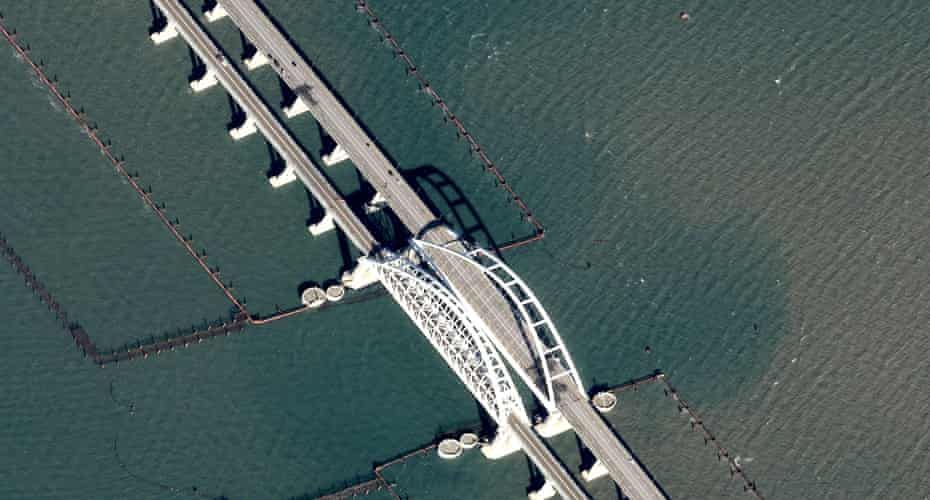
Third attack in one week raises concerns over bridge security
Wednesday’s incident was particularly significant because the bridge had already suffered substantial damage from previous attacks in the same week.
One of the earlier operations destroyed a 227-metre section of the road span, leaving a major portion of the crossing damaged. Although the road infrastructure was seriously affected, the railway corridor appeared to remain operational despite sustaining some damage.
The repeated attacks have raised fresh questions about Russia’s ability to protect the strategically important structure, which serves as a major supply and transport route between mainland Russia and Crimea.
The Kerch Strait Bridge, also known as the Crimean Bridge, connects the Russian mainland to the peninsula seized by Moscow from Ukraine in 2014.
Since its construction, the bridge has become a powerful symbol of Russia’s annexation of Crimea and President Vladimir Putin’s determination to maintain control over the territory.
Its strategic importance extends beyond symbolism. The crossing provides a direct route for transporting military equipment, personnel, fuel and other supplies to Russian forces operating in Crimea and parts of southern Ukraine.
Consequently, attacks on the structure have become an important element of Ukraine’s campaign to weaken Russia’s military logistics and challenge Moscow’s control over occupied territories.
Ukraine previously claimed responsibility for damaging the bridge
Earlier in the week, Ukraine claimed responsibility for an operation that critically damaged the bridge, with President Volodymyr Zelenskyy describing the mission as an unprecedented military operation.
Zelenskyy said the operation was the culmination of a lengthy and complicated campaign involving Ukrainian-developed weapons, including drones and ballistic missiles.
The operation reportedly involved the use of Palianytsia drones against the road section, while Neptune and other missiles were directed towards the adjoining railway infrastructure.
The destruction of the 227-metre road section demonstrated the vulnerability of a structure that Russia has repeatedly presented as a major engineering achievement and a symbol of its authority over Crimea.
Ukraine’s latest operations also underline the increasing importance of domestically developed weapons in its efforts to strike strategically significant Russian targets.
Although the bridge has remained a major challenge for Ukrainian military planners, the repeated attacks suggest that Kyiv continues to regard it as a critical target in its broader campaign against Russian military infrastructure.
Kerch bridge attack recalls earlier Ukrainian operations
The latest Kerch bridge attack also brings back memories of previous attempts by Ukraine to destroy or seriously damage the crossing.
In October 2022, a powerful truck bomb exploded on the bridge, damaging sections of the road and railway infrastructure and killing several people.
The explosion caused part of the road section to collapse into the water, while several fuel tankers on a passing train caught fire.
Russia subsequently repaired the damaged sections and restored traffic, although the incident exposed the vulnerability of the crossing.
In July 2023, another attack involving a sea drone struck the bridge, causing further damage and disrupting movement across the structure.
The two earlier incidents demonstrated that Ukraine was prepared to target the bridge despite the significant security measures Russia had introduced to protect it.
The latest series of attacks has therefore added another chapter to the continuing contest over the security of the crossing.
Bridge attacks carry political and military significance
Beyond their immediate military consequences, the repeated attacks have considerable political significance for the Kremlin.
The bridge is closely associated with Putin’s leadership and Russia’s annexation of Crimea. Any successful operation against it therefore represents more than damage to transport infrastructure.
A Ukrainian armed forces source told The Guardian that the attacks were intended to embarrass Putin ahead of his meeting with US President Donald Trump and Chinese President Xi Jinping in China.
“The bridge is a symbol of Putin’s rule. Destroying it sends a message to the other two great leaders that Putin is not as strong as he pretends,” the source said.
The comment suggests that Ukraine sees attacks against the bridge as an opportunity to challenge both Russia’s military capabilities and the image of strength Moscow seeks to project internationally.
The timing of the operations also places the attacks within a wider diplomatic and geopolitical context, as Russia continues to pursue international support and maintain its position in negotiations over the war.
Russia faces renewed pressure to protect strategic infrastructure
The latest attack presents another security challenge for Russian authorities, particularly as the bridge remains essential to transportation between Russia and Crimea.
Repeated disruptions can affect civilian movement, commercial transportation and military supply operations. Even when damage is repaired, the possibility of further attacks creates uncertainty over the reliability of the route.
The suspension of traffic and train services following Wednesday’s incident also illustrates how quickly operations on the bridge can be interrupted.
For Ukraine, targeting the crossing offers an opportunity to impose logistical difficulties on Russia without necessarily having to seize territory around the structure.
For Moscow, protecting the bridge remains a major priority because of its military importance and political symbolism.
However, the succession of attacks within a single week suggests that the security challenge has not been eliminated.
Read more: Shabana Mahmood’s immigration reforms pass Commons despite Labour rebellion
As Russian authorities assess the latest damage and work to restore normal operations, attention will remain focused on whether Ukraine intends to continue targeting the crossing and how effectively Moscow can defend it.
The Kerch Bridge has survived previous attacks and undergone repairs, but the latest developments show that it remains a recurring target in the war between Russia and Ukraine.
About The Author