

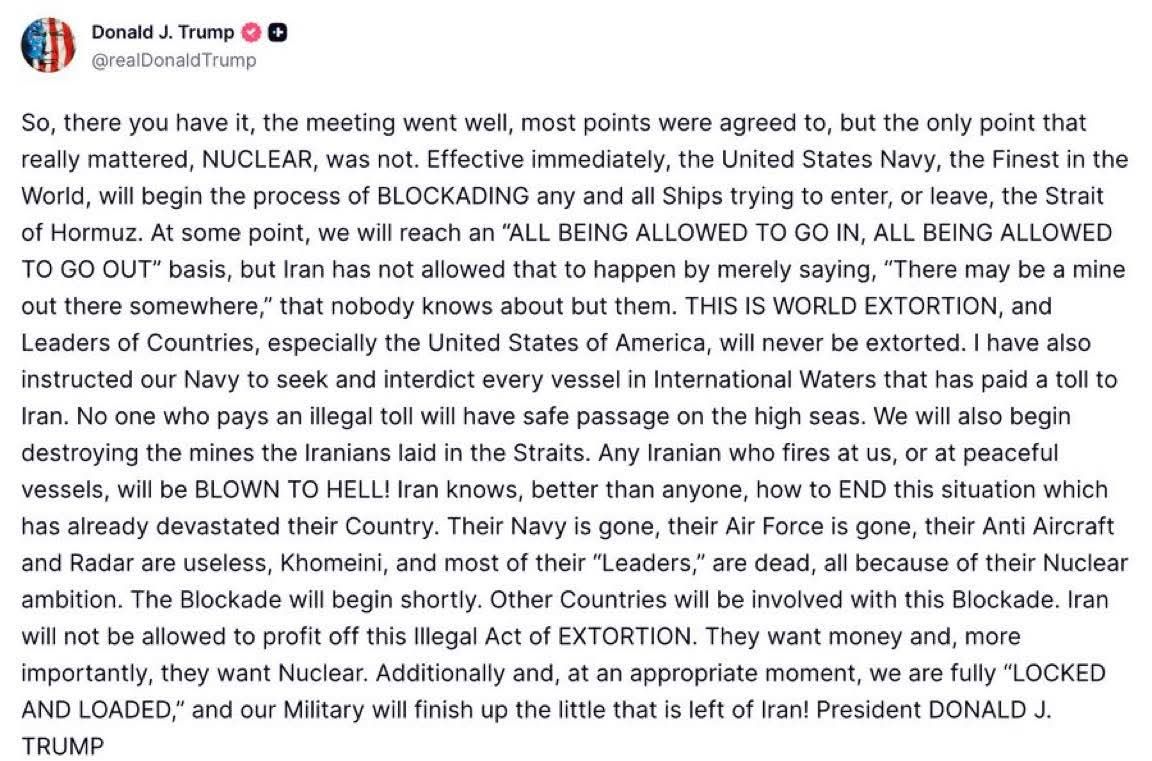
The Trump Strait of Hormuz blockade order sparks global crisis after Iran nuclear talks collapse as geopolitical tensions surge following the breakdown of high-stakes negotiations between the United States and Iran. The announcement, made by United States President Donald Trump, signals a dramatic escalation from diplomacy to maritime confrontation in one of the world’s most critical energy corridors.
The Trump Strait of Hormuz blockade order sparks global crisis after Iran nuclear talks collapse after 21 hours of failed negotiations ended without agreement on nuclear restrictions, triggering fears of global oil disruption, military escalation, and a widening regional conflict involving strategic waterways and naval forces.
According to Trump, the collapse of the talks leaves the world facing what he described as “economic extortion at sea,” setting the stage for a blockade of one of the most sensitive maritime chokepoints on Earth.
Trump confirms breakdown of nuclear talks and shifts to military pressure
Diplomatic failure triggers immediate escalation
The crisis began after negotiations between the United States and Iran collapsed over nuclear program restrictions, sanctions relief, and maritime security guarantees.
Trump claimed that while “most points were agreed to,” the nuclear issue remained unresolved, making any deal impossible.
In a strongly worded statement, he said:
“So, there you have it, the meeting went well, most points were agreed to, but the only point that really mattered, NUCLEAR, was not.”
The breakdown immediately shifted US strategy from diplomacy to military enforcement, marking a significant turning point in US-Iran relations.
Strait of Hormuz blockade becomes central flashpoint
World’s most critical oil route under pressure
At the center of the crisis is the Strait of Hormuz, a narrow maritime passage connecting the Persian Gulf to global shipping routes.

Trump announced that the US Navy would begin what he described as a “blockading process” of all vessels entering or exiting the strait.
He framed the move as a response to what he called Iranian “extortion tactics” involving tolls and maritime restrictions.
The Strait is vital to global energy stability, with a significant portion of the world’s oil supply passing through daily. Any disruption risks immediate economic consequences across Europe, Asia, and the United States.
Trump orders US Navy to enforce maritime blockade
Military enforcement expands rapidly
The United States Navy has been directed to begin intercept operations targeting vessels suspected of engaging in transactions with Iran or operating under its maritime control system.
Trump stated:
“Effective immediately, the United States Navy, the Finest in the World, will begin the process of BLOCKADING any and all Ships trying to enter, or leave, the Strait of Hormuz.”
He further warned that vessels allegedly paying tolls to Iran could be intercepted in international waters, escalating the legal and military complexity of the operation.
He also added that any hostile action would be met with overwhelming force, reinforcing a doctrine of deterrence over diplomacy.
Iran rejects blockade and warns of consequences
Tehran challenges US authority
Iran has rejected the blockade announcement, arguing that the Strait of Hormuz is an international waterway and cannot be controlled unilaterally.
Officials in Tehran describe the move as illegal and destabilizing, warning it could lead to broader regional conflict.
Iran continues to assert that its nuclear program is peaceful, accusing the United States of using economic pressure and military threats to enforce political demands.
Global oil markets react to escalating crisis
Energy shock fears intensify worldwide
Financial markets reacted immediately to the announcement, with analysts warning of a potential global energy shock.
The Strait of Hormuz is one of the most important oil transit routes in the world. Any disruption raises fears of supply shortages, price spikes, and inflationary pressure across major economies.
Energy-importing nations in Asia and Europe are now reassessing risk exposure, while shipping companies face rising insurance costs and route uncertainty.
From failed diplomacy to strategic confrontation
Collapse of talks deepens mistrust
The breakdown of negotiations reflects a deeper strategic divide between Washington and Tehran over nuclear development, sanctions, and regional influence.
Trump claimed Iran had missed a final opportunity to reach a deal, arguing that continued nuclear ambitions made agreement impossible.
Iran maintains that it is acting within international law, creating a direct contradiction that now fuels escalation rather than compromise.
Rising risk of US Iran military escalation 2026
Naval confrontation becomes a real possibility
The introduction of blockade operations significantly increases the risk of US Iran military escalation 2026, particularly in narrow maritime zones where naval forces operate in close proximity.
Experts warn that even minor incidents could trigger rapid escalation, drawing in allied forces and expanding the conflict beyond its current scope.
The Strait of Hormuz now functions as both a strategic chokepoint and a potential ignition point for wider confrontation.
Trump’s hardline doctrine and global reaction
Strong rhetoric fuels international concern
Trump described the situation as a form of “world extortion,” accusing Iran of using maritime control for political and economic leverage.
He emphasized that the United States would not allow itself to be pressured, framing the blockade as a necessary defensive action.
International reaction has been mixed, with some governments calling for restraint while others express concern about the legality and consequences of unilateral maritime enforcement.

Strait of Hormuz global oil supply crisis fears grow
Energy security at risk
The announcement has intensified fears of a global oil supply crisis Strait of Hormuz, as even partial disruption of the route could significantly impact global energy flows.
Analysts warn that prolonged instability could lead to inflation spikes, supply chain disruption, and increased geopolitical fragmentation in energy markets.
The situation has already pushed global shipping risk premiums higher, reflecting uncertainty over safe passage through the region.
Fresh perspective: a shift from diplomacy to maritime power politics
The Trump Strait of Hormuz blockade order sparks global crisis after Iran nuclear talks collapse represents more than a breakdown in negotiations—it signals a structural shift in global conflict management.
Instead of diplomatic resolution, strategic waterways are increasingly becoming arenas of military pressure and economic coercion.
This reflects a broader global trend where control over shipping chokepoints is becoming as important as traditional territorial power.
The Strait of Hormuz is no longer just a shipping lane—it is now a geopolitical pressure valve for global energy security.
A crisis moving toward an unpredictable phase
The Trump Strait of Hormuz blockade order sparks global crisis after Iran nuclear talks collapse has pushed US-Iran relations into a new and more dangerous phase of confrontation.
With diplomacy collapsed, naval enforcement underway, and global markets reacting, the risk of miscalculation is rising sharply.
Whether this leads to renewed negotiations or deeper conflict remains uncertain, but the Strait of Hormuz has now become the defining pressure point of a global geopolitical crisis with far-reaching consequences.
Read also: Hungary election 2026: Orbán faces historic showdown as voters decide future after 16 years in power