

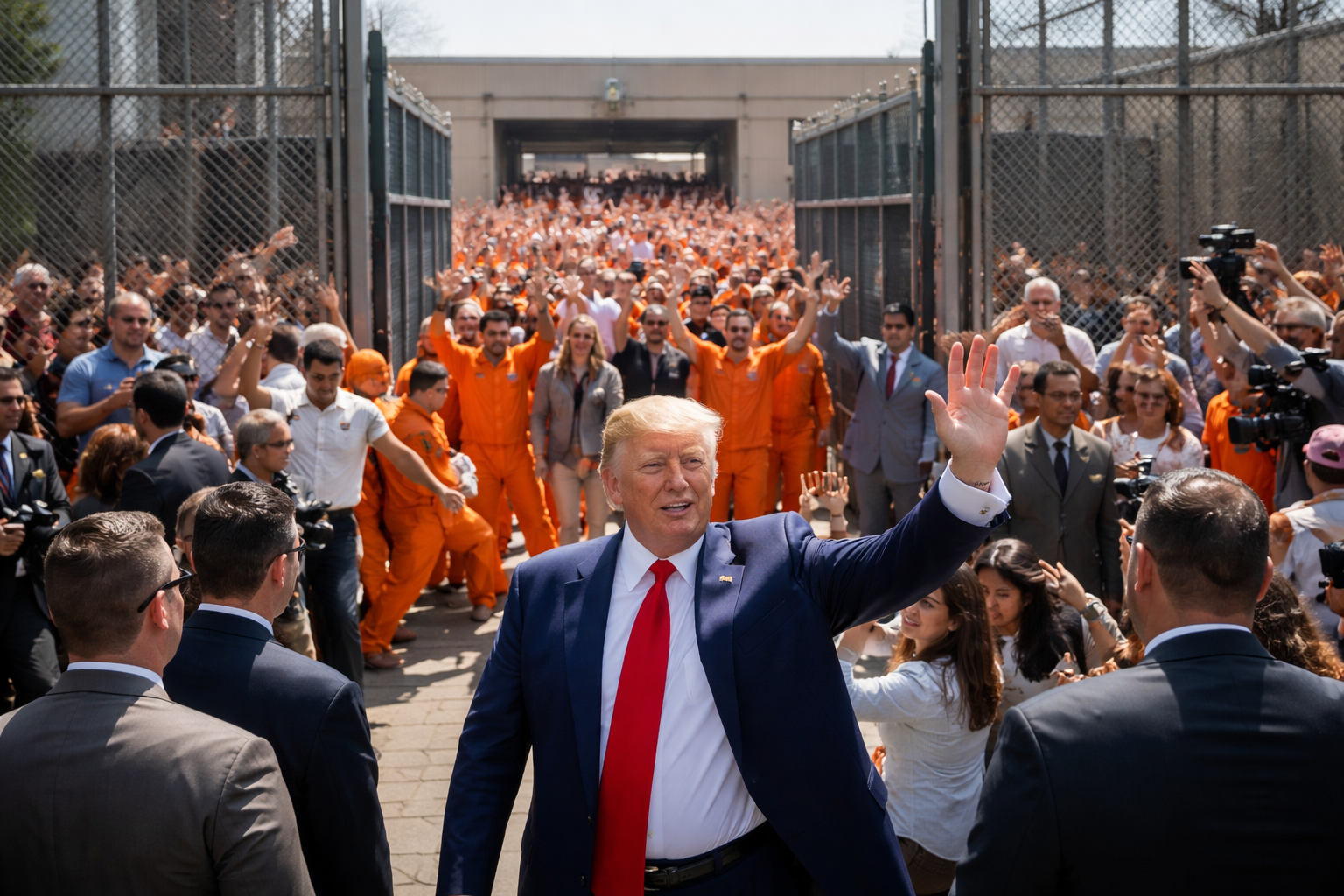
The Trump mass pardons plan has triggered shock across political circles and renewed debate over the limits of presidential authority, as reports suggest sweeping clemency may be considered for political allies before the end of the US presidency. The development has intensified scrutiny of executive power and raised fears of a potential constitutional crisis.
Reports indicate Donald Trump privately discussed broad pardon scenarios involving close political associates, including remarks interpreted as informal signals about large-scale clemency intentions that could reshape political accountability.
The White House responded cautiously, insisting the comments are not official policy while reaffirming constitutional pardon powers. However, the uncertainty has triggered backlash from political opponents and legal analysts warning of institutional strain and rising public mistrust.
Constitutional Power Under Crisis Scrutiny
The US Constitution grants presidents wide authority to issue pardons for federal offenses, a safeguard originally designed to correct judicial errors but increasingly controversial in modern political environments marked by polarization and mistrust.
The Trump mass pardons plan controversy has escalated into a broader debate about whether expansive clemency for political allies could push the limits of constitutional design and create a governance crisis if applied at scale.
Since returning to office, Trump has reportedly issued over 1,800 pardons, including individuals linked to the January 6 Capitol riot, deepening shock among critics who argue the justice system is being reshaped through executive discretion.

Political Shock and Rising Domestic Backlash
Supporters argue presidential pardons are necessary tools to correct what they describe as politically motivated prosecutions, but critics say the scale and timing of recent clemency decisions represent a growing crisis of accountability.
In the context of the Trump mass pardons plan, clemency has shifted from a legal mechanism into a political flashpoint, triggering backlash across Washington and intensifying partisan divisions over justice and fairness.
Opponents warn that mass pardons for political allies could send a dangerous signal that legal consequences depend on proximity to power, fueling public anger and institutional distrust.
Judicial Uncertainty and Legal Tensions
Legal experts warn that ongoing cases connected to earlier political events could face renewed uncertainty as defendants attempt to link their charges to broader pardon discussions and prior clemency decisions.
The Trump mass pardons plan has created procedural tension in courts, with judges increasingly required to separate constitutional authority from politically charged interpretations that risk expanding the scope of executive clemency.
This growing uncertainty has contributed to what some analysts describe as a developing legal crisis, where the boundaries of presidential pardon power are being tested in real time.
Global Shockwaves and Governance Concerns
International observers have expressed concern over the Trump mass pardons plan, noting that decisions by the US presidency often set benchmarks for democratic governance and institutional behavior worldwide.
In Africa, Europe, and other regions, analysts warn that perceived overuse of executive clemency could fuel backlash in countries already grappling with debates about accountability and separation of powers.
The shock generated by the reports highlights how American political decisions continue to influence global expectations about justice systems and executive restraint.
Media Amplification and Narrative Backlash
The reporting behind the Trump mass pardons plan is based on anonymous sources and private remarks, reflecting how modern media ecosystems can rapidly escalate political conversations into global controversies.
This has led to backlash over media framing, with critics arguing that informal statements are being amplified into crisis-level narratives before any formal policy decisions are made.
At the same time, supporters of investigative reporting argue that such disclosures are essential for transparency when dealing with powerful executive decisions and potential abuse of authority.
Read also:Israel Hezbollah ceasefire crisis deepens as deadly strikes hit Lebanon ahead of high-stakes talks
Institutional Trust at the Center of a Political Crisis
At its core, the Trump mass pardons plan debate reflects a deeper crisis of institutional trust, where constitutional powers are increasingly viewed through the lens of political loyalty rather than legal neutrality.
Even without formal implementation, the shock generated by the reports has already influenced public perception, judicial caution, and political messaging across multiple levels of governance.
As backlash continues, the issue remains a defining example of how executive power, public trust, and democratic stability intersect in moments of heightened political tension.