

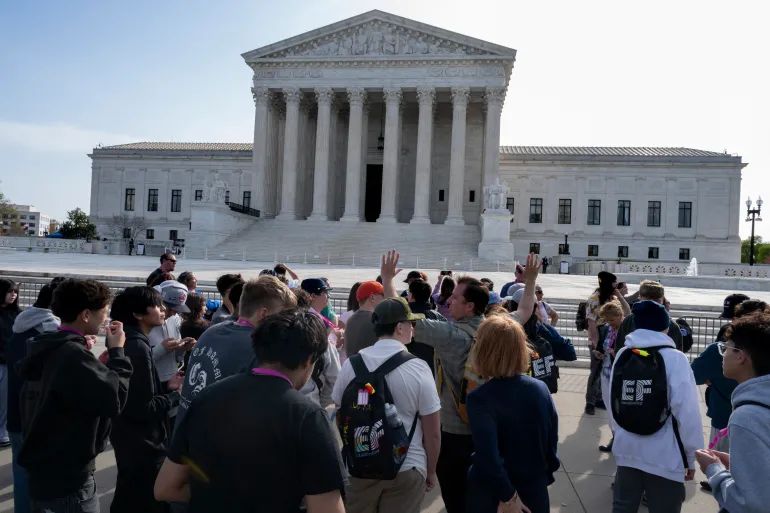
The “US Supreme Court birthright citizenship test” has emerged as one of the most consequential legal battles in modern American history, raising fundamental questions about citizenship, constitutional authority, and executive power.
The case centres on whether individuals born on American soil automatically receive citizenship, a principle long associated with the Constitution but now challenged by a controversial presidential directive.
At the heart of the dispute lies a sweeping executive order seeking to reinterpret longstanding legal norms governing nationality, prompting fierce debate across political, legal, and social landscapes nationwide.
Supporters of the challenge argue the order violates clear constitutional language, while opponents claim historical interpretations have been flawed and require correction to reflect original legal intent.
The legal confrontation has drawn intense attention because it tests the limits of presidential authority in redefining rights traditionally protected by constitutional provisions and judicial precedent.
Central to arguments against the order is the 14th Amendment, widely understood to guarantee citizenship to all individuals born within the United States regardless of parental status.
Advocates insist the amendment’s language is explicit and leaves little room for reinterpretation, describing the executive action as an overreach threatening foundational legal principles.
Opponents, however, focus on specific wording within the amendment, particularly the phrase concerning jurisdiction, arguing it has been historically misapplied beyond its intended scope.
Legal experts note that interpretations of jurisdiction have typically excluded only narrow categories, such as children of diplomats or individuals not subject to domestic legal authority.
The “US Supreme Court birthright citizenship test” therefore hinges on whether broader exclusions can be justified without undermining established constitutional protections and decades of consistent legal practice.
Lower courts have overwhelmingly rejected the executive order, reinforcing the prevailing interpretation that birthplace alone confers citizenship under constitutional guarantees.
These rulings have set the stage for a definitive judgment at the highest judicial level, where justices must reconcile competing readings of historical texts and modern legal realities.
The administration’s legal team contends that earlier interpretations expanded constitutional meaning beyond its original purpose, particularly regarding individuals without permanent legal residency.
They argue the amendment was primarily designed to address post-slavery citizenship rights rather than establish universal birth-based nationality for all individuals regardless of immigration status.
Critics strongly dispute this view, pointing to historical records and legislative debates suggesting lawmakers intended a broad and inclusive definition of citizenship.
They emphasise that subsequent legal frameworks reinforced this interpretation, embedding birthright citizenship as a core feature of national identity and legal structure.
The case also revisits longstanding judicial precedents affirming that children born to non-citizens within national territory are entitled to citizenship under constitutional protections.
These precedents have shaped immigration policy and societal expectations for generations, making any reversal potentially transformative for millions of individuals and families.
Analysts warn that altering birthright citizenship could significantly expand the population lacking formal legal status, creating complex administrative and humanitarian challenges.
Estimates suggest hundreds of thousands of births annually could be affected, dramatically reshaping demographic trends and legal classifications within the country.
Advocacy groups highlight concerns about the emergence of a permanent underclass, comprising individuals born domestically but denied full legal recognition and associated rights.
Such outcomes, they argue, could deepen inequality and create long-term societal divisions rooted in legal status rather than place of birth.
The “US Supreme Court birthright citizenship test” has therefore become a focal point for broader debates about immigration, identity, and national values in an increasingly diverse society.
Political implications are equally significant, as the case aligns with broader policy efforts aimed at restricting immigration and redefining pathways to citizenship.
Critics view the executive order as part of a wider strategy to limit demographic change and reshape the electorate by narrowing access to legal recognition.
Supporters counter that revisiting constitutional interpretations is necessary to ensure laws reflect current realities and national interests in immigration control.
The judiciary now faces the challenge of balancing textual analysis, historical context, and practical consequences in delivering a ruling with far-reaching implications.
Legal scholars note that constitutional interpretation often evolves, but abrupt shifts in foundational principles can destabilise established legal systems and societal expectations.
Read also:Pakistan China five-part peace initiative calls for immediate Middle East ceasefire
The case also raises questions about the separation of powers, particularly whether the executive branch can unilaterally redefine constitutional provisions through policy directives.
Opponents argue such actions undermine judicial authority and threaten the balance intended by constitutional design.
Supporters maintain that executive interpretation plays a legitimate role in shaping policy, especially in areas where legal ambiguity exists.
The outcome may clarify the extent to which presidents can influence constitutional meaning without legislative or judicial endorsement.
Public reaction to the case reflects deep divisions, with opinions often shaped by broader views on immigration, national identity, and governance.
Community organisations, legal institutions, and advocacy groups have mobilised to influence public discourse and highlight potential consequences of the ruling.
Educational campaigns aim to inform citizens about the historical and legal foundations of birthright citizenship and its role in shaping national identity.
At the same time, political rhetoric surrounding the issue has intensified, contributing to polarised narratives and heightened public interest in the court’s decision.
International observers are also closely monitoring developments, recognising that changes in citizenship policy could affect global migration patterns and diplomatic relations.
Comparative analyses reveal that birthright citizenship is not universally practised, adding complexity to arguments about its necessity and relevance.
However, its longstanding presence in American law makes any reconsideration particularly significant and potentially disruptive.
The “US Supreme Court birthright citizenship test” ultimately represents more than a legal dispute; it is a defining moment in the ongoing evolution of constitutional interpretation.
Its resolution will likely shape immigration policy, legal precedent, and national identity for decades, influencing how citizenship is defined and who is entitled to it.
As arguments unfold, the court’s decision will reflect broader tensions between tradition and change, inclusivity and restriction, and law and political power.
Regardless of the outcome, the case underscores the enduring importance of constitutional interpretation in addressing contemporary challenges within a rapidly changing society.
The final ruling is expected to set a precedent that will resonate across legal, political, and social spheres, marking a pivotal chapter in the nation’s constitutional history.
In this context, the “US Supreme Court birthright citizenship test” stands as a critical examination of foundational principles that continue to define the meaning of citizenship in modern times.
About The Author
