The Lagos Bowling Club Membership has ignited online debate after Siraheem Okoya described the ₦7.5 million annual fee as affordable for a private club.
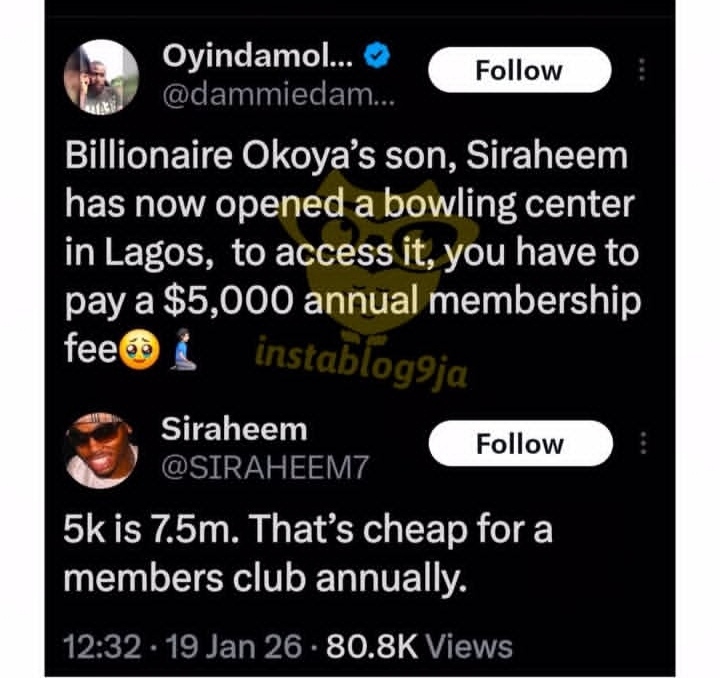
The launch of Lagos Bowling Club Membership has ignited a wave of public debate after details emerged about the cost of joining the exclusive bowling facility in Lagos. The private centre, owned by Siraheem Okoya, the son of billionaire industrialist Razak Okoya, requires an annual membership fee of $5,000, estimated at ₦7.5 million. While the club was designed for a niche luxury audience, comments describing the fee as “cheap” quickly shifted public attention from the business concept to a broader discussion about wealth, privilege, and economic realities in Nigeria.

Unlike conventional bowling alleys open to the general public, the new centre operates strictly as a private members-only club. According to information shared by its founder, the intention was never to create an affordable recreational space for everyone but rather an exclusive environment catering to a select group of individuals who value privacy and premium experiences.
Supporters of the initiative argue that the model is not unusual. Across major cities worldwide, private leisure clubs often charge significant annual fees to maintain exclusivity, ensure top-tier services, and limit overcrowding. In this sense, Lagos Bowling Club Membership aligns with global luxury standards rather than local mass-market expectations.
Public reaction intensified after a social media post quoted Siraheem Okoya stating that the ₦7.5 million membership fee was inexpensive for a private club. Many Nigerians interpreted the remark as dismissive, especially in light of prevailing economic challenges such as inflation, rising living costs, and unemployment.
Critics argued that describing such an amount as affordable demonstrated a disconnect from the realities of the average Nigerian. For many households, ₦7.5 million represents several years of income, making the statement emotionally charged and widely criticized.
On the other hand, defenders of the club emphasized that luxury services are not designed to be universally accessible. They noted that private golf clubs, elite gyms, and high-end social lounges operate on similar pricing structures both within and outside Nigeria.
From this viewpoint, the controversy surrounding Lagos Bowling Club Membership stems less from the existence of the club and more from public sensitivity to how wealth is discussed in a highly unequal society. Business analysts also point out that Lagos hosts a growing number of high-net-worth individuals who actively seek premium leisure experiences comparable to those abroad.
Lagos has steadily evolved into a city that supports both mass-market businesses and elite lifestyle brands. Over the past decade, the rise of luxury restaurants, beach resorts, private fitness clubs, and members-only lounges reflects the city’s expanding economic diversity.
The bowling centre fits into this broader trend, positioning itself as part of Nigeria’s emerging luxury leisure market. Proponents believe developments like this could help retain affluent Nigerians who might otherwise seek similar experiences overseas.
Despite the business logic, the backlash highlights a deeper issue: messaging. Experts in public relations suggest that the reaction may have been less severe if the fee had been explained without comparative language such as “cheap.”
In a country where a significant percentage of citizens struggle to meet basic needs, discussions about wealth often carry emotional weight. The Lagos Bowling Club Membership controversy underscores the importance of balancing entrepreneurial expression with social awareness.
Ironically, the debate has significantly boosted the club’s visibility. Searches and online discussions related to the bowling centre surged following the controversy, drawing attention from its intended target audience.
Marketing analysts note that while public backlash can be risky, it often increases brand awareness. In this case, Lagos Bowling Club Membership has become widely known, even among those who would never consider joining.
Beyond bowling and membership fees, the issue has evolved into a reflection of Nigeria’s wider conversation on inequality, privilege, and perception. It highlights how statements made in private business contexts can take on national significance once they enter the public domain.
As Nigeria continues to develop economically, similar debates are likely to emerge whenever luxury and affordability intersect.
The discussion surrounding Lagos Bowling Club Membership reveals more than just opinions about an exclusive leisure club. It exposes the delicate balance between luxury entrepreneurship and public sentiment in an economically diverse society. While the club remains a legitimate private venture, the reaction to its pricing and presentation serves as a reminder that words, context, and timing matter especially in the public eye.
Read more news at: ireport247news.com
About The Author