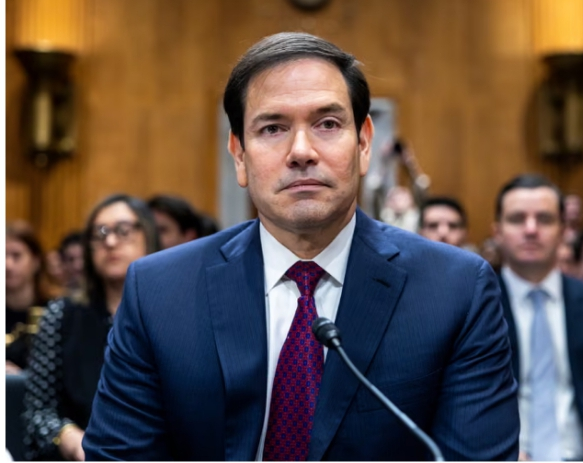
Rubio declines to rule out US military action in Venezuela after facing intense questioning from lawmakers during a Senate foreign relations committee hearing, where the US secretary of state sought to justify Washington’s unprecedented intervention in the South American nation while attempting to reassure Congress that further escalation is not the administration’s preferred course.
Appearing before the committee, Marco Rubio repeatedly emphasised that the Trump administration does not currently intend to launch additional military operations in Venezuela, even as he stopped short of closing the door entirely on the use of force.
His testimony came amid heightened scrutiny of US policy following the removal of Nicolás Maduro and the installation of interim president Delcy Rodríguez, a transition that has dramatically altered Venezuela’s political landscape and intensified debate in Washington over legality, strategy and long-term consequences.
Pressed by Democratic senators, Rubio acknowledged that the president retains broad authority to act in defence of US interests.
When asked directly by Connecticut senator Chris Murphy whether military force could be used to compel cooperation from Venezuelan authorities, particularly regarding oil production and sales, Rubio replied that “the president does reserve the option in self-defense to eliminate that threat.”
The comment underscored the administration’s position that military action remains a tool of last resort, even if it is not actively being pursued.
Rubio sought to frame the administration’s posture as one of deterrence rather than aggression, arguing that refusing to rule out force strengthens US leverage at a critical moment.
He insisted, however, that there are no active plans for additional strikes or operations. “I can tell you right now with full certainty, we are not postured to, nor do we intend or expect to have to take any military action in Venezuela at any time,” Rubio told the committee, attempting to strike a balance between reassurance and resolve.
The hearing followed weeks of international controversy after US involvement in the removal of Maduro, a move that stunned allies and critics alike.
Maduro’s departure, coupled with Washington’s swift recognition of Delcy Rodríguez as interim president, has left Venezuela under temporary leadership while the US seizes and sells Venezuelan oil assets, citing national security and regional stability concerns.
Critics argue the policy amounts to an extraordinary intervention in a sovereign state, while supporters say it was necessary to end years of instability and economic collapse.
Rubio defended the administration’s actions as lawful and strategic, contending that Venezuela under Maduro had become a threat to regional security and US interests. He pointed to intelligence assessments suggesting growing influence from hostile actors and framed the intervention as a preventive measure rather than an act of conquest.
At the same time, he acknowledged the risks associated with military involvement, conceding that “military action is not good for recovery and transition” in countries attempting to rebuild institutions and restore economic confidence.
In an effort to clarify his remarks, Rubio offered a hypothetical scenario involving an Iranian drone factory operating near US forces in the region. He suggested that such a development could justify defensive action, while stressing that Venezuela does not currently present an equivalent threat.
The example appeared designed to illustrate the administration’s broader doctrine on self-defense rather than signal an imminent escalation in Caracas.
Several senators expressed unease with Rubio’s reasoning, questioning whether the administration had exceeded constitutional limits by acting without explicit congressional authorisation.
Lawmakers also raised concerns about the precedent set by seizing and selling Venezuelan oil, warning that it could provoke retaliation or undermine international norms.
Rubio responded by arguing that the president’s authority in matters of national security and foreign policy had been exercised responsibly and in consultation with key partners.
Throughout the hearing, Rubio repeatedly returned to the administration’s stated objective of facilitating a peaceful transition in Venezuela.
He described early engagement with Rodríguez’s interim government as “constructive,” suggesting that cooperation on economic stabilisation and democratic reforms could pave the way for sanctions relief and normalised relations. According to Rubio, the threat of force exists primarily to deter obstruction and ensure compliance with international expectations.
Despite these assurances, scepticism remained evident among some committee members, who warned that ambiguity over military intentions could inflame tensions rather than reduce them.
Senator Murphy argued that leaving the option of force on the table risks entrenching US involvement and alienating allies in Latin America, many of whom have voiced concern over Washington’s approach. Rubio countered that credibility requires clarity about consequences, even if diplomacy remains the preferred path.
The hearing also highlighted deep partisan divides over Venezuela policy. Republican senators largely defended the administration’s stance, portraying Rubio’s testimony as a measured explanation of a difficult situation inherited from years of mismanagement and instability.
Democrats, by contrast, questioned whether the administration had adequately weighed the humanitarian and geopolitical fallout of its actions.
International reaction to Rubio’s comments has been cautious. Regional governments have called for restraint and urged the US to support multilateral solutions, while markets have reacted nervously to uncertainty over Venezuelan oil exports.
Analysts note that even rhetorical openness to military action can have significant economic and diplomatic repercussions, particularly in a country whose recovery depends heavily on foreign investment and stability.
For Rubio, the challenge lies in maintaining pressure without triggering escalation. His testimony reflected an attempt to reassure Congress and the public that the administration is not seeking a prolonged conflict, while preserving strategic flexibility.
Whether that balance can be sustained will depend on developments in Venezuela over the coming months, including the interim government’s willingness to cooperate with international partners and move toward credible elections.
Read also: Storm Chandra floods claim lorry driver’s life as severe flooding forces evacuations across UK
As the Senate hearing concluded, Rubio reiterated that the administration’s goal is a stable, democratic Venezuela integrated into the global economy. Yet by declining to rule out US military action in Venezuela, he left open a possibility that continues to trouble critics and allies alike.
The testimony made clear that while Washington hopes diplomacy will prevail, it remains prepared to act decisively if it believes US interests are threatened.
About The Author