The Serbia student protest movement is preparing for a historic electoral challenge against President Aleksandar Vučić’s political establishment, as student-backed candidates seek to end more than a decade of Serbian Progressive Party rule in a parliamentary election scheduled for Sunday.
The movement, known as Student List, emerged from two years of nationwide demonstrations and has developed into a serious political force. Its campaign is challenging the ruling party’s dominance while demanding accountability, democratic reforms and action against corruption.
With public dissatisfaction growing over governance and unresolved questions surrounding a deadly railway station disaster, the students hope to transform street protests into electoral victory and reshape Serbia’s political future.
Serbia Student Protest Movement Takes on Vučić’s Political Machine
The Serbia student protest movement is attempting an unconventional political strategy to defeat the Serbian Progressive Party (SNS), which has dominated national politics for years.
Rather than relying on traditional political campaigning, the movement has organised volunteers to visit homes, speak directly with residents and identify potential supporters across urban neighbourhoods and rural communities.
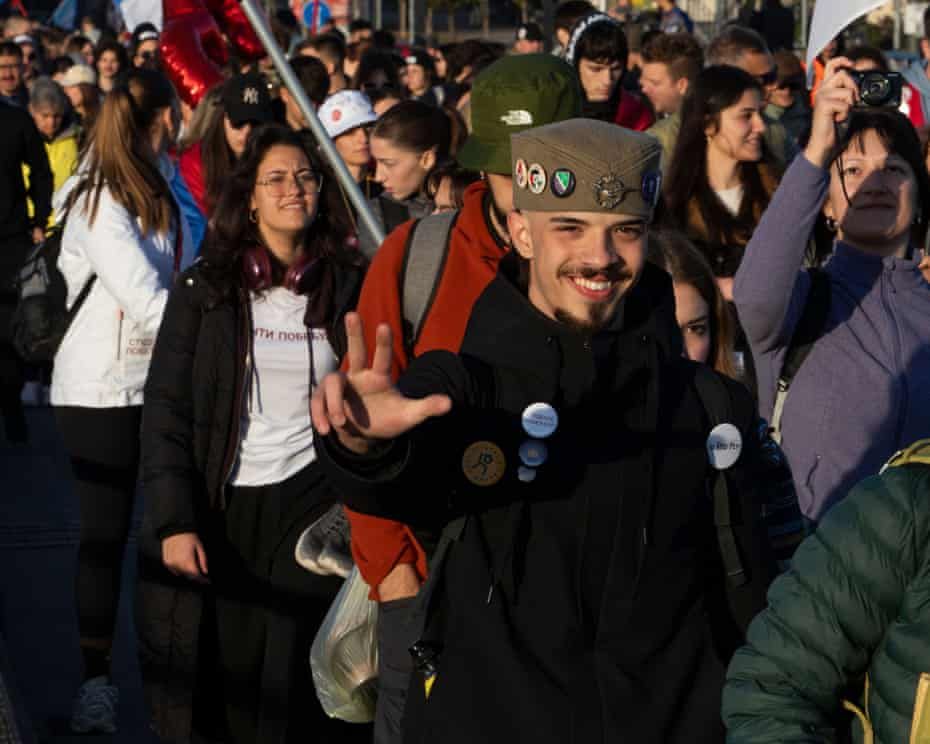
During a campaign visit to Krnjača, a suburb of Belgrade, student volunteers carried identification lanyards, questionnaires and a mobile application designed to record the homes they visited and the level of support they encountered.
The approach reflects the movement’s determination to reach voters directly, particularly those who may feel disconnected from conventional political parties or dissatisfied with the country’s leadership.
Many residents reportedly welcomed the volunteers and used the visits to express frustration about public services, corruption and infrastructure problems.
Some residents promised to vote for the students, while others offered practical assistance, including helping transport voters to polling stations.
One supporter emphasised the importance of participation, arguing that high turnout could determine whether the opposition movement succeeds.
The students are hoping to repeat the political upset that removed Hungarian leader Viktor Orbán, an ally of Vučić, from power six months earlier, potentially triggering wider democratic changes across Central Europe.
However, opinion polls have produced conflicting forecasts, leaving the outcome uncertain as both sides prepare for a closely contested election.
Corruption Emerges as a Major Campaign Issue
Corruption has become one of the most prominent complaints among voters approached by Student List campaigners.
The movement’s slogan, “Serbia or Mafia?”, directly challenges widespread perceptions that organised crime and political influence are dangerously intertwined.
There have been repeated allegations of connections between elements of the ruling party and organised crime, although the government denies the accusations and maintains that it is working to combat criminal activity.
Serbia’s standing on Transparency International’s corruption index has also fuelled concerns about governance and institutional accountability.
For many residents, however, dissatisfaction extends beyond national politics to everyday problems that have remained unresolved despite government promises.
In Krnjača, campaigners heard complaints about a poorly maintained bridge connecting the suburb to central Belgrade and a sewage system that repeatedly fails during heavy rainfall.
Residents recalled that Vučić had personally promised improvements during an earlier visit, but they remained frustrated by the condition of local infrastructure.
The contrast between luxury car showrooms and neglected public spaces has further reinforced concerns about how economic growth benefits ordinary citizens.
Although Serbia’s economy has expanded in recent years, critics argue that the advantages have not been distributed fairly across society.
Railway Station Disaster Sparked Nationwide Protests
The student movement’s rise can be traced to the collapse of a concrete canopy at Novi Sad railway station on 1 November 2024, a disaster that killed 16 people.
The tragedy triggered widespread anger after evidence pointed towards potentially faulty modifications carried out during refurbishment work.
Despite the seriousness of the incident, no official finding had established the cause in the account published ahead of the election, and no official had been held accountable.
Three weeks after the collapse, students in Belgrade blocked a road during a vigil for the victims. The demonstration became a turning point when protesters were attacked by individuals described as supporters of the ruling Serbian Progressive Party.
The confrontation helped transform a local protest into a nationwide movement that attracted students, academics and citizens demanding accountability.
The demonstrations continued for two years, gradually developing from protests against alleged negligence into a broader campaign for democratic change.
For many participants, the railway station disaster came to represent a deeper problem: the belief that political connections and weak accountability could prevent those responsible for public failures from facing consequences.
Electoral consultant Radivoje Grujić suggested the tragedy had also mobilised people who had previously avoided politics.
“These people were saying: I’m not involved in politics, and then politics got them killed,” he said.
Grujić argued that voters who had previously remained outside the political process could become decisive if they turned out to support the students.
Student List Introduces an Unconventional Political Model
Student List has attempted to distinguish itself from traditional opposition parties by avoiding a conventional leadership structure and allowing decisions to emerge through collective discussions.
Initially, the movement deliberately distanced itself from established political organisations, partly because of ideological objections and partly because individual opposition figures have frequently faced attacks and negative portrayals in state-aligned media.
Its candidates were largely nominated through university faculties, with more than 160 doctorate holders among the 250 candidates, alongside people from farming and other professional backgrounds.
Each candidate had to receive approval through plenary meetings associated with the student protests.
The movement also developed its policy platform through collective decision-making, avoiding some divisive issues that could alienate potential supporters.
Questions surrounding future European Union membership have been left for a referendum, while the platform maintains Serbia’s claim over Kosovo.
Milica Jovanović, an assistant professor at the University of Belgrade and one of the selected candidates, defended the movement’s lack of conventional political experience.
“We are political amateurs, but we are experts,” Jovanović said.
She argued that participants had experience managing projects, organisations and communities, adding that the movement’s central objective was to improve governance through expertise and public support.
The strategy represents a significant experiment in Serbian politics, as the students attempt to translate their protest organisation into a functioning parliamentary force.
Vučić Resigns as President to Contest Election as Prime Minister
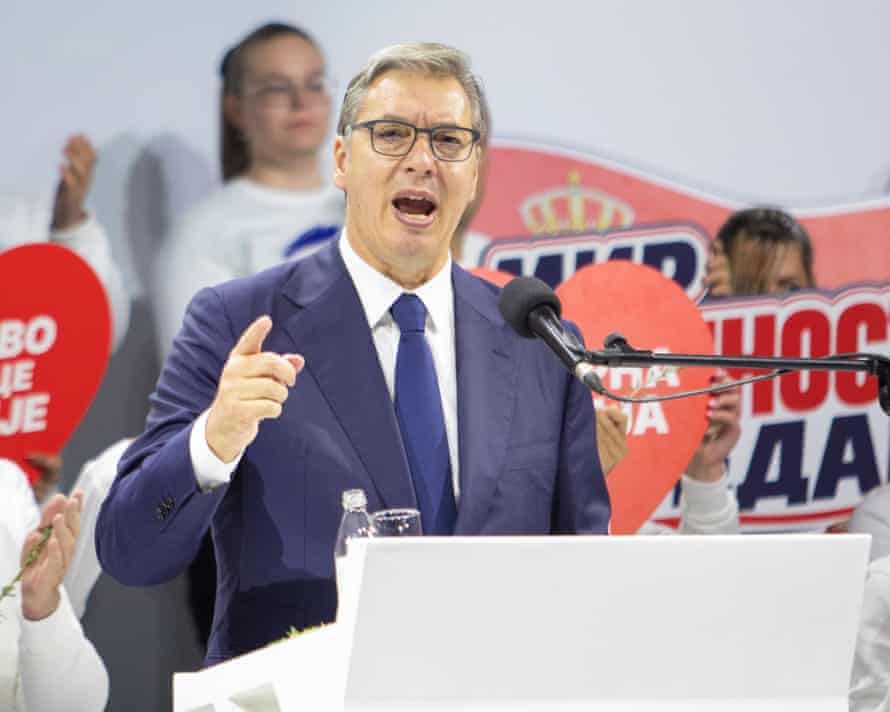
The election presents a major challenge for Vučić, who has exercised considerable influence over Serbian politics during the past 12 years.
He announced his resignation as president in late September, months before the constitutional end of his second and final presidential term, and called an early parliamentary election.
The move was widely interpreted as an attempt to preserve his political influence by positioning himself to lead the government as prime minister under the Serbian Progressive Party.
Vučić rose to prominence during the 1990s as a radical nationalist and served as information minister under Slobodan Milošević during the Kosovo conflict.
Although his presidency has not replicated Milošević’s militaristic approach, critics argue that Vučić has maintained nationalist political messaging and regularly portrayed opponents as agents of foreign interests.
The student movement has proved difficult for the ruling party to contain through conventional political attacks.
Raša Nedeljkov, programme director of the Centre for Research, Transparency and Accountability, said the political environment was changing.
“What we are seeing in the past days, weeks, months, is that strength; the homogeneous government that Vučić used to have is no longer there. He is faced with a completely unorthodox political actor and the toolbox that he has improved over the years since he came to power is no longer effective.”
A survey published in July by the pro-democracy organisation and Stanford University recorded support for the students at 45 per cent, compared with 36 per cent for the SNS.
However, the figures preceded Vučić’s resignation announcement and the ruling party’s intensified election campaign. More recent domestic polls have placed the SNS ahead, although opposition figures question the independence of some polling organisations.
Vučić has also intensified his media appearances, making 129 live television appearances in August, more than four times the previous month’s total.
Media Dominance and Rural Votes Could Determine the Outcome
One of Student List’s biggest challenges is competing against a ruling party with extensive influence over state institutions and national media.
A September survey by CRTA found that 69 per cent of airtime on Serbian television channels was devoted to the ruling majority.
Of the remaining coverage allocated to the opposition, 42 per cent was negative in tone, while 53 per cent was neutral.
The students have sought to overcome this disadvantage by expanding their door-to-door campaign beyond major cities and into rural communities where Vučić’s political support is believed to be stronger.
Their strategy depends partly on persuading voters who have traditionally supported the ruling party or remained politically inactive.
Gordana Čomić, a former opposition politician who later served as a minister in the SNS government, questioned whether the movement had built sufficient support outside urban centres.
She predicted that Student List might win around 80 of the 250 parliamentary seats but doubted whether its candidates could work effectively with established political parties.
Read also: Alberta Independence referendum: 76% reject separation as Mark Carney celebrates Canada unity victory
The students, however, are banking on public dissatisfaction over corruption, infrastructure failures and the handling of the Novi Sad disaster to expand their support.
In a closely contested parliament, minority parties representing ethnic Hungarians, Bosniaks and Albanians could also become important in determining which political bloc can form a government.
Election Fraud Allegations Raise Fears of Unrest
Concerns about the integrity of the vote have added another layer of tension to the campaign.
Previous Serbian elections have been accompanied by allegations of vote-buying, voter intimidation and ballot-box stuffing.
Student List has also accused the foreign ministry of manipulating diaspora voting arrangements by keeping polling stations open in areas where Vučić enjoys substantial support while closing them in parts of North America where the opposition expects stronger backing. The ministry had not responded to a request for comment in the report.
The movement plans to deploy an unprecedented number of opposition monitors to observe voting and help identify potential irregularities.
However, the presence of large numbers of monitors could increase the possibility of confrontations if disputes emerge at polling stations.
In the days before the election, Momcilo Marjanovic, who said he had previously worked with groups used to intimidate opponents, spoke to the Balkan Investigative Reporting Network about alleged activities connected to the ruling party.
“My role was to lead a group of guys to the riskiest and most critical places, to any gatherings where students or the opposition were on the other side,” Marjanovic said.
He alleged that he was covertly paid through a fictitious position at a public utility and described the use of force against opposition gatherings.
“It was our job, as a last resort of course, to use force, although it often happened not as a last resort.”
These allegations could intensify scrutiny of the election environment, although they do not independently establish that the ruling party directed every alleged incident.
Diplomats in Belgrade believe the government’s plans to host the international EXPO 2027 event could discourage widespread violence because of the potential reputational consequences.
Nevertheless, the possibility of recounts, disputed results and street protests remains a major concern if the election produces a narrow margin.
Student Movement Says the Fight Will Continue After Election Day
Student List is preparing not only for the vote but also for the possibility of having to defend its result through demonstrations.
The movement believes its nationwide organisation and volunteer networks could help mobilise supporters if the outcome is disputed.
Jelena Kleut, an associate professor of media studies, described the mood among protesters as a critical moment for Serbia’s democratic future.
“I think there is a strong feeling of now or never,” Kleut said.
She added that many citizens had become more aware of the government’s methods and understood that sustained public pressure would remain necessary.
“I think that people have really felt in their skin what the regime is capable of and there is a sense you still need to stay strong because the job is not finished.”
The election could therefore become a defining test of whether a student-led protest movement can challenge a well-established political system through democratic participation.
Even if Student List fails to win an outright majority, a strong parliamentary performance could weaken the ruling party’s dominance and give the movement a platform to demand institutional reforms.
For Vučić, the contest represents a serious challenge to his political influence. For the students, it is an opportunity to turn two years of protests into electoral change.
The outcome could influence not only Serbia’s domestic political direction but also wider debates about democratic accountability, political participation and the future of Central and Southeastern Europe.
About The Author