NYC Mayor Zohran Mamdani faces criticism– New York City Mayor Zohran Mamdani has found himself at the center of a political storm following criticism of his response to his wife Rama Duwaji’s past illustration work connected to Palestinian author Susan Abulhawa.
The controversy erupted after several conservative news outlets reported on Duwaji’s involvement with Abulhawa’s online collection, which featured writings from displaced residents of Gaza.
While the illustrations were commissioned independently and did not reflect Duwaji’s personal views, some commentators interpreted the connection as politically sensitive, drawing attention to the mayor’s judgment and raising questions about media framing, free expression, and the challenges faced by Muslim leaders in the U.S.
The work at the center of the controversy involved an illustration for a short story titled A Trail of Soap, which depicts the struggles of residents using makeshift public facilities amid the devastation of Gaza.
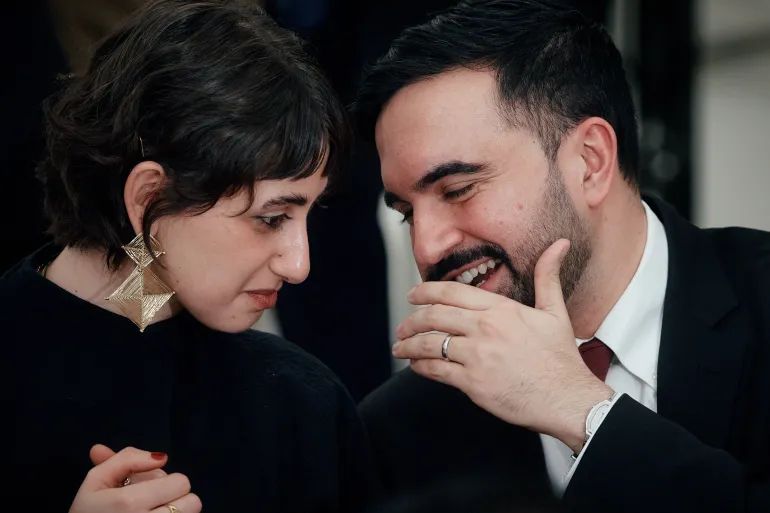
Mamdani emphasized that Duwaji had never met Abulhawa and was unaware of the author’s controversial social media posts. Abulhawa later confirmed that Duwaji’s contribution had been arranged by a third party and did not imply agreement with her personal opinions.
Despite these clarifications, the initial reports amplified criticism, framing the mayor and his family as politically vulnerable due to their association with Palestinian advocacy.
At a press conference, Mamdani sought to make clear the separation between his administration and his wife’s independent work. “The First Lady does not have a formal role in our administration, and our city stands unequivocally against all forms of bigotry,” Mamdani said. He described Abulhawa’s posts as “patently unacceptable” and “reprehensible,” underscoring his administration’s commitment to inclusivity and respect for all communities.
While the mayor intended to clarify the situation, some of his supporters criticized him for engaging with the controversy, arguing that it inadvertently legitimized attacks on Palestinian solidarity and Muslim leaders.
Activist Shaiel Ben-Ephraim wrote on X that Mamdani was “stupid for apologizing and explaining” and emphasized that “nothing will ever be enough for Zionists anyway.”
Palestinian writer Mohammed El-Kurd also highlighted the mayor’s longstanding advocacy for Palestinian rights, noting that Mamdani should be held to the principles that motivated his political career.
Former United Nations human rights official Craig Mokhiber urged Mamdani to stand firm rather than yield to pressure, stressing that fear should not guide political decisions during such critical moments.
Abulhawa herself addressed the controversy in a video statement, rejecting allegations of anti-Semitism. She framed her comments as opposition to the Zionist power structure, rather than a critique of Jewish people as a whole.
“Israel and by extension, Israelis, have destroyed, shattered, and robbed my family of everything,” she said, adding that her statements reflected personal experiences of loss and displacement during ongoing conflicts. She further emphasized that her goal was to use her platform to advocate for those defenseless against systemic violence, highlighting the pain, rage, and frustration felt by Palestinians under war conditions.
Critics of Mamdani argue that engaging with the controversy has drawn attention away from larger political issues, while supporters contend that his handling of the situation illustrates the unfair scrutiny applied to Muslim politicians in the United States.
While Mamdani faces intense examination over personal associations and family connections, other high-profile officials who engage in Islamophobic rhetoric often face minimal consequence.
Republican Senator Tommy Tuberville, for example, has repeatedly attacked Mamdani’s faith on social media without facing significant rebuke, highlighting a stark double standard in political accountability.
The situation also highlights broader questions about the role of personal connections and advocacy in politics. Mamdani, as the first Muslim mayor of New York City, has navigated waves of Islamophobia and accusations of anti-Jewish sentiment due to his public statements on Israel’s policies in Gaza. He has described the military actions in Gaza as “genocide” while emphasizing that his leadership represents all New Yorkers, regardless of religion or ethnicity.
The current controversy illustrates the challenges faced by Muslim leaders, who are often expected to defend or explain the work of family members and associates under disproportionate scrutiny.
Supporters of the mayor stress that maintaining principled leadership in the face of media attacks is essential. Palestinian advocacy groups argue that criticism of Duwaji’s commissioned illustration should not overshadow broader discussions about human rights and the protection of Palestinian communities.
Ben-Ephraim and El-Kurd both insist that Mamdani remain aligned with the values that initially drove his political career, including advocacy for Palestinian rights and resisting oppression. Abulhawa urged the mayor to treat the controversy as a learning moment, warning that conceding to pressure from media and political adversaries can erode personal integrity and leadership effectiveness.
The controversy surrounding Mamdani also has implications for Muslim politicians across the country. It demonstrates the complex balance required between personal associations, political expression, and public perception.
Supporters note that other political figures engage in rhetoric targeting marginalized communities with little scrutiny, while Muslim leaders are often subjected to intense examination for comparatively minor associations or expressions of solidarity.
The debate over Mamdani’s response to his wife’s past work underscores the broader societal tensions between free expression, media framing, and accountability in politically charged contexts.
Looking ahead, Mamdani’s handling of the situation is likely to influence perceptions of Muslim leadership in politics. Observers are watching to see whether he maintains his current approach, emphasizing the independence of his wife’s work and the administration’s commitment to inclusivity, or whether ongoing criticism pressures him to alter his strategy.
Read also: Japan and Australia reject Strait of Hormuz security mission despite Trump pressure
For now, Mamdani continues to engage with constituents and maintain a public presence, emphasizing principled governance while navigating the complex intersection of personal, political, and media scrutiny.
The debate surrounding the controversy will likely continue, offering insight into how political leaders manage personal associations, advocacy, and public expectations in the modern media environment.
About The Author