Nnamdi Kanu has been granted honorary citizenship of Georgia, USA, sparking renewed global debate over his imprisonment and international recognition.
The international profile of Nnamdi Kanu, leader of the Indigenous People of Biafra (IPOB), has taken a new turn following his recognition by the State of Georgia in the United States.
Despite being incarcerated in Nigeria, the separatist figure has been conferred with honorary citizenship by the American state, an action that has drawn widespread attention across political, diplomatic, and human rights circles.
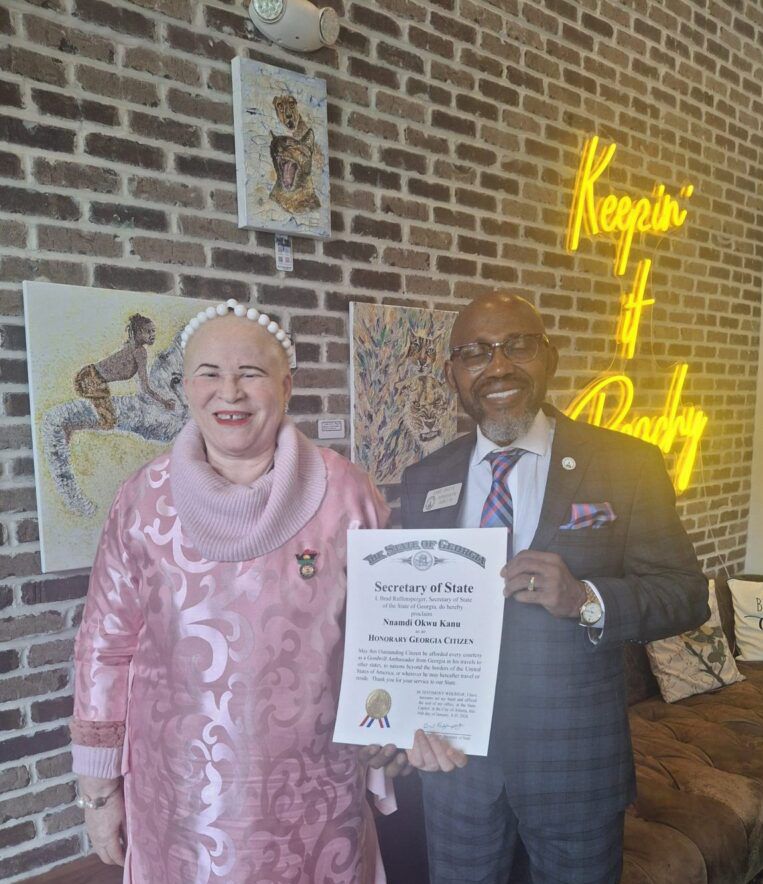
The proclamation, issued by Georgia’s Secretary of State, Brad Raffensperger, formally recognises Nnamdi Kanu as an Honorary Citizen of Georgia.
Beyond the symbolic citizenship, the document also identifies him as an “Outstanding Citizen” deserving of courtesy and recognition as a Goodwill Ambassador of the state.
The gesture, though ceremonial, carries diplomatic weight given Kanu’s current legal status in Nigeria.
Dated January 16, 2026, the proclamation was officially presented a week later, on January 23, 2026, in Milledgeville, one of Georgia’s historic capital cities.
The presentation was conducted by State Representative Gab Okoye during a low-key but symbolic event that underscored Georgia’s acknowledgement of Kanu’s global visibility and advocacy.
Although Nnamdi Kanu was not physically present to receive the honour, the certificate was accepted on his behalf by Ambassador Uche Ajulu-Okeke, a former Nigerian Consul General to South Africa.
Ajulu-Okeke described Kanu as one of Africa’s most prominent political prisoners and a globally recognised prisoner of conscience, a description that aligns with long-standing claims by IPOB supporters and some international observers.
According to the wording of the proclamation, the Georgia Secretary of State stated that Kanu should be “accorded every courtesy as a Goodwill Ambassador from Georgia” in his interactions across the United States and beyond.
The document further notes that the honour reflects appreciation for what the state described as his service and advocacy, without directly referencing the legal controversies surrounding him in Nigeria.
The development has once again placed Nnamdi Kanu at the centre of international discourse, particularly among members of the African diaspora in the United States.
Supporters argue that the honorary citizenship is an affirmation of his right to self-determination advocacy and freedom of expression, while critics view it as a provocative gesture that could complicate diplomatic relations.
Back home, the IPOB leader remains in detention, serving a life sentence at the Sokoto Correctional Facility.
He was convicted by Justice James Omotosho of the Federal High Court in Abuja on charges related to terrorism and treasonable activities.
The conviction followed years of legal battles, rearrests, and court appearances that have kept his case in the public spotlight.
The Nigerian government has consistently maintained that Kanu’s prosecution is a matter of national security and rule of law.
However, his supporters insist that his detention is politically motivated and have continued to lobby international governments and institutions to intervene.
The honorary citizenship from Georgia is now being cited by these groups as further evidence of growing global sympathy for his cause.
Observers note that while honorary citizenship does not carry legal immigration or diplomatic privileges, it is often used by governments to make symbolic statements.
In the case of Nnamdi Kanu, the recognition appears to reinforce his international relevance and sustain global interest in the broader Biafra movement.
As reactions continue to trail the announcement, the development raises broader questions about international perception, political advocacy, and the role of symbolic gestures in global human rights debates.
Whether the recognition will have any practical impact on Kanu’s legal situation remains uncertain, but it has undeniably added a new layer to an already complex and highly charged narrative.