China’s top ranking general under investigation has sent shockwaves through Beijing’s political and military establishment, marking the most dramatic escalation yet in President Xi Jinping’s sweeping campaign to purge alleged corruption and disloyalty from the armed forces.
The confirmation that Zhang Youxia, vice-chairman of the Central Military Commission and long regarded as Xi’s closest military ally, is facing investigation for suspected serious violations of discipline and law represents an unprecedented rupture at the summit of China’s command structure.
As China’s top ranking general under investigation becomes global news, the implications stretch far beyond a single individual, raising urgent questions about internal stability, elite trust, military readiness, and the true scope of Xi’s authority within the People’s Liberation Army.
The defence ministry’s announcement placed Zhang alongside Liu Zhenli, chief of staff of the joint staff department, signalling that the inquiry is not isolated but part of a broader institutional reckoning targeting the military’s most powerful operational layers.
For years, Zhang Youxia was seen as untouchable, a revolutionary pedigree officer whose personal history, battlefield credentials, and ideological alignment made him indispensable to Xi Jinping’s consolidation of power over China’s armed forces.
Zhang’s role as vice-chairman of the Central Military Commission placed him directly beneath Xi in the military hierarchy, granting him immense influence over strategic planning, appointments, procurement, and the execution of modernisation initiatives.
His sudden disappearance from public view after November, followed by confirmation of investigation weeks later, underscores the opaque nature of elite Chinese politics and the speed with which power can evaporate once internal trust collapses.
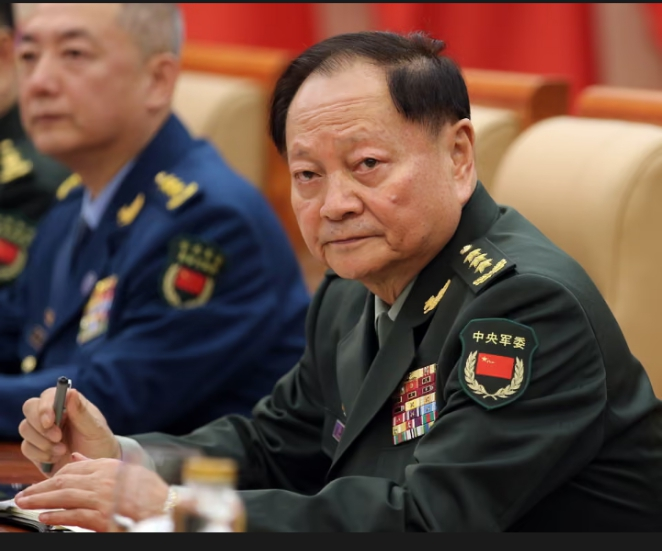
Reports circulating among international observers allege that Zhang is suspected of leaking sensitive military information and accepting bribes tied to high-level promotions, though these claims have not been officially detailed or independently verified.
The seriousness of the allegations is magnified by Zhang’s longstanding reputation as a loyal executor of Xi’s vision, making his fall particularly destabilising for a leadership that prioritises unity and absolute control.
China’s top ranking general under investigation also revives memories of earlier purges, but this case stands apart due to Zhang’s proximity to the core of decision-making and his symbolic role in reshaping the modern Chinese military.
Since assuming power in 2012, Xi Jinping has framed anti-corruption as both a moral crusade and a strategic necessity, particularly within the military, where loyalty is viewed as existential to party survival.
The People’s Liberation Army became a focal point of that campaign after years of entrenched patronage networks, opaque procurement systems, and promotion pathways often influenced by personal connections rather than competence.
That drive intensified dramatically in recent years, culminating in the dismantling of entire leadership layers within elite branches, including the strategically vital Rocket Force responsible for China’s nuclear deterrent.
Zhang’s removal represents only the second time since the Cultural Revolution that a sitting member of the Central Military Commission has been sidelined while still holding office, underscoring the gravity of the moment.
Foreign diplomats and defence analysts are closely monitoring developments, recognising that the investigation’s outcome may reshape China’s military command at a time of heightened regional tension and global scrutiny.
China’s assertive posture in the South China Sea, East China Sea, and around Taiwan has elevated the strategic importance of stable military leadership capable of executing complex operations without internal disruption.
Late last year, Beijing conducted its largest-ever military exercises around Taiwan, signalling readiness while simultaneously exposing the risks of conducting major manoeuvres amid leadership uncertainty.
Despite official reassurances that daily military operations will continue uninterrupted, the targeting of such a senior figure suggests deeper anxieties within the leadership about loyalty, discipline, and institutional credibility.
Observers note that Xi has increasingly turned to second-line officers and interim appointments to fill vacancies created by purges, a strategy that maintains control but risks slowing decision-making and long-term planning.
China’s top ranking general under investigation also highlights the paradox of Xi’s rule, where relentless centralisation of power can simultaneously strengthen authority and expose vulnerabilities when trusted allies fall.
Zhang’s career trajectory once embodied the ideal revolutionary officer, rising through the ranks after joining the army in the late 1960s and forging his reputation during China’s border conflicts with Vietnam.
His combat experience, rare among today’s senior officers, distinguished him as a pragmatic moderniser who understood both the costs of war and the necessity of technological and doctrinal reform.
During the brief but violent 1979 conflict with Vietnam, Zhang reportedly demonstrated operational competence that accelerated his promotion and cemented his standing within the military establishment.
He later participated in additional border clashes, experiences that shaped his advocacy for professionalisation, improved training, and advanced weapons systems across the People’s Liberation Army.
These credentials made Zhang a natural ally for Xi Jinping’s ambition to transform the PLA into a world-class force capable of matching global rivals by the middle of the century.
Yet the very reforms Zhang championed have been hindered by repeated purges, which have disrupted procurement pipelines, delayed weapons development, and shaken confidence among defence contractors.
Several of China’s largest defence firms have reportedly suffered revenue setbacks as investigations stalled projects and forced reviews of contracts linked to disgraced officials.
The investigation also raises sensitive questions about information security, given Zhang’s access to classified programmes and strategic planning discussions at the highest level.
Any suggestion of leaked intelligence, regardless of its veracity, would strike at the heart of Beijing’s concerns about foreign infiltration and technological espionage.
China’s top ranking general under investigation thus carries symbolic weight, serving as both a warning to remaining elites and a demonstration of Xi’s willingness to sacrifice even the most trusted figures.
Within China’s political system, such actions reinforce discipline but also generate fear, potentially discouraging initiative and honest reporting among senior officers.
The long-term impact on military morale remains uncertain, particularly among younger officers who see advancement increasingly tied to political survival rather than battlefield competence.
At the same time, Xi’s supporters argue that the purge is necessary to cleanse the system and ensure that China’s military remains firmly under party control during a volatile global era.
Internationally, the case adds another layer of complexity to relations between Beijing and Western capitals already wary of China’s strategic ambitions and internal opacity.
For neighbouring countries, leadership turbulence within the PLA introduces unpredictability at a moment when regional flashpoints demand clear chains of command and restraint.
Read also: Andy Burnham’s by-election ambition blocked after Labour NEC decision
China’s top ranking general under investigation is therefore not merely a domestic political story but a development with far-reaching consequences for global security and balance of power.
Whether the investigation leads to formal charges, quiet removal, or eventual rehabilitation, its significance lies in what it reveals about the pressures shaping China’s ruling elite.
As Xi Jinping continues to tighten his grip, the fall of Zhang Youxia underscores a stark reality: in today’s China, proximity to power offers no immunity when loyalty itself becomes suspect.
About The Author