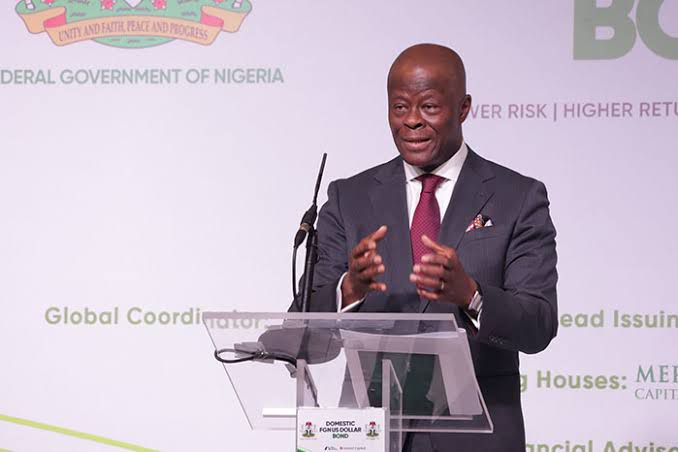
Nigeria’s mounting debt burden has returned to the centre of national economic debate after the Minister of Finance and Coordinating Minister of the Economy, Wale Edun, warned that the country must urgently reduce its reliance on borrowing and build a stronger domestic revenue base to secure long-term fiscal stability.
Speaking on Tuesday at a management retreat of the Nigerian Revenue Service (NRS) in Abuja, Edun said the global financial environment had become increasingly hostile to developing economies, making debt-financed growth both expensive and risky.
According to him, the era when countries like Nigeria could comfortably rely on external borrowing to fund development is rapidly closing.
His remarks come at a time when Nigeria’s public debt continues to rise, while debt service costs consume a growing share of government revenue, leaving limited fiscal space for infrastructure, healthcare, education, and social protection.
Global shifts are squeezing developing economies
Edun explained that Nigeria’s challenges are unfolding against a backdrop of profound changes in the global economic order. Multilateral cooperation, he said, is retreating as advanced economies prioritise domestic interests, tighten financial conditions, and scale back cross-border support.
Data cited by the finance minister illustrates the imbalance confronting developing countries. In 2024 alone, developing economies paid an estimated $163 billion in debt service, compared with $42 billion in overseas development assistance and $97 billion in foreign direct investment.
This disparity, Edun argued, means that external financial flows have effectively turned negative, with countries paying out far more to creditors than they receive in new funding or aid.
“For countries like ours, this is not sustainable,” he said, warning that continued dependence on debt under such conditions would deepen fiscal vulnerability rather than support growth.
Nigeria must cut dependence on debt to secure fiscal sustainability
At the core of Edun’s message was a clear policy direction: Nigeria must cut dependence on debt and anchor its economic future on predictable, internally generated revenue.
According to him, fiscal sustainability can no longer be built on borrowing, especially at a time of elevated global interest rates and volatile capital flows.
Instead, Nigeria must strengthen its capacity to generate revenue, create savings, and channel those resources into productive investment.
“The primary anchor of our fiscal sustainability is going to be our own fiscal effort,” Edun said. “Before you can generate savings, you must first generate revenue.”
Economists note that Nigeria’s tax-to-GDP ratio remains one of the lowest globally, limiting the government’s ability to fund development without resorting to borrowing.
Edun’s remarks signal a renewed push to reverse this structural weakness.
Debt pressures shaped by global shocks
The minister linked Nigeria’s growing debt exposure to a series of external shocks that have affected developing economies over the past decade.
These include the COVID-19 pandemic, geopolitical conflicts, supply chain disruptions, and trade tensions, all of which forced governments to borrow heavily to cushion economic fallout.
At the same time, rising interest rates have increased the cost of servicing existing debt, compounding fiscal stress and crowding out spending on essential services.
“These pressures have squeezed fiscal space everywhere,” Edun said, adding that the experience has underscored the urgency of building sustainable domestic revenue streams.
Revenue reform as a development imperative
Edun framed revenue mobilisation not merely as a fiscal exercise, but as a developmental imperative.
He argued that only through stronger and more reliable revenues can Nigeria invest meaningfully in infrastructure, improve public services, and protect the most vulnerable citizens.
“That is why it is critical at this time that we move to an era of sustainable revenues,” he said.
Central to this shift are ongoing tax reforms designed to improve fairness, equity, and efficiency within the system. Edun said these reforms aim to broaden the tax base, reduce distortions, and ensure that revenue generation supports inclusive growth rather than placing excessive burden on a narrow segment of taxpayers.
Compliance, trust, and the limits of enforcement
While acknowledging the importance of policy reform, Edun cautioned that legislation and institutional changes alone would not deliver results without effective execution and broad-based compliance.
“No fiscal reform can succeed if compliance is weak or uneven,” he said. “But compliance cannot be achieved through enforcement alone. It must combine both incentives and sanctions.”
According to the minister, trust in the tax system is essential. Citizens and businesses must believe that the system is fair, transparent, and that revenues collected are translated into visible public benefits.
“People must see the results of their contributions—in roads, schools, hospitals, and basic services,” he said, describing revenue reform as both a technical and governance challenge.
Senate acknowledges borrowing pressures
Edun’s call for Nigeria to cut dependence on debt comes amid contrasting signals from the legislature. At a public hearing on the 2026 Appropriation Bill, the Chairman of the Senate Committee on Appropriations, Olamilekan Adeola, said fresh borrowing remained difficult to avoid given Nigeria’s large budget deficits and infrastructure needs.
Adeola argued that the issue was not borrowing per se, but how deficits are financed and whether debt remains sustainable over time.
“Nigeria cannot help but keep borrowing because revenue inflows are unpredictable and development needs are enormous,” he said. “What matters is how we borrow and how we structure our deficits.”
The tension between Edun’s caution and the Senate’s pragmatism reflects the difficult trade-offs facing policymakers as they attempt to balance fiscal discipline with urgent development demands.
Nigerian Revenue Service at the centre of reform
Edun identified the Nigerian Revenue Service as a critical institution in delivering the government’s fiscal reset. He said the success of revenue reforms would depend heavily on the NRS’s ability to translate policy intent into measurable outcomes.
Earlier at the retreat, the Executive Chairman of the NRS, Zacch Adedeji, said the establishment of the service marked a decisive break from past practices and placed significant responsibility on its leadership.
Adedeji warned that legacy habits and assumptions could undermine reform if left unchallenged, stressing that leadership and organisational culture would be as important as technology or structure.
“What brought us here will not be sufficient for where we are going,” he said.
A defining moment for Nigeria’s fiscal future
As Nigeria confronts rising debt costs and tightening global financial conditions, Edun’s message underscores a defining moment for economic policy.
Whether the country can successfully shift from debt-driven financing to a revenue-led growth model will shape its fiscal resilience for years to come.
For now, one message from the finance minister is clear: Nigeria must cut dependence on debt if it hopes to stabilise its finances, rebuild investor confidence, and deliver sustainable development.
About The Author