French Prime Minister Sébastien Lecornu has appealed to lawmakers not to use the national budget vote as an excuse to topple his administration, warning against political gamesmanship.
The Lecornu government, still consolidating its authority, faces a tense debate as parliament examines the 2026 budget — a test that could determine its survival in the coming weeks.
Addressing the National Assembly on Tuesday, Lecornu urged lawmakers to act responsibly. “There is no longer any pretext for a no-confidence motion,” he said to a chamber divided by ideology and mistrust.
He told deputies that the Lecornu government was not seeking confrontation but cooperation. “We must place France above our differences. Stability is not weakness — it is responsibility,” he declared.
The Lecornu government is trying to avoid a confidence vote that could plunge France into deeper political paralysis. Lecornu said the budget debate must not become “a trap of political revenge.”
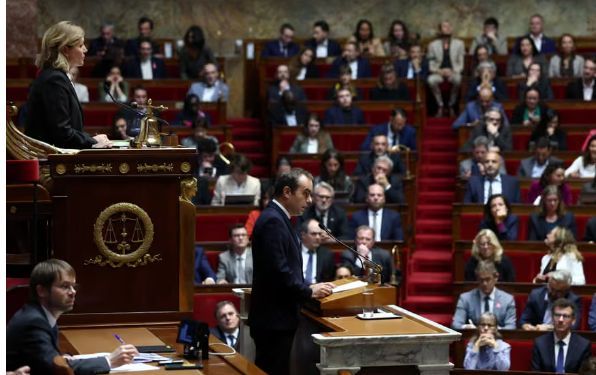
In his first major policy speech since taking office, Lecornu outlined budget priorities aimed at “rebuilding trust” between citizens and government while maintaining France’s economic credibility abroad.
“The Lecornu government is here to repair the link between fiscal responsibility and social fairness,” he said, promising transparency and long-term vision in how public money is used.
Opposition parties, however, accused the Lecornu government of repackaging Macron-era policies under new rhetoric. “There is nothing new here — just the same austerity with a different face,” one Socialist lawmaker said.
Still, Lecornu insisted his government was different in tone and purpose. “We will listen, we will adapt, but we will not surrender to cynicism or paralysis,” he told parliament.
Political analysts say the Lecornu government needs support from moderate centrists to survive the budget vote. If they abstain or side with the opposition, Lecornu’s position could become untenable.
The French prime minister presented his budget as a “path of equilibrium,” balancing social spending with fiscal prudence to safeguard France’s creditworthiness and investor confidence.
“The world is watching us,” Lecornu warned. “Our credibility in Europe depends on what happens in this chamber.” He described the budget as “a mirror of France’s seriousness.”
The Lecornu government plans higher allocations for defense, education, and green energy, calling them investments in sovereignty rather than expenses. He said, “Every euro must serve the future.”
But opposition deputies challenged how the Lecornu government would finance its pledges without increasing national debt, now over 110 percent of GDP. “You speak of control, but the numbers tell another story,” a conservative MP retorted.
Left-wing lawmakers criticized the budget as “austerity dressed in moderation,” arguing that cuts to public services would deepen inequality rather than restore balance.
In response, Lecornu said the Lecornu government was “neither blind to social hardship nor deaf to fiscal responsibility.” He insisted France could be fair without being reckless.
At stake for the Lecornu government is not only the passing of its first budget but its legitimacy as a stable force in an increasingly fragmented French political landscape.
Since succeeding Gabriel Attal, Lecornu has tried to soften tensions between the Élysée and parliament, promising dialogue after years of combative politics under President Emmanuel Macron.
“We must learn to govern differently,” Lecornu said. “Parliament is not an obstacle; it is the heart of democracy. Let us make it beat together again.”
Observers note that the Lecornu government’s tone marks a departure from previous administrations that often bypassed parliament using constitutional shortcuts to pass contentious reforms.
Supporters within Macron’s camp praised Lecornu’s conciliatory approach. “Finally, a prime minister who understands that persuasion is stronger than confrontation,” said one Renaissance party member.
Still, right-wing critics argue that the Lecornu government is “trapped between loyalty to Macron and fear of the streets,” referring to France’s recent wave of protests over cost-of-living pressures.
Lecornu acknowledged the social fatigue. “Our citizens are weary of conflict,” he said. “They expect results, not endless quarrels. Let us not disappoint them again.”
The Lecornu government is also facing scrutiny from Brussels to meet EU deficit rules, even as it pledges more spending on security and climate programs.
European Commission officials have warned that France’s fiscal deficit must be reduced to avoid sanctions, but Lecornu argued that “Europe’s strength lies in responsible flexibility.”
He said the Lecornu government would maintain France’s commitment to NATO and EU security priorities, calling defense spending “a moral duty, not an optional choice.”
Economists say the Lecornu government faces a delicate balancing act — satisfying international partners while preventing another round of domestic discontent.
One Paris-based analyst said, “If Lecornu fails to pass this budget, his credibility will collapse before it has even been built.”
Among ordinary French citizens, reactions are mixed. Some praise the Lecornu government’s call for unity, while others dismiss it as rhetoric disconnected from economic hardship.
In Marseille, teacher Claire Dubois said she wanted “a government that stops talking about responsibility and starts acting for ordinary people’s dignity.”
Lecornu knows such sentiments run deep. That is why he has framed the budget vote as a moral as well as political decision for every French lawmaker.
“The budget is not just numbers; it is a reflection of who we are,” he said. “To reject it is to reject stability itself.”
The Lecornu government has intensified behind-the-scenes talks with parliamentary committees, offering regional development incentives and education grants to soften resistance among wavering centrists.
One Renaissance official admitted, “We are negotiating line by line. The goal is not triumph but survival.” Such horse-trading reflects the fragility of Lecornu’s majority.
Even within Macron’s ranks, anxiety lingers that another governmental collapse could strengthen extremist movements ahead of next year’s European elections.
“The country cannot live in permanent uncertainty,” Lecornu warned. “We must give France a horizon, not a headache.”
For Lecornu, the upcoming budget vote is more than a fiscal decision; it is a referendum on whether France can still govern itself through dialogue.
As he left the chamber, applause from supporters mixed with jeers from opponents — a sign that the Lecornu government’s fight for legitimacy is far from over.
What happens next will determine not only the prime minister’s future but France’s capacity to remain a stable force within a turbulent European landscape.
Lecornu’s appeal summed it up: “We can choose to build or to break. The Lecornu government chooses to build — and I ask this Assembly to do the same.”