Nick Kyrgios defeated Aryna Sabalenka 6-3, 6-3 in a highly publicised Battle of the Sexes exhibition that reignited long-running debates about gender, spectacle, and fairness in tennis.
The exhibition, staged in Dubai and promoted globally, drew enormous attention by pitting the outspoken former Wimbledon finalist against the reigning women’s world number one.
Despite modified rules designed to level the contest, Kyrgios controlled much of the match, using variety, touch, and experience to neutralise Sabalenka’s trademark power.
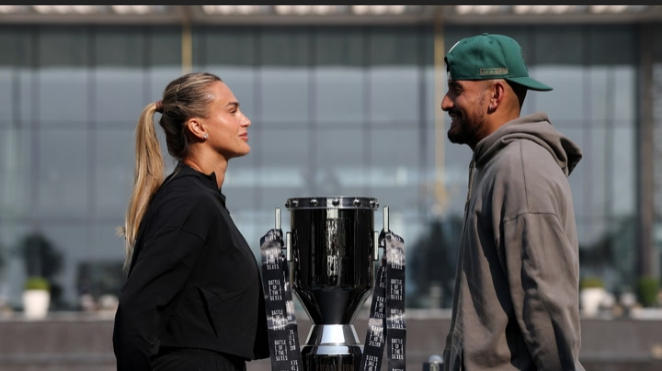
Organisers introduced a single-serve limit for Kyrgios and reduced Sabalenka’s side of the court by nine percent, changes that immediately split opinion among players and commentators.
The match was inspired by Billie Jean King’s historic 1973 victory over Bobby Riggs, though critics questioned whether the modern exhibition honoured that legacy meaningfully.
Sabalenka entered the contest as a four-time Grand Slam champion and the dominant force on the WTA Tour, carrying expectations despite acknowledging the unusual conditions.
Kyrgios, ranked outside the world’s top 600 after years of injury struggles, approached the exhibition with minimal physical expectations but considerable tactical awareness.
From the opening games, Kyrgios relied on sliced backhands, disrupted rhythm, and awkward angles, forcing Sabalenka into uncomfortable positions during extended rallies.
Sabalenka struggled particularly on serve, committing several faults as she adjusted to the modified rules, which removed her ability to rely on a powerful first delivery.
Kyrgios secured an early break in the opening set, using deft touch at the net and well-timed drop shots to exploit Sabalenka’s deeper court positioning.
The Australian closed out the first set 6-3, appearing physically limited but strategically sharp, conserving energy while keeping rallies short and unpredictable.
In the second set, Sabalenka attempted to increase aggression, stepping inside the baseline and flattening groundstrokes in search of quicker points.
However, Kyrgios responded calmly, absorbing pressure and forcing errors with slower balls and sudden changes of pace that frustrated the Belarusian star.
Another crucial break swung momentum decisively toward Kyrgios, who maintained control and sealed victory with a composed service game.
Following the match, Kyrgios acknowledged Sabalenka’s competitiveness, describing the contest as emotionally significant after his long absence from elite competition.
“Seeing someone as great as Aryna out here with me is truly a spectacle and a stepping stone forward for tennis,” Kyrgios told broadcasters afterward.
He admitted nerves ahead of the exhibition, saying few players would willingly accept the scrutiny attached to such a controversial event.
Sabalenka, meanwhile, showed visible frustration but also resilience, immediately expressing interest in a potential rematch under altered conditions.
“Next time I play him, I already know his strengths and weaknesses,” Sabalenka said. “It will be a better match for sure.”
The world number one also questioned the decision to limit her opponent’s serve while simultaneously restricting her own serving opportunities.
BBC analyst Annabel Croft suggested the rule changes prevented Sabalenka from showcasing her full abilities on a global stage.
“I didn’t feel like it showed what she’s truly capable of,” Croft explained. “Taking away her first serve changed everything.”
Croft added that Kyrgios’ unconventional style played a major role, describing him as an “awkward customer” capable of disrupting even elite opponents.
“He slices, slow-balls, and moves the ball in the air,” she said. “You could see how uncomfortable Sabalenka was returning serve.”
BBC reporter Russell Fuller focused on Kyrgios’ physical condition, questioning whether the exhibition boded well for his Australian Open prospects.
“He looked exhausted after 25 minutes,” Fuller observed. “That doesn’t bode well for best-of-five matches in Melbourne heat.”
Fuller also framed the match from Sabalenka’s perspective, noting the psychological challenge of facing a physically stronger opponent.
Despite the criticism, organisers hailed the event as a commercial success, citing global viewership figures and social media engagement.
The exhibition’s promoters argued that alternative formats could attract new audiences to tennis, particularly in regions lacking major tournaments.

However, many fans reacted negatively, describing the broadcast as uncomfortable and questioning the motives behind the spectacle.
Technical issues during the broadcast further damaged perception, with disrupted feeds and poor visuals undermining the match’s presentation.
Several commentators argued the exhibition blurred lines between entertainment and competitive sport, risking damage to tennis’ credibility.
Others insisted exhibitions should be judged differently, emphasising their role in experimentation rather than competitive fairness.
Kyrgios defended the concept, suggesting such events could coexist with traditional tennis without replacing established tours.
“This was all the world talked about for six months,” Kyrgios said. “That’s good for the sport.”
He also revealed emotional relief at simply competing again, referencing persistent wrist injuries that have limited his professional appearances.
“To be back out here, honestly, it’s emotional,” Kyrgios admitted. “I wasn’t even able to use my right hand for a long time.”
Sabalenka’s willingness to consider a rematch impressed many observers, reinforcing her reputation as one of tennis’ fiercest competitors.
Some analysts suggested a rematch without serve restrictions would produce a far more compelling contest.
“I’d love to see her with her first serve,” Croft reiterated. “That’s how she sets up her tennis.”
The debate now shifts toward whether organisers will attempt similar exhibitions involving other high-profile players.
Questions remain about commercial viability, player willingness, and long-term impact on perceptions of gender equality in sport.
Read also: Van Dijk hails Wirtz as smart, impactful player for Liverpool
While Kyrgios walked away with victory, the broader conversation surrounding the event may prove more significant than the scoreline itself.
For tennis, the exhibition served as both a spectacle and a warning, highlighting the fine balance between innovation and respect for competition.
Whether celebrated or criticised, the Kyrgios-Sabalenka Battle of the Sexes ensured one thing: the sport remains capable of provoking global discussion.