The Israeli president has condemned shocking settler attacks in the occupied West Bank, describing the violent assaults on Palestinian communities as a national disgrace that demands immediate and decisive government action.
He called the escalating violence “shocking and unacceptable,” warning that such behaviour undermines Israel’s legal and moral foundations while endangering fragile efforts to maintain peace across the region.
The shocking settler attacks have intensified in recent weeks, targeting Palestinian civilians, mosques, vehicles, and farmland. Entire communities have been terrorised, with residents living in constant fear of renewed aggression.
The president’s statement represented one of the strongest public criticisms of settler violence from within Israel’s leadership, a rare move amid growing concern over impunity for such attacks.
He emphasised that “all state authorities must act decisively to eradicate this phenomenon,” calling the shocking settler attacks “a red line that no civilised nation should tolerate.”
The military leadership echoed this sentiment, vowing that the army “will not tolerate criminal behaviour by any group of individuals” and promising to restore law and order across the occupied territory.
Officials said the shocking settler attacks not only harm Palestinian civilians but also damage Israel’s international reputation and strain its relations with global partners advocating peace.
Reports indicated that settlers recently vandalised a mosque near a small West Bank town, setting fire at its entrance and painting racist slurs across its walls. The incident sparked widespread outrage.
Local residents managed to extinguish the flames before the fire spread, preventing complete destruction. Community leaders described the shocking settler attacks as acts of provocation intended to incite further unrest.
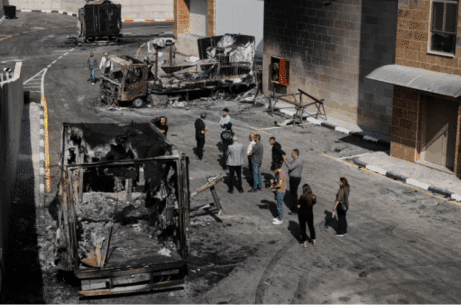
Witnesses in nearby villages reported that groups of masked settlers had attacked homes, torched vehicles, and destroyed olive groves. The shocking settler attacks left behind scenes of chaos and fear.
Civilians said that in many cases, soldiers present failed to intervene promptly, creating growing anger among Palestinians who accuse the authorities of protecting settlers through silence and inaction.
Palestinian activists argue that the shocking settler attacks are not isolated incidents but part of a systematic campaign to displace communities and seize more land under occupation.
They warn that unchecked violence risks sparking a broader confrontation that could derail peace efforts and worsen already dire humanitarian conditions in the occupied territories.
International observers expressed concern that the shocking settler attacks could destabilise ongoing negotiations aimed at sustaining a tenuous ceasefire in Gaza, warning of the potential for spillover conflict.
Diplomatic representatives urged Israel to hold perpetrators accountable, stressing that maintaining order in the occupied West Bank is essential for any progress toward long-term regional peace.
Recent reports detail multiple shocking settler attacks across several villages, where residents’ homes were burned, farmlands destroyed, and livestock killed. These acts have crippled local livelihoods.
Community leaders described the ongoing violence as “an orchestrated campaign of terror” designed to drive Palestinians away from their ancestral lands and deepen divisions between communities.
Authorities later announced the arrest of several individuals linked to recent incidents, though critics dismissed the action as symbolic, arguing that deeper systemic change is necessary.
Video footage circulating online shows vehicles engulfed in flames, while frightened residents attempt to extinguish fires and rescue trapped animals during the shocking settler attacks.
Military vehicles were also damaged when settlers clashed with soldiers, a rare instance of direct confrontation that highlights the deteriorating control over violent extremist groups.
The shocking settler attacks reflect a long-standing imbalance in enforcement. Many human rights monitors report that settlers often act with near-total impunity under military protection.
Statistical reports show that more than two thousand violent incidents involving settlers or military forces occurred across the occupied West Bank in a single month, a record surge in aggression.
Most of the shocking settler attacks were concentrated in rural areas where olive harvests take place, targeting farmers during a crucial economic period vital for Palestinian families’ survival.
The destruction of olive trees, theft of produce, and burning of equipment have left hundreds of families without income, intensifying poverty and resentment under continued occupation.
Observers say that each wave of shocking settler attacks contributes to a dangerous cycle of retaliation and despair, making reconciliation increasingly difficult between the two populations.
International law considers Israeli settlements illegal, yet more than 700,000 settlers now live across hundreds of communities scattered throughout the occupied West Bank and East Jerusalem.
These settlements are frequently located near Palestinian villages, creating flashpoints for violence and enabling armed groups to launch shocking settler attacks with ease and mobility.
Armed settlers have been seen patrolling the perimeters of Palestinian neighbourhoods, sometimes escorted by soldiers, further blurring the line between civilian and military authority.
Local residents describe nights filled with gunfire, stone-throwing, and torch-bearing groups descending on their homes — a chilling routine now synonymous with shocking settler attacks.
Experts warn that failure to curb this violence could severely undermine Israel’s democratic image and erode global confidence in its commitment to uphold international law.
Domestic critics argue that lenient policies have emboldened extremist settlers who now believe they can act above the law without fear of prosecution or restraint.
The government has faced growing pressure to dismantle illegal outposts and increase accountability for those participating in shocking settler attacks, but progress remains limited.
Rights organisations continue to document a pattern of selective enforcement, where Palestinian victims receive little justice while offenders are often released without significant consequence.
The shocking settler attacks have also taken a psychological toll. Families have fled their villages, while others remain haunted by the constant threat of night raids and arson.
Children are especially vulnerable, with many suffering trauma from witnessing violence. Schools in affected areas often remain closed following waves of shocking settler attacks.
Economic damage from these attacks extends beyond individual villages. The destruction of farms, markets, and transport infrastructure has disrupted food supplies and deepened economic hardship.
Farmers describe watching generations of effort go up in flames, while others have abandoned land they can no longer protect from the next round of shocking settler attacks.
Diplomatic analysts believe the latest condemnation could mark a turning point if followed by tangible policy measures to restore stability and rebuild public trust.
They caution, however, that rhetoric alone will not end the shocking settler attacks without systematic reform, consistent prosecution, and international oversight of security forces.
Civil society groups have urged coordinated intervention, proposing independent monitoring teams and increased documentation of each shocking settler attack to ensure transparency and accountability.
Despite renewed promises of justice, Palestinian communities remain sceptical. Many fear that the cycle of violence will continue unless deeper political changes are made.

Calls for international intervention have intensified, with humanitarian organisations describing the shocking settler attacks as violations of both human rights and international humanitarian conventions.
Diplomats warn that ongoing violence risks reigniting widespread conflict. The shocking settler attacks threaten fragile peace efforts, raising the possibility of regional instability spilling into neighbouring areas.
In conclusion, the president’s condemnation underscores the urgency of halting these acts of terror and restoring lawful order. Without concrete accountability, shocking settler attacks will persist unchecked.
Only through genuine enforcement, mutual restraint, and respect for international law can both peoples begin to rebuild trust and prevent the occupied West Bank from descending into irreversible chaos.