

Heavy security deployed at Niamey airport after overnight gunfire and explosions has heightened tensions in Niger’s capital, where residents were jolted awake by sustained shooting and detonations close to the country’s main aviation hub.
The incident, which unfolded shortly after midnight, left aircraft damaged on the tarmac, prompted the sealing of key access points, and deepened concerns about Niger’s deteriorating security environment as authorities offered no immediate public explanation.
Residents living near the airport described being startled by prolonged gunfire followed by loud blasts that echoed across surrounding neighbourhoods.
The airport complex lies adjacent to a major military installation, making the sounds particularly alarming for civilians who feared a coordinated assault.
According to those nearby, the intensity of the shooting suggested the use of heavy-calibre weapons, while flashes of light were seen in the sky during the explosions.
Within roughly an hour, the noise subsided and an uneasy calm returned, though the damage was already visible by daylight. Footage recorded by local residents showed streaks of light arcing overhead, followed by bursts of flame and the reverberation of explosions.
Other images circulating locally showed vehicles burned beyond recognition and blackened ground near airport infrastructure, indicating that the blasts had significant force.
Aviation sources later confirmed that multiple civilian aircraft were struck while parked on the airport’s tarmac. One airline source said gunfire punctured the fuselages of two planes that had been grounded overnight.
The crews were not on board at the time, having been accommodated at a hotel in the city, but were left unable to depart following the attack. “They destroyed both aircraft … They left evidence at the scene,” the source said, pointing to visible damage that made the planes unfit for immediate operation.
Another airline operating regional routes confirmed that one of its aircraft had also been hit during the incident. A spokesperson acknowledged the damage and said an official statement was being prepared to address the situation.
While no passengers were reported to have been harmed, the targeting of commercial aircraft has raised alarm across the aviation sector, particularly given the airport’s strategic role in connecting Niger to neighbouring countries.
Despite the severity of the overnight violence, officials in Niger did not immediately comment on who was responsible or whether there had been any casualties.
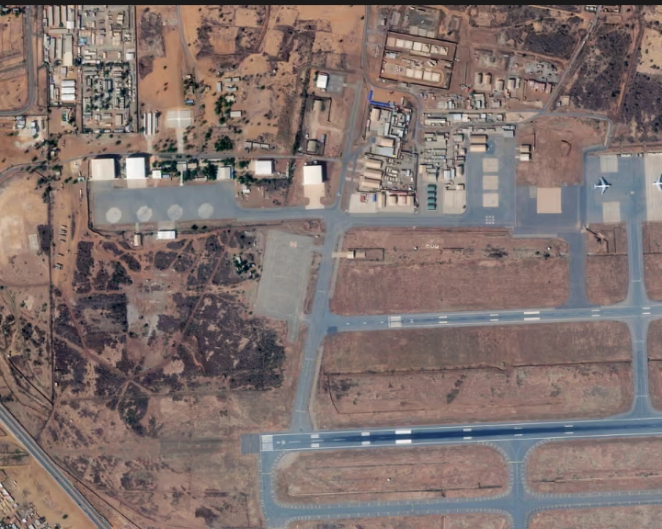
By Thursday morning, satellite imagery revealed scorched areas close to the runway, reinforcing accounts from residents who described flames rising several metres into the air during the explosions.
The imagery suggested that the attack, whether deliberate or opportunistic, had reached areas of high operational sensitivity.
As daylight broke, heavy security was deployed around the airport perimeter, with armed personnel blocking access roads and restricting movement near the adjoining military base.
Checkpoints were reinforced, and vehicles were turned away from the area as security forces sought to secure the site and assess the extent of the damage.
Access to the military installation was particularly tightly controlled, underscoring fears that it may have been a primary or secondary target.
Elsewhere in Niamey, daily life appeared to continue largely as normal. Markets reopened, traffic resumed, and residents went about their routines, though conversations frequently turned to the events of the night before.
For many, the calm elsewhere in the city contrasted sharply with the violence at the airport, reinforcing a sense that critical infrastructure rather than civilian neighbourhoods had been singled out.
Security analysts and regional observers suggested the incident bore the hallmarks of an attack by armed militant groups active in Niger and the wider Sahel. The country has faced sustained pressure from jihadist organisations affiliated with both Islamic State and al-Qaida, particularly in border regions shared with Mali and Burkina Faso.
These groups have increasingly demonstrated the capacity to strike high-profile targets, even as authorities claim to have improved security controls.
In recent days, warnings had circulated among security circles about the heightened risk of an attack near the capital.
Analysts noted that militant groups have been expanding their operational footprint closer to Niamey, probing defences and seeking to undermine confidence in the authorities’ ability to protect strategic sites.
One regional analyst said there had been clear indicators of growing militant presence in areas surrounding the city, raising fears that a major strike was imminent.
Read also: Former Radio 1 DJ Andy Kershaw ‘unable to walk’ after cancer diagnosis: ‘I’m determined not to die before Tr**p’
The attack also fits a broader pattern of efforts by armed groups to challenge Niger’s military leadership by targeting symbols of state authority and security infrastructure.
Such operations are often intended to project strength, disrupt economic activity, and erode public trust in ruling juntas. By striking an airport used for both civilian and military purposes, attackers can generate outsized psychological and economic impact without engaging in prolonged combat.
The overnight violence comes against the backdrop of profound political upheaval in Niger over the past two years. In July 2023, the presidential guard overthrew the country’s democratically elected leader, ushering in military rule and suspending the constitution.
The takeover triggered widespread international condemnation, sanctions, and the withdrawal of financial and security assistance from key partners.
Following the coup, Niger’s military leaders severed longstanding defence relationships with Western allies and expelled foreign forces that had previously assisted in counterterrorism operations.
The country later joined with neighbouring Mali and Burkina Faso, both also under military rule, to form a new regional alliance outside established West African political structures. The shift marked a significant geopolitical realignment and left Niger increasingly isolated.
Despite promises by the junta to restore order and improve security, violence linked to extremist groups has intensified. Attacks on military convoys, villages, and infrastructure have continued, particularly in rural areas, and have increasingly edged closer to urban centres.
The overnight incident at the airport has reinforced fears that even the capital is no longer insulated from such threats.
Recent data underscores the scale of the challenge facing Niger.
Terrorism-related deaths rose sharply over the past year, reaching levels not previously recorded in the country.
Analysts warn that the combination of political instability, reduced international cooperation, and emboldened militant groups has created a volatile security landscape with limited capacity for rapid improvement.
For now, uncertainty surrounds the airport attack. Without official confirmation of responsibility or motive, speculation continues, and residents remain wary of further violence.
The damaged aircraft, scorched ground, and heightened security presence serve as visible reminders of the fragility of safety in a country grappling with overlapping political and security crises.
As investigations continue behind closed doors, the silence from authorities has only deepened public concern. For many in Niamey, the question is not only who carried out the attack, but whether similar incidents could follow.
With heavy security deployed at Niamey airport after overnight gunfire and explosions, the episode stands as one of the most direct challenges yet to stability in Niger’s capital since the military


