Nigeria’s energy sector could be on the verge of a major investment breakthrough as Shell Plc confirmed plans to inject $20 billion into the country, in a move that the company said was triggered by the improved investment climate under President Bola Tinubu’s administration.
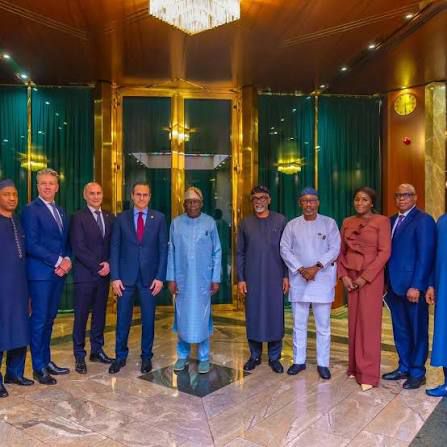
The confirmation came during a high-level meeting between President Tinubu and Shell’s Chief Executive Officer, Mr. Wael Sawan, at the Presidential Villa in Abuja.
According to a statement by the President’s Special Adviser on Information and Strategy, Bayo Onanuga, the CEO praised Tinubu’s leadership for restoring investor confidence and creating a stable environment for long-term investments.
Sawan, who described Nigeria as a key destination for global oil companies, said Shell was deepening its commitment to the country and would invest $20bn mainly in the Bonga Southwest deep offshore oil project and other related ventures.
The investment plan, he said, reflects a significant shift from Shell’s earlier posture, when the company had appeared to be scaling down operations in Nigeria due to regulatory and security concerns.
“We have really been in a space where we are very keen to invest in Nigeria. But I would say this has not always been the case. Your leadership and your vision have created an investment climate over the last few years that, I will be very honest with you, propelled us to invest,” Sawan told the President.
$20bn Nigeria investment
Shell’s CEO emphasised that the company’s long-term strategy was driven by the need for stability.
“We are investing not for one administration or five or 10 years; we want to invest for 20, 30, or 40 years,” he said, adding that Nigeria would remain a strategic investment destination for decades.
The planned investment, Sawan said, is expected to be split between capital expenditure and operating expenses, thereby supporting Nigeria’s local economy through job creation, infrastructure development, and increased gas supply for industrial use.
He also highlighted recent investments by Shell in Nigeria, including the $5bn Bonga North project, $2bn in the HI project, and gas-related investments to Nigeria LNG (NLNG).
He stated that Shell was now expanding its footprint by acquiring OML 118, the Bonga block, from TotalEnergies.
“We bought it because we want to deepen it further. But that, we think, is not enough. We think there is more to invest here,” Sawan said.
According to him, Shell’s new commitments mark a “sea change” from previous years, when the company had been hesitant about investing in Nigeria.
He further explained that the proposed Bonga Southwest deep offshore project could reach Final Investment Decision (FID) within Tinubu’s first term, provided necessary incentives and regulatory support are in place.
“This will be one of the biggest energy projects in the world,” he said, adding that the project could attract $20bn in foreign direct investment with strong local content requirements.
Government Response and Incentives
President Tinubu responded by approving the gazetting of targeted, investment-linked incentives for the project, stressing that these incentives would not be blanket concessions but ring-fenced benefits focused on new capital and incremental production.
“My expectation is clear: Bonga Southwest must reach a Final Investment Decision within the first term of this administration,” Tinubu said.
He directed his Special Adviser on Energy, Mrs. Olu Arowolo-Verheijen, to ensure the incentives were properly gazetted under Nigeria’s existing legal and fiscal frameworks.
The President also insisted that the incentives must deliver strong local content, in-country value addition, and employment opportunities for Nigerians.
Economic Implications
Analysts said the announcement could be a major boost to Nigeria’s economy, especially as the country seeks to increase domestic oil production, expand gas utilization, and reduce dependence on imports.

They also noted that the investment would strengthen Nigeria’s position as a key player in global energy markets, particularly at a time when investors are cautious about long-term commitments due to geopolitical risks and market volatility.
For Nigeria, the planned $20bn investment could provide a major stimulus to the local supply chain, as deep offshore projects typically require extensive support services, logistics, and manpower.
However, industry watchers cautioned that achieving the investment will depend on the resolution of longstanding issues such as security in the Niger Delta, regulatory delays, and the need for policy consistency.
Still, Shell’s renewed confidence, expressed through the $20bn Nigeria investment, signals a positive shift in the perception of Nigeria’s investment environment.
In his closing remarks, Sawan praised the professionalism of the President’s team, stating that they were among the best he had dealt with globally.
“That professionalism allows us to have the confidence to continue to invest,” he said.
About The Author