
BCOS MEDIA CITY IN THE ABYSS
In May 2018, Vanguard published a story that captured what could have become one of the most ambitious economic transformations ever conceived for the Broadcasting Corporation of Oyo State (BCOS).
The headline was striking:
“With Ooni’s support, we want to turn Ibadan into the Yoruba multi-billion-dollar media, entertainment hub.”
The story was about a vision conceived under the administration of the late Governor Abiola Ajimobi — a vision that placed BCOS at the centre of an ambitious plan to transform Ibadan into a major media, entertainment and creative-industry destination.
At the heart of that plan was the BCOS complex in Basorun.
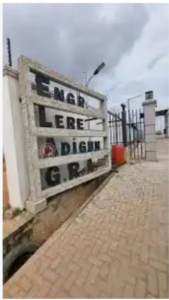
Today, however, a significant portion of that property has become the Engineer Lere Adigun GRA, a residential development that the Oyo State Government’s Lands Department now lists as “Sold out.”
This raises an uncomfortable but legitimate question:
What happened to Ajimobi’s plan to turn the BCOS estate into a commercially driven media city capable of generating sustainable revenue for the corporation and Oyo State?
The 2018 Vanguard story
The importance of the Vanguard report is that this was not merely an idea discussed casually in political circles.
It was a formally articulated project.
Published in May 2018, the report explained the ambition to turn Ibadan into a multi-billion-dollar media and entertainment hub, with the BCOS complex serving as the physical foundation of the project.
The figures were significant.
The BCOS complex was reported to occupy approximately 65 acres of land, with only about 20 acres then being utilised.
Rather than dispose of the unused land, the Ajimobi administration wanted to leverage it for a major media and entertainment development.
The idea was simple but potentially transformative:
Use the asset to create more assets.
What Ajimobi planned for the BCOS land
According to the project explanation given at the time by Yomi Layinka, who was involved in the Ibadan Media City project, the development was intended to preserve BCOS while expanding its economic possibilities.
The proposed Media City was to contain several complementary business units.
Among them were:
A world-class sound stage.
This was envisioned as a facility capable of hosting major television productions, reality shows, sporting events, concerts, drama and film productions.
The ambition was for productions by major international media organisations to be able to use the facility without having to leave Ibadan.
A film park and resort.
The proposal included a large recreational and film environment where families could visit, tourists could be attracted and productions could take place.
An entertainment mall.
This was to include cinemas, shopping facilities, exhibition spaces and other entertainment infrastructure.
A four-star hotel.
The hotel was intended to accommodate visitors, producers, entertainers, creative professionals and other users of the Media City.
A media academy.
This would provide training in broadcasting, film, technology and other aspects of the creative economy.
In other words, the plan was to create an entire ecosystem around BCOS.
Not just another studio.
Not just another government building.
A commercial media city.
And this was the most important part: sustainability
The real significance of Ajimobi’s proposal was not simply the physical structures.
It was the economic model.
The project was conceived as a public-private partnership.
According to the 2018 Vanguard report, government was expected to provide the land, enabling environment and necessary facilities, while private-sector participation would provide the investment and development capacity.
That meant the BCOS land was being viewed as an economic asset that could be leveraged rather than simply liquidated.
The objective was to create businesses that would generate continuous economic activity.
Studios could generate rental income.
Events could generate revenue.
Cinemas could generate revenue.
Hotels could generate revenue.
Training could generate revenue.
Entertainment could generate revenue.
Advertising and production could generate revenue.
The entire ecosystem could create employment and attract investment.
And BCOS could potentially benefit from the commercial activity taking place on its own estate.

That is the part of the Ajimobi vision that should not be forgotten.
BCOS had the land. The question was what to do with it.
The 2018 proposal recognised something that remains true today:
BCOS was sitting on a potentially valuable commercial asset.
The corporation had the land.
It had a historic broadcasting brand.
It had trained professionals.
It had studios and broadcasting infrastructure.
It had decades of institutional experience.
What it needed was a strategy to turn those assets into sustainable economic value.
The Media City proposal was one attempt to do precisely that.
The project was described as an innovation hub and regional headquarters for the creative economy of Western Nigeria, using the latent resources within BCOS as its starting point.
Read also: Boko Haram terrorist surrenders with RPG launcher, bomb in Borno State
Then government changed
Governor Abiola Ajimobi left office in 2019.
The administration of Governor Seyi Makinde subsequently came into power.
The Media City vision did not become the defining development of the BCOS estate.
Instead, another approach emerged.
Part of the BCOS property — particularly the area occupied by the corporation’s staff quarters — became the site of the Engineer Lere Adigun GRA.
By 2021, the redevelopment was underway.
The transformation generated controversy among BCOS workers, particularly because it involved the demolition of staff quarters and the displacement of occupants.
BCOS management subsequently announced that 36 eligible occupants received ₦5.95 million in compensation, while affected workers were given a period to secure alternative accommodation.
The administration defended the development as part of its approach to unlocking the value of government property through infrastructure development and private-sector participation.
And, to be fair, that explanation should be acknowledged.
But what happened to the Media City?
This is where the story becomes interesting.
The Makinde administration did not simply inherit an empty piece of land.
It inherited a previously articulated economic vision for that land.
A vision that had already been publicly presented.
A vision that proposed using the BCOS estate as the foundation of a major media and entertainment hub.
Instead, the government pursued a residential GRA model.
The state’s own PPP documentation describes the Engineer Lere Adigun GRA as a LandSwap-type arrangement.
Under the model, the government contributed the land while the private-sector infrastructure partner provided funding and executed the infrastructure. The resulting serviced plots were then divided according to the valued contributions of the parties and sold to members of the public to recover the investment.
The Oyo State Government’s Lands Department now lists:
“Engr Lere Adigun GRA Basorun, Ibadan — Sold out.”
That is a very different economic proposition from the Media City.
From a permanent income-generating ecosystem to sold residential plots
This is the central issue.
The question is not whether residential development is good.
Of course, housing development has value.
Infrastructure has value.
Private investment has value.
The question is whether the BCOS land was put to its most strategic and sustainable use.
Ajimobi’s Media City proposal was built around creating businesses.
The businesses would operate.
The businesses would generate revenue.
The businesses could employ people.
The businesses could attract investment.
And, theoretically, the value could continue growing for decades.
The Lere Adigun model, by contrast, created serviced residential plots which were subsequently sold.
Both models can generate economic value.
But they generate value in fundamentally different ways.
One creates a continuing commercial ecosystem.
The other monetises land through property development.
What did BCOS actually gain?
This is the question that should concern everyone interested in the future of the corporation.
If BCOS land was used as part of a development arrangement, how much value ultimately accrued to BCOS itself?
Was BCOS given a financial return?
Was the corporation given replacement property?
Was an income-generating structure created for BCOS?
Was any portion of the proceeds earmarked for modernising the corporation?
Was the corporation’s long-term commercial interest considered?
These questions deserve answers.
Because it is one thing for government to develop public land.
It is another thing to develop the strategic asset of a government-owned institution without clearly demonstrating how that institution will benefit in the long term.

Makinde’s defence
Governor Seyi Makinde has himself addressed criticism surrounding the BCOS property.
In a later interview, he argued that the Lere Adigun GRA was part of an effort to demonstrate how government could mobilise private capital to develop infrastructure.
He also rejected the allegation that he personally appropriated BCOS land, challenging anyone with evidence of a plot belonging to him to produce it.
That position deserves to be put on record.
This article is therefore not claiming that Governor Makinde personally took BCOS land.
The issue is much broader.
It concerns government policy and the use of public assets.
Did the Makinde administration “lose the plot”?
This is where the headline becomes more than a political slogan.
From Ajimobi’s Multi-Billion-Dollar BCOS Media City to Lere Adigun GRA: How Makinde Administration Lost the Plot.
“Lost the plot” does not necessarily mean that every decision made by the Makinde administration was wrong.
It means that somewhere along the line, the original strategic question may have been forgotten:
How do we use BCOS’s assets to build a stronger and more financially independent BCOS?
That question remains relevant today.
Imagine if the Media City had survived
Imagine a different scenario.
Suppose the Makinde administration had reviewed Ajimobi’s proposal and decided to modernise it.
Suppose the original concept was redesigned to reflect the realities of 2026.
Instead of abandoning the idea, imagine a new BCOS Media and Creative City featuring:
- Digital television production studios;
- Film and television sound stages;
- Podcast and content-creation studios;
- Music production facilities;
- Cinema and entertainment facilities;
- A modern media academy;
- Co-working spaces for technology companies;
- A creative-industry incubation centre;
- Event and conference facilities;
- Hotel and hospitality infrastructure;
- Advertising and commercial production facilities.
BCOS could potentially have become the anchor institution of a major creative economy in Oyo State.
Young people could train there.
Film producers could work there.
Broadcasters could rent facilities there.
Musicians could record there.
Events could take place there.
Technology companies could operate there.
And BCOS could earn legitimate commercial revenue from the ecosystem.
That was the broader opportunity embedded in the original vision.
The irony
The irony is that Oyo State still needs exactly the kind of economic diversification that the Media City proposal was designed to encourage.
The world has changed dramatically since 2018.
Media has moved further into digital platforms.
Streaming has transformed film and television.
Podcasting has exploded.
Content creation has become a major industry.
Artificial intelligence is transforming production.
Digital advertising has become a multibillion-dollar global business.
Nigeria’s entertainment industry continues to expand internationally.
And Ibadan remains one of Nigeria’s most culturally significant cities.
The opportunity did not disappear.
If anything, it became bigger.
What should Oyo State tell the people?
The people of Oyo State deserve a transparent account of the transition from the Media City proposal to the Lere Adigun GRA.
Not political accusations.
Not propaganda.
Facts.
What happened to the Ibadan Media City project?
Was it formally cancelled?
If so, when?
Why?
Were investors already involved?
What happened to those discussions?
What was the original development agreement?
How was the BCOS land valued?
How much land was used for Lere Adigun GRA?
What was the government’s contribution?
What did the private-sector partner contribute?
How were the resulting plots divided?
How much revenue or value accrued to government?
And most importantly:
What did BCOS receive?
These are legitimate questions about a public asset.
Public land should create public value
There is nothing inherently wrong with using government land to develop housing.
But strategic public assets should be evaluated not only by their immediate financial returns but also by their long-term opportunity cost.
If a piece of land can be sold for a certain amount today, that is one calculation.
If the same land can support a commercial ecosystem generating revenue for 30 or 50 years, that is another.
The second calculation requires vision.
It requires patience.
It requires strong institutions.
And it requires governments to think beyond the immediate political cycle.
That was arguably the strength of the original BCOS Media City idea.
Ajimobi’s vision deserves to be revisited
Whatever one’s political opinion of Abiola Ajimobi, the Media City proposal deserves to be judged on its merits.
It was ambitious.
It recognised the untapped value of BCOS.
It proposed private-sector participation.
It sought to create jobs.
It sought to develop the creative economy.
And it attempted to answer a question that BCOS still faces today:
How can a government-owned broadcaster become more commercially sustainable?
The answer cannot always be another government allocation.
Sometimes, the answer lies in making the assets already owned by the institution work for it.
The bigger question for BCOS
BCOS should not be reduced to its current financial challenges.
It should not be viewed merely as another government agency waiting for monthly allocations.
It is an institution with history, infrastructure, human capital, a valuable brand and assets that can potentially be leveraged responsibly.
The challenge for today’s leadership is to develop a new commercial strategy around those assets.
Perhaps the original Media City blueprint can no longer be implemented exactly as proposed in 2018.
Fine.
Then build a 2026 version.
Update it.
Modernise it.
Bring in credible investors.
Create proper governance.
Protect BCOS’s core broadcasting operations.
And, above all, ensure that the corporation itself benefits.
The land is gone. The question is what remains.
The Oyo State Government’s Lands Department lists the Engineer Lere Adigun GRA in Basorun as sold out.
That fact makes the historical question even more important.
A piece of the BCOS estate that was once identified as part of the foundation for a major media and entertainment hub has instead become a residential development.
The question is not whether the people who bought the plots have a right to them.
They do.
The question is whether the state got the best long-term value from the original BCOS asset.
And whether BCOS itself emerged stronger from the transaction.
From Ajimobi’s dream to today’s reality
In 2018, the vision was bold:
Turn Ibadan into a multi-billion-dollar media and entertainment hub.
The BCOS estate was to be the launching pad.
The corporation was to be preserved and expanded.
Private investment was to be attracted.
Businesses were to be created.
Jobs were to be generated.
Revenue was to be produced.
BCOS was to have a stronger commercial future.
Years later, the story is different.
Part of the property became the Engineer Lere Adigun GRA.
The state provided the land under a PPP/LandSwap model.
Infrastructure was developed.
Serviced plots were created.
And the state now records the GRA as sold out.
Perhaps the development has generated value.
Perhaps it has benefited the state.
Perhaps the government’s model was economically sound.
But if so, the figures should tell the story.
Because the people of Oyo State deserve to know whether they exchanged a potentially permanent media and entertainment revenue engine for a property-development opportunity.
And BCOS workers deserve to know whether the institution they serve gained or lost from that decision.
The debate should therefore not be about Ajimobi versus Makinde.
It should be about vision versus short-term monetisation, institutional sustainability versus asset conversion, and public interest versus immediate returns.
Ajimobi looked at the BCOS estate and saw a potential Media City.
The Makinde administration looked at part of that same estate and saw a potential GRA.
History will ultimately judge which vision created greater value.
But one question remains unavoidable:
Did Oyo State lose the plot when the dream of Ajimobi’s multi-billion-dollar BCOS Media City gave way to Lere Adigun GRA?
That is a question worth answering — with documents, figures and facts, not politics.
About The Author