The Nepal-Tibet flood rescue operation has recorded a remarkable breakthrough after two hydropower workers were found alive inside a tunnel nine days after devastating flash floods struck the region.
The workers, identified as Sanjay Shah and Kabir Maharjan, were rescued from the Trishuli 3A hydropower project after spending more than a week trapped approximately 170 metres underground.
According to The Guardian, the rescue came as authorities continued searching for hundreds of workers believed to be trapped or missing across hydropower facilities affected by the disaster.
🆘 Two Workers Pulled Alive From Darkness
Sanjay Shah was reportedly the first worker rescued from the tunnel before Kabir Maharjan was subsequently brought out by rescue teams.
Shah was identified as a foreman at Upper Trishuli 3A, while Maharjan worked as a supervisor at the facility.
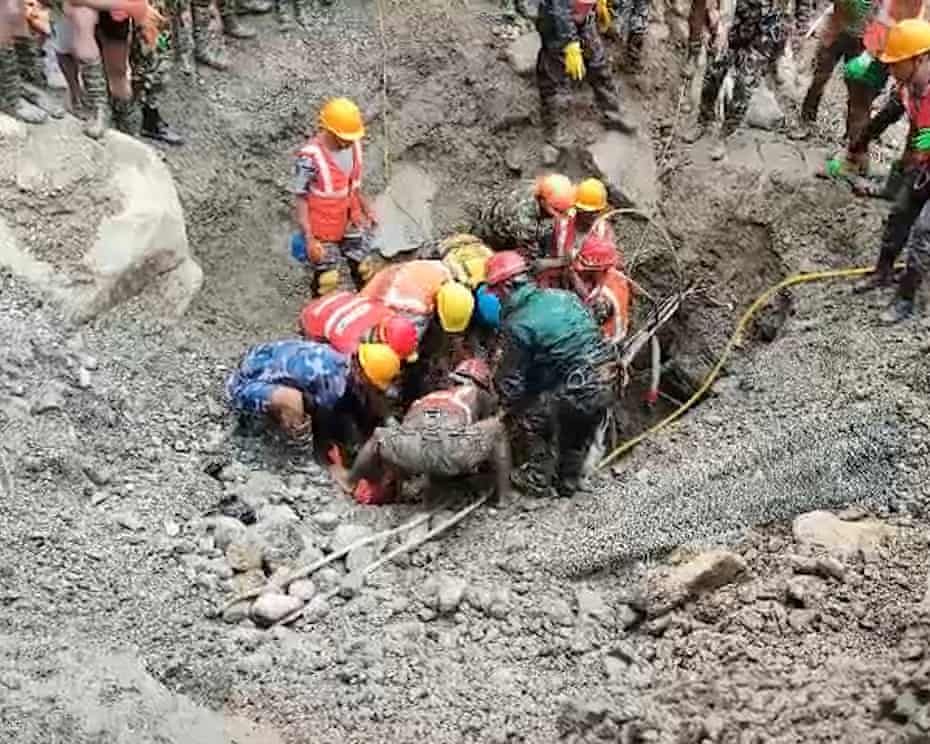
Nepal Army spokesperson Brig Gen Raja Ram Basnet confirmed that the two men were rescued from a depth of approximately 170 metres inside the tunnel.
Images released by the Nepal Army showed Shah emerging from the tunnel covered in mud but conscious as rescuers carried him away from the dangerous site.
Officials said both workers were in stable condition and were flown to a hospital in Kathmandu for medical assessment and treatment.
😢 ‘What Day Is It?’ Survivor Asks Rescuers
After being brought to safety, Shah reportedly asked rescuers a simple but emotional question: “what day is it?”
The question reflected the extraordinary circumstances surrounding his survival after being isolated underground for nine days.
Shah told officials that he had been inside the tunnel’s control room when the flooding occurred and initially focused on helping other workers escape.
“Since I was in the control room, my responsibility was to save everyone’s lives,” Shah explained.
He said there were normally only five or six people in the area, but approximately 40 to 45 people were inside when the disaster struck.
According to Shah, he warned the workers that a major accident had occurred at the dam and urged them to escape.
However, his decision to help others cost him valuable time, eventually leaving him trapped inside the tunnel.
🙏 Worker Survived by Chanting Mantras
While trapped underground, Shah said he tried to remain calm by chanting mantras as he waited for rescuers to reach him.
He said he maintained communication with three or four other people inside the tunnel by shouting to them from nearby areas.
“There could also be people inside the powerhouse. Some of them may not have been able to escape,” Shah told officials after his rescue.
His account has increased hopes that other workers could still be alive in underground sections of hydropower projects devastated by the flooding.
Nepal’s communication minister Bikram Timilsina also expressed hope that rescue teams would find more survivors during the continuing operation.
“We are waiting for the rescue of more and more people,” Timilsina said in a social media post.
🌊 How the Nepal-Tibet Flood Disaster Happened
The disaster caused widespread destruction along the Bhote Koshi and Trishuli river valleys after a huge surge of water, mud and debris swept through the area.
The flooding was linked to the collapse of a melting glacier along the Nepal-Tibet border, triggering an enormous flow that devastated communities and infrastructure.
Several hydropower projects located along the rivers were badly damaged or destroyed as floodwaters carried large boulders and enormous quantities of debris downstream.
The Nepal-Tibet flash flood has consequently created one of the most challenging rescue operations faced by authorities in the affected Himalayan region.
At least 1,259 people had reportedly been killed, while more than 5,000 remained missing according to Nepal’s disaster management agency.
🏗️ Hundreds of Hydropower Workers Still Missing
The latest hydropower tunnel rescue has raised hopes among families waiting desperately for information about relatives still missing after the disaster.
Authorities believe that air pockets inside some underground tunnels may have allowed trapped workers to survive for more than a week.
More than 270 people had reportedly been rescued across several hydropower projects, but the search remains far from complete.
At Upper Trishuli 3A, rescue teams reportedly needed almost six days to locate the tunnels after the entrances were buried by debris and floodwater.
Army personnel and specialist rescue teams subsequently worked continuously to clear blocked entrances and search for signs of life.
🔦 Voices Heard Inside Tunnel
A major breakthrough came when rescue workers heard voices from inside the tunnel after making progress through the debris.
Rescuers reportedly called out: “Don’t panic, we are rescuing you.”
A response came from inside: “Okay.”
The exchange provided a powerful indication that survivors were still inside the underground facility.
For families waiting for news, the discovery offered renewed hope that additional workers could potentially be recovered alive.
👨👩👧 Families Wait for Missing Relatives
Families of missing workers have spent nine days waiting at hospitals in Kathmandu and offices linked to Nepal’s electricity authorities.
Posters displaying photographs and details of missing workers from Trishuli 3A and other hydropower projects have reportedly been placed around Tribhuvan University Teaching Hospital.
Read also:🕊️ Gloria Steinem dies at 92 after lifetime of feminist activism
The scale of the disappearance has made the Nepal flood disaster particularly devastating for communities whose relatives worked at the affected projects.
The Independent Power Producers Association of Nepal reportedly estimated that at least 557 workers were missing from hydropower projects along the Trishuli River.
Around 115 workers were believed to be trapped inside the main tunnel at one project.
🚧 Rescue Operation Continues
Local authorities estimate that approximately 900 workers are missing from 12 hydropower projects located high in the Himalayas.
Of those, roughly 500 are believed to be trapped inside tunnels or underground structures.
Rescue teams have therefore continued concentrating their efforts on facilities where workers may have survived inside enclosed spaces.
Another major focus is the Rasuwagadhi hydropower plant, where authorities reportedly believe 46 workers trapped inside an underground chamber could still be alive.
The successful Nepal-Tibet flood rescue of Shah and Maharjan has strengthened hopes that rescuers can reach other survivors before conditions underground become fatal.
❤️ Hope Amid Devastation
The rescue of two workers nine days after the flooding represents a rare moment of hope amid a disaster that has caused widespread deaths, destruction and displacement.
Their survival demonstrates the possibility that people trapped inside protected sections of hydropower tunnels may endure for surprisingly long periods under difficult conditions.
For rescue teams, the discovery is also a reminder that every blocked tunnel could potentially contain survivors.
As operations continue, authorities face a race against time to clear debris, locate trapped workers and provide medical assistance to anyone still alive underground.
The Nepal-Tibet flood rescue effort remains ongoing, with families and officials hoping that more voices will emerge from the darkness and that additional workers can be brought home safely.
💬 What do you think?
Do you believe more workers could still be found alive inside the hydropower tunnels? What should authorities prioritise as the rescue operation continues?
Drop your thoughts in the comment section. 👇❤️
About The Author