Henry Omoile, who is standing trial alongside former Central Bank of Nigeria governor Godwin Emefiele, has told the court that the statement he earlier gave to investigators from the Economic and Financial Crimes Commission (EFCC) was not truthful.
Omoile made this revelation while testifying before Justice Rahman Oshodi of the Special Offences Court sitting in Ikeja, Lagos.
His testimony came during a trial-within-trial convened to determine whether the statement he made to EFCC officials was voluntarily given.
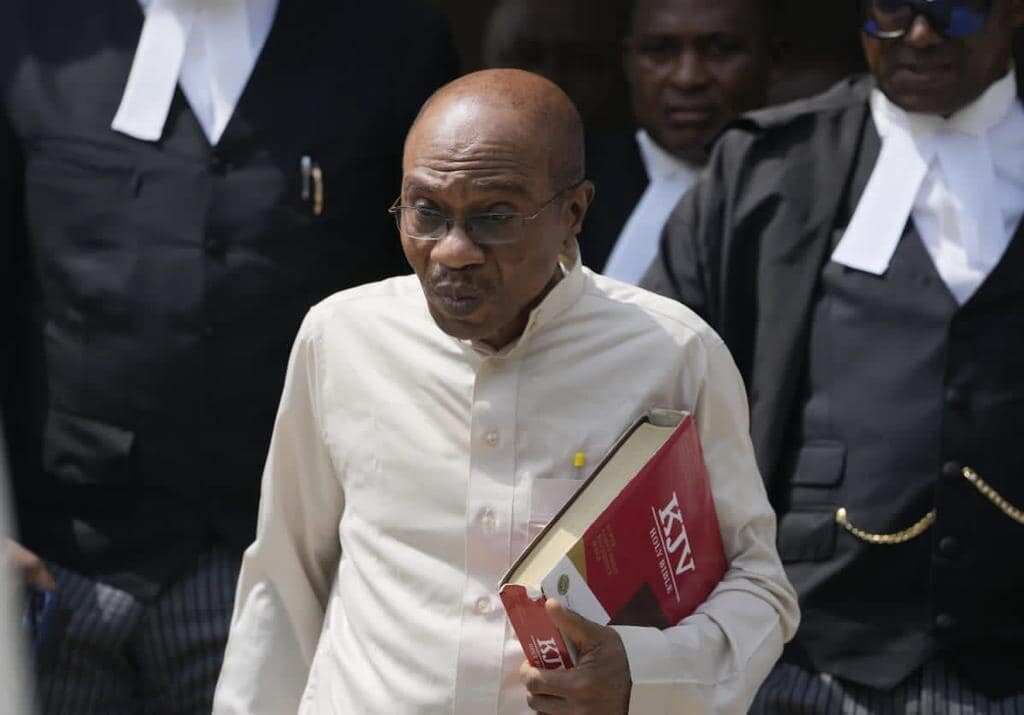
The Emefiele trial has attracted significant attention as the former apex bank chief faces a 19-count charge brought by the anti-graft agency.
The charges include allegations of receiving gratification and making corrupt demands while serving as governor of the Central Bank of Nigeria.
Omoile, who is the second defendant in the case, is facing a separate three-count charge. Prosecutors allege that he unlawfully accepted gifts while acting as an agent.
Both defendants have denied all the allegations against them.
While giving evidence in court, Omoile stated that the written statements he submitted to EFCC investigators were not genuine confessions.
According to him, the documents marked as Exhibits TWT 1 to 4 during the Emefiele trial did not reflect the truth of events.
He explained that the statements were written under pressure from investigators who allegedly threatened to prosecute him if he refused to comply with their instructions.
Omoile told the court that he merely wrote what the investigators directed him to include.
“The statements in Exhibits TWT 1 to 4 do not contain a confession from me,” he told the court.
“I lied in those statements because EFCC officials threatened that if I refused to write what they wanted, they would take me to court.”
His testimony forms a key part of the Emefiele trial, as the court must first determine whether the statements were voluntarily made before deciding if they can be admitted as evidence.
During cross-examination, the prosecution questioned Omoile about the circumstances surrounding the statement he submitted during the EFCC investigation.
He admitted that before writing the statement, investigators read him a cautionary note explaining his rights.
He also confirmed that he signed the document acknowledging the caution.
When asked whether the EFCC had filed a counter-affidavit challenging his allegations of intimidation, Omoile responded that such a document existed.
However, he conceded that he had not presented the document before the court during the proceedings.
The prosecution also questioned him about legal steps he had taken after the alleged threats.
Omoile told the court that he had spoken with his legal counsel about filing a suit seeking enforcement of his fundamental human rights.
According to him, a motion ex parte related to that matter had been submitted earlier that same morning.
Despite presenting a court ruling linked to the application, Omoile acknowledged under questioning that the ruling had no direct connection to Exhibit D4, one of the documents tendered in the trial.
Nevertheless, he maintained that the issues were related.
Earlier in his testimony, Omoile claimed that investigators attempted to persuade him to implicate Emefiele during the course of their interrogation.
According to him, the head of the investigative team, whom he identified as Alvan, allegedly suggested that cooperating with investigators could lead to favourable treatment.
Omoile alleged that the officer promised he might be granted bail or possibly avoid prosecution entirely if he provided statements that incriminated the former CBN governor.
The allegation forms part of the defence argument in the Emefiele trial, as lawyers seek to challenge the credibility and admissibility of the statements obtained by the EFCC.
However, when questioned by prosecutors, Omoile admitted that he had not filed any formal complaint or petition against members of the EFCC investigative team regarding the alleged threats.
After hearing the testimony and arguments from both parties, Justice Rahman Oshodi adjourned the Emefiele trial.
The case was postponed until April 17, 2026, when lawyers representing both sides are expected to adopt their final written addresses on the matter.
The court will then determine whether the contested statements made by Omoile to EFCC investigators were voluntary and therefore admissible as evidence in the ongoing corruption case involving the former CBN governor.
The outcome of this decision could play a significant role in shaping the direction of the Emefiele trial, as the prosecution seeks to prove its allegations while the defence continues to challenge the circumstances under which key evidence was obtained.
About The Author