The Jordan church funeral shooting has left seven people dead and 40 others injured after armed men opened fire during a funeral service at a Greek Orthodox church in Karak, southern Jordan, prompting three days of national mourning and condemnation from regional leaders and the United Nations.
The attack occurred on Friday, October 23, when mourners had gathered inside the church, approximately 180 kilometres south of Amman, Jordan’s capital. Authorities described the assailants as unknown, while investigations continued to establish their identities and motives.
Footage broadcast by Jordanian state television showed two men apparently carrying pistols approaching the church and firing shots. A third man, who appeared to be armed with a semiautomatic rifle, subsequently approached and opened fire.
The images showed the men moving towards the church before all three reportedly ran in the same direction. Witness-recorded footage later revealed shattered glass and pools of blood on the church floor, illustrating the violence that unfolded during the funeral.
Jordan Church Funeral Shooting Triggers National Mourning
The deadly shooting has shocked Jordan, where authorities are investigating the circumstances surrounding the attack and seeking to establish who was responsible.
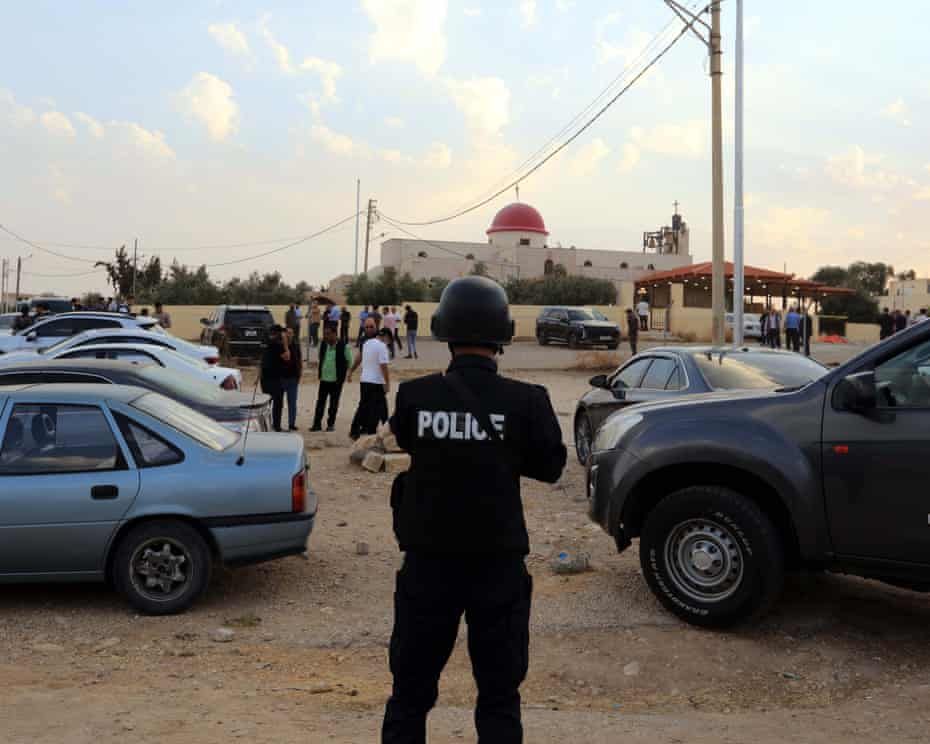
The government issued a statement describing the incident as an attack “carried out by unknown assailants” but did not immediately confirm whether any suspects had been arrested or killed.
Officials said investigations were progressing urgently, declaring that “investigations are under way at full speed”.
Jordan subsequently declared three days of national mourning, according to the kingdom’s Petra news agency. The announcement reflected the seriousness of the incident and the loss suffered by the families of those killed.
Karak, where the shooting occurred, has a minority Christian population. The attack took place at a Greek Orthodox church while mourners were attending a funeral, turning a gathering intended to honour the dead into a scene of panic and bloodshed.
Authorities have yet to establish publicly the precise motive behind the shooting or confirm the number of people directly involved.
Witness Describes Intense Gunfire Inside the Church
Dorgham Halasa, one of the mourners present inside the church, described the terrifying moments when gunfire erupted during the funeral.
According to Halasa, approximately 15 minutes had passed since the service began when the shooting started, sending people fleeing in different directions.
“It was a weird situation, and heavy gunfire,” he said.
Halasa explained that he did not personally see the gunmen. However, he said other people at the scene reported seeing four assailants.
The Associated Press could not independently verify the number of attackers, while Jordanian security services had not immediately released detailed information about their identities or the sequence of events.
The discrepancy between the witness accounts and the number of men visible in state television footage underscores the need for investigators to establish exactly how many people participated in the attack.
Jordanian King Abdullah Promises Harshest Penalties
King Abdullah II condemned the shooting and vowed that those responsible would face severe punishment.
In a statement published on X, the Jordanian monarch said the country “will confront the terrorist act that targeted Karak with the harshest penalties”.
He also expressed his “deepest condolences to the families of the martyrs, and our wishes for recovery to the wounded”.
The king’s remarks signalled the government’s determination to respond firmly, although authorities had not yet publicly identified the perpetrators or announced arrests connected with the incident.
Jordanian Prime Minister Jafar Hassan also condemned the attack during a security meeting in Karak on Friday evening.
Hassan attributed the incident to terrorist ideology and what he described as blind extremism, warning that those responsible would face punishment.
He said legal measures would be taken against individuals seeking to introduce or promote extremism, reinforcing the government’s position that the attack required a strong security and judicial response.
The prime minister’s comments came as investigators worked to establish the circumstances surrounding the shooting and determine whether the assailants had links to any organised group.
Health Minister Confirms Critical Injuries
Jordan’s Health Minister, Ibrahim al-Budour, said two of the injured victims were in critical condition following the attack.
The reported death toll stood at seven, while 40 people had sustained injuries. The available information did not provide a detailed breakdown of the victims’ identities or the severity of every injury.
The number of casualties has made the shooting one of the most serious recent attacks reported in Karak, a city with a history of deadly violence involving armed assailants.
The condition of the critically injured victims remained a major concern as the country mourned those killed during the funeral.
Jordan Faces Renewed Memories of Deadly 2016 Karak Attacks
The latest shooting has revived memories of a deadly series of attacks in Karak in 2016, when gunmen ambushed police officers and carried out violence at several locations, including a Crusader castle popular with tourists.
That earlier incident killed 10 people, among them seven police officers, and wounded dozens of others.
Jordanian security forces eventually killed the attackers following a prolonged standoff.
The 2016 violence demonstrated the security challenges that armed attacks can pose in the kingdom, particularly when police officers, public locations and tourist destinations become targets.
However, authorities have not established a connection between the earlier attacks and Friday’s shooting at the Greek Orthodox church.
Read also: France deploys 70000 police officers as protests escalate, government faces backlash over demonstration bans
Investigators will need to determine whether the latest incident was linked to an organised extremist network, a specific dispute or another motive. No definitive explanation had been publicly established in the initial reports.
The fact that the shooting occurred during a funeral has also intensified concerns about the vulnerability of civilians gathered for religious and family occasions.
Regional Leaders Condemn Deadly Church Attack
Condemnation of the shooting came from across the Middle East, with officials and religious leaders expressing sympathy for the victims and solidarity with Jordan.
Statements of condemnation came from Lebanon, Syria, Egypt and Oman, reflecting the regional concern generated by the attack.
Ahmed al-Tayeb, the grand imam of Al-Azhar in Cairo, offered condolences to the victims’ families and described the shooting as a “heinous terrorist attack”.
Al-Azhar is widely regarded as one of the most prominent institutions of Sunni Muslim religious scholarship, making the condemnation a significant religious response to the killings.
Iraqi Foreign Minister Fuad Hussein also contacted his Jordanian counterpart following the incident.
According to a statement from Hussein’s office, the Iraqi minister “affirmed Iraq’s solidarity with Jordan in the face of terrorism”.
The messages of support came as Jordan began its period of national mourning and security officials continued investigating the attack.
United Nations Calls for Those Responsible to Be Held Accountable
United Nations Secretary-General António Guterres also condemned the shooting, describing an attack during a funeral as “especially heinous”.
His spokesperson, Stephane Dujarric, said the secretary-general had called for those responsible to be identified and held accountable.
“The secretary-general also calls for all those responsible to be found and to be held to account,” Dujarric said.
The UN’s response added an international dimension to the condemnation, with the organisation stressing accountability for the deadly violence against civilians.
The call for justice also reflected the immediate challenge facing Jordanian authorities: identifying the attackers, determining their motive and establishing whether other individuals were involved in planning or facilitating the shooting.
Investigation Continues as Jordan Mourns Victims
As Jordan observes three days of national mourning, attention is turning towards the investigation and the possibility of further official announcements about the perpetrators.
The government has promised a firm response, while the king and prime minister have publicly condemned the attack and warned that those responsible will face punishment.
Nevertheless, several important questions remain unanswered, including the confirmed number of gunmen, their identities and the precise motive behind the shooting.
Authorities have not immediately disclosed whether suspects have been apprehended or whether any group has claimed responsibility.
The confirmed casualty figures remain seven dead and 40 injured, with two of the wounded reported to be in critical condition by the health minister.
For families who attended the funeral, the attack has transformed a moment of mourning into another tragedy. For Jordan, it has prompted renewed concerns about extremist violence and the protection of civilians at religious gatherings.
The investigation is expected to be central to determining how the attack unfolded and ensuring that those responsible are brought before the law.
About The Author