Deadly protests rock Syria’s coast– The coastal cities of Syria erupted into turmoil as protests by Alawite Syrians turned deadly, underscoring how fragile the country remains after Bashar al-Assad’s dramatic fall.
Demonstrations broke out across Latakia, Tartous and Jableh, drawing hundreds into the streets demanding justice, security, and political restructuring after months of rising fear.
At least three people were killed during the clashes, including a member of the security forces, while dozens of protesters were injured amid chaotic confrontations.
The protests followed a devastating bombing at an Alawite mosque in Homs, an attack that killed eight worshippers and reignited sectarian anxieties nationwide.
For many Alawites, the bombing was not an isolated act of violence but a symbol of growing vulnerability since the collapse of Assad’s regime.
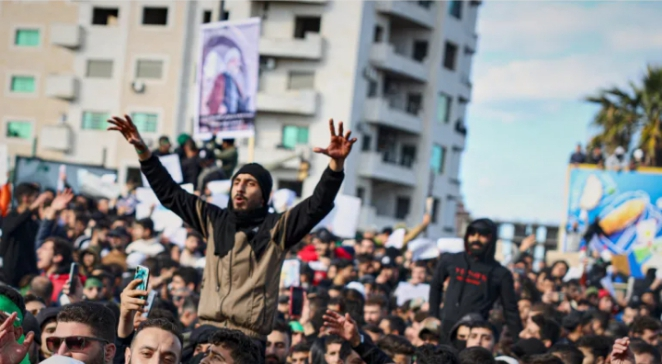
Crowds gathered carrying banners, chanting slogans, and demanding the release of detained Alawite soldiers dismissed after the former government’s downfall.
Demonstrators accused Syria’s new authorities of failing to protect minority communities and of allowing discrimination to replace the old authoritarian order.
Security forces initially maintained a heavy presence, erecting checkpoints and attempting crowd control, but tensions escalated as protesters refused to disperse.
Skirmishes erupted when counter-protesters loyal to the new government confronted Alawite demonstrators, hurling stones and shouting rival slogans.
Witnesses reported chaotic scenes as security personnel fired into the air to separate the groups, deepening fear among civilians caught between factions.
Authorities denied opening fire directly on demonstrators, insisting they acted to “contain the situation” and restore public order.
Officials instead blamed remnants of the Assad era, accusing them of exploiting communal grievances to destabilise the fragile transition.
Yet among protesters, distrust of official explanations ran deep, fuelled by years of propaganda, repression, and unaddressed grievances.
Many demonstrators carried images of Ghazal Ghazal, an Alawite cleric living abroad who called for peaceful marches across Syria.
Ghazal urged Alawites to reject sectarian violence while demanding a federal political system that would guarantee minority protection.
His appeal struck a chord among communities who feel stripped of influence and exposed to reprisals after decades of dominance under Assad.
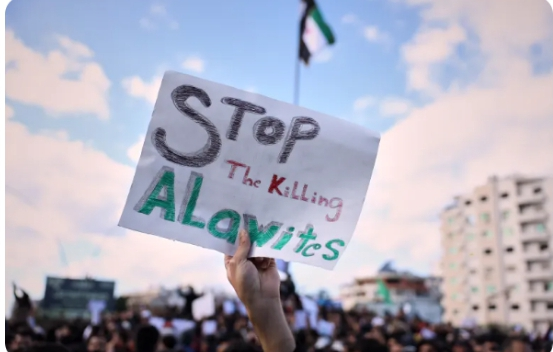
Placards at the protests called for an end to “sectarian speech,” reflecting fears that Syria’s wounds are reopening rather than healing.
One protester, a middle-aged mother, declared that federalism was the only way to stop bloodshed and ensure equal worth for all Syrians.
Read also:2025: The world in retrospect and 2026 Projections — Is global war on the horizon?
Her words echoed a broader sentiment: that identity-based violence threatens to unravel hopes of a unified post-war state.
The Syrian civil war may officially be over, but the divisions it entrenched remain painfully visible across the country.
Latakia and Tartous, long considered regime strongholds, now stand at the centre of a new struggle over power and belonging.
During the Assad dynasty, Alawites were heavily represented in the military and public sector, creating deep resentment among other communities.
Since the regime’s collapse, many Alawites report losing jobs, facing arbitrary detentions, and becoming targets of sporadic attacks.
In March, an ambush by Assad loyalists against security forces triggered days of violence that killed hundreds, most of them Alawites.
Although the situation later calmed, mistrust hardened, leaving scars that resurfaced dramatically during the latest protests.
Reporting from Damascus, journalists noted that security reinforcements were rushed to coastal hotspots as tensions mounted.
Armoured vehicles and additional troops signalled the government’s fear that unrest could spiral beyond localised demonstrations.
Analysts warn that Syria’s new leadership faces a near-impossible balancing act between asserting authority and avoiding collective punishment.
Heavy-handed responses risk alienating minorities further, while restraint may embolden armed spoilers seeking chaos.
The bombing in Homs added another volatile layer, exposing ongoing security gaps despite promises of stability after Assad’s flight to Russia.
That attack during Friday prayers shattered any illusion that sectarian violence had been decisively contained.
For Alawites, the memory of being targeted during the civil war remains fresh, intensifying anxiety and defensive mobilisation.
For other Syrians, the protests raise fears of renewed fragmentation just as the country attempts to rebuild institutions.
Calls for federalism, once marginal, are gaining traction as communities seek guarantees against domination by any single group.
However, critics argue federalism could entrench divisions rather than heal them, risking the permanent breakup of the state.
The government’s challenge lies in transforming revolutionary victory into inclusive governance without reviving authoritarian reflexes.
Failure to address minority fears could open space for extremist groups eager to exploit chaos and grievance.
International observers remain cautious, noting that Syria’s transition is unfolding without a comprehensive reconciliation framework.
Economic hardship, unemployment, and destroyed infrastructure compound political tensions, leaving little margin for error.
For ordinary Syrians, survival often eclipses ideology, yet violence repeatedly drags them back into identity-driven conflict.
The images from Latakia—tear gas, bloodied streets, desperate chants—serve as a grim reminder of unfinished business.
As night fell on the coastal cities, uncertainty lingered over whether calm would hold or unrest would spread further.
Syria stands at a crossroads where reconciliation, justice, and security must advance together or risk total collapse.
The protests are not merely about one bombing or one leader’s call, but about a nation still searching for itself.
Until grievances are addressed through dialogue rather than force, the promise of post-war peace will remain dangerously fragile.
About The Author