Libya on Sunday laid to rest its army chief of staff, General Mohammed al-Haddad, in the coastal city of Misrata, closing a chapter defined by war, uneasy truces and fragile hopes of military unity.
The funeral followed days of national mourning after al-Haddad and other senior officers were killed in a plane crash shortly after takeoff from Ankara, where they had held talks with Turkish defence officials.
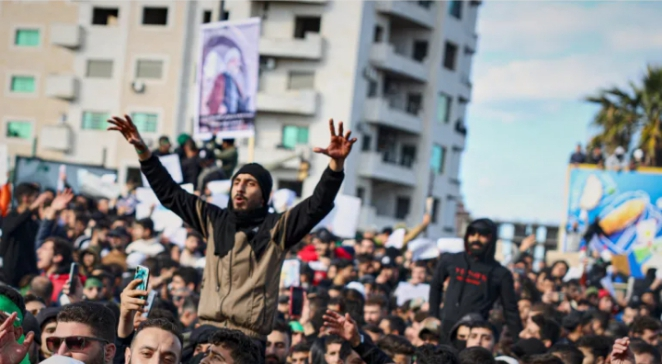
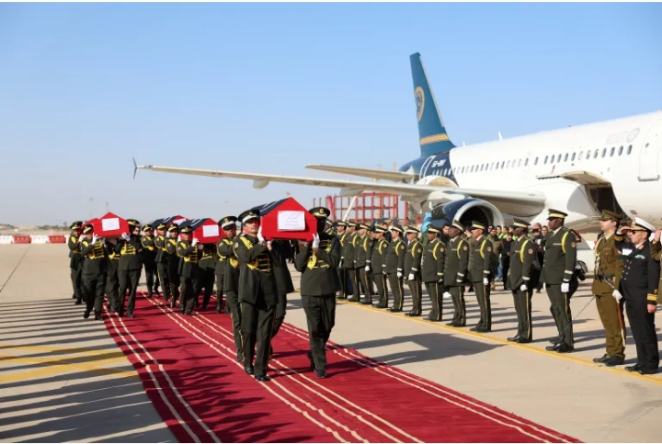
Flag-draped coffins were carried through streets thick with grief and symbolism, as thousands gathered for prayers in Misrata’s football stadium, a city long central to Libya’s post-2011 conflicts.
Al-Haddad’s death has resonated far beyond personal loss, striking at the heart of Libya’s delicate military and political balance at a time of economic distress and public unrest.
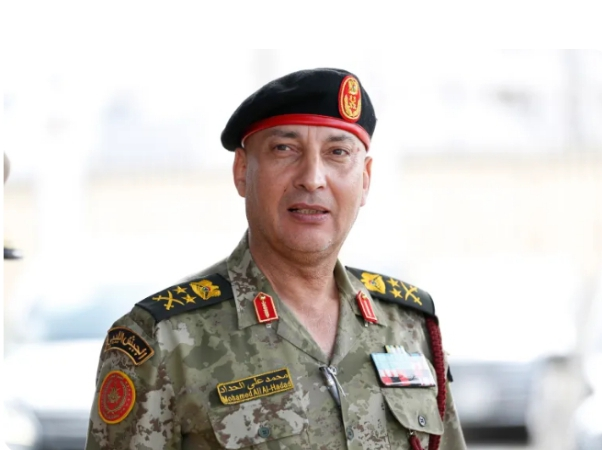
The general, widely regarded as disciplined and pragmatic, served as a rare figure respected across factional lines, including by adversaries who once fought his forces on the battlefield.
His final journey home underscored Libya’s persistent divisions, with official receptions split between rival airports controlled by competing armed groups and political authorities.
The aircraft crash that claimed al-Haddad’s life also killed senior commanders Fetouri Ghrebil and Mahmoud al-Gedewi, compounding the institutional shock to Libya’s security establishment.
Libyan and Turkish authorities say preliminary findings point to technical failure, though full conclusions await an international investigation involving a neutral third country.
A Libyan military committee dispatched to Ankara described a catastrophic crash scene, with identification of remains requiring DNA testing before repatriation could proceed.
The tragedy unfolded against a sensitive political backdrop, just one day after Turkey’s parliament voted to extend its troop presence in Libya under existing cooperation agreements.
For Tripoli’s internationally recognised authorities, al-Haddad was more than a chief of staff; he was a stabilising broker between armed formations and political institutions.
He rose to prominence during the 2019–2020 battle for Tripoli, when forces loyal to eastern commander Khalifa Haftar advanced to the capital’s outskirts.
Under al-Haddad’s operational leadership, western forces regrouped, halted Haftar’s campaign and eventually pushed his troops back toward eastern Libya.
His influence extended beyond combat, playing a decisive role in negotiations that produced the nationwide ceasefire agreement signed in October 2020.
That ceasefire, though repeatedly strained, remains one of the few pillars preventing Libya’s long civil conflict from reigniting at full scale.
Even Haftar, who does not recognise Tripoli’s current political framework, issued a statement expressing sadness and offering condolences to al-Haddad’s family.
Such cross-camp acknowledgment highlighted the general’s unique standing in a country where legitimacy is fiercely contested and rarely shared.
Yet unity in death has not erased uncertainty in life, as Libya now faces the question of who can replace a man seen as both soldier and mediator.
The Presidential Council, Libya’s collective head of state and supreme military authority, has appointed General Salah al-Namroush as interim chief of staff.
In his eulogy, al-Namroush pledged continuity, promising to pursue army unification and uphold the discipline his predecessor championed.
Political analysts caution, however, that the permanent appointment may become entangled in wider power-sharing negotiations rather than professional merit.
Libya is already bracing for a long-delayed cabinet reshuffle, prompted by public anger over inflation, unemployment and deteriorating public services.
Al-Haddad’s death has inserted the chief of staff role into those talks, raising fears the position could be used to appease armed factions or political blocs.
Such concerns resonate deeply in a country where institutions remain weak and armed groups retain decisive leverage over formal authority.
Recent clashes around Tripoli’s Mitiga airport, involving the powerful Special Deterrent Force, underscored how quickly local disputes can escalate.
Al-Haddad had chaired a truce committee formed with United Nations support to defuse that crisis, again illustrating his central role in crisis management.
His absence leaves a vacuum at precisely the moment Libya can least afford one, with elections stalled and rival governments still competing for legitimacy.
The logistics of the funeral itself mirrored Libya’s fractured geography, as officials avoided Mitiga airport due to political hostility and security concerns.
Instead, ceremonies were held at the long-damaged Tripoli international airport, a site symbolic of years of conflict and incomplete reconstruction.
At the military ceremony, Presidential Council head Mohamed al-Menfi posthumously promoted al-Haddad to field marshal, lauding his service to state stability.
Prime Minister Abdul Hamid Dbeibah praised the general as a cornerstone of national security and vowed transparent cooperation with Turkey in the investigation.
From Tripoli, the coffins were flown to Misrata, where local authorities declared a public holiday to allow mass participation in burial rites.
Mourners travelled from distant regions, including the Nafusa Mountains, describing their presence as a statement against division and fragmentation.
For many Libyans, al-Haddad embodied a fleeting possibility of a professional, unified army loyal to institutions rather than personalities.
That vision remains unfinished, and his death has intensified anxieties about whether Libya’s security sector can withstand renewed politicisation.
As prayers concluded in Misrata, the mood combined reverence with resolve, reflecting a society weary of loss yet determined to avert further collapse.
Libya now stands at a crossroads, mourning a commander while confronting the unresolved question of who can fill his role without reopening old wounds.
Read also: 2025: The world in retrospect and 2026 Projections — Is global war on the horizon?
The coming days will test whether Libya’s leaders can honour al-Haddad’s legacy through restraint and consensus, or repeat patterns that have long undermined the state.