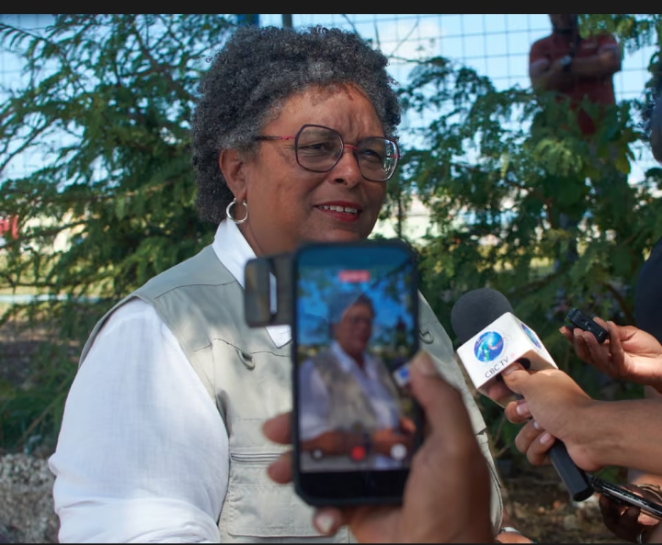
Barbados PM Mia Mottley third election victory has cemented her dominance after the Barbados Labour party secured all 30 seats in parliament, sweeping the opposition aside.
State broadcaster CBC confirmed that the Barbados Labour party achieved a complete parliamentary sweep, unseating opposition leader Ralph Thorne in a decisive national contest.
The result marks Mottley’s third consecutive mandate, reinforcing her political authority in the eastern Caribbean island nation of about 283,000 residents.
Supporters dressed in the party’s trademark red gathered in celebration as results were announced, chanting and waving flags outside campaign headquarters.
In her victory speech, Mottley pledged to focus on social justice and economic opportunity for ordinary citizens across Barbados.
“Our mission first and foremost is to stop poor people from being poor and to remove injustice wherever it exists,” she told cheering supporters.
The Barbados PM Mia Mottley third election victory also underscores her enduring appeal among voters concerned about economic stability and cost-of-living pressures.
Her administration has repeatedly promised to prioritise economic growth, affordability and Barbados’s standing on the international stage.
Mottley, 60, has built one of the Caribbean’s strongest global profiles, frequently advocating for climate justice and fairer financial systems for small island states.
The Barbados Labour party clean sweep leaves the Democratic Labour party without representation in the House of Assembly.
Ralph Thorne described the outcome as disappointing but thanked supporters for maintaining what he called a respectful and clean campaign.
The opposition had campaigned heavily on domestic security and infrastructure concerns, arguing that local priorities required renewed focus.
Despite those arguments, voters delivered a comprehensive endorsement of the incumbent government’s record and future agenda.
The Barbados PM Mia Mottley third election victory follows a campaign that highlighted social equity, fiscal management and international diplomacy.
Last year, Barbados commemorated 75 years since universal adult suffrage without property qualifications, a milestone Mottley referenced in her remarks.
She promised to safeguard democratic institutions and ensure broad participation in national development.
Mottley also announced that Friday would be declared a public bank holiday to celebrate the electoral outcome.
Political analysts say the total seat sweep reflects organisational strength within the Barbados Labour party and fragmented opposition structures.
Such dominance in a parliamentary democracy raises questions about checks and balances, though supporters argue stability enables decisive governance.
Barbados transitioned to a republic in 2021, removing the British monarch as head of state while remaining within the Commonwealth.
Under Mottley’s leadership, the country has sought to balance economic reform with social welfare protections.
Tourism remains a central pillar of the Barbadian economy, alongside international business services and emerging renewable energy initiatives.
Global economic uncertainty and climate vulnerability continue to shape policy priorities for the island nation.
Mottley has frequently used international platforms to demand climate financing for Caribbean states facing rising sea levels and extreme weather.
Her strong diplomatic presence has elevated Barbados’s profile far beyond its geographic size.
Domestically, cost-of-living challenges and infrastructure upgrades remain pressing concerns for many households.
The Barbados Labour party clean sweep may provide legislative freedom to advance reforms without parliamentary resistance.
However, critics caution that overwhelming majorities must still ensure transparency and accountability in governance.
The Barbados PM Mia Mottley third election victory signals continuity in policy direction rather than abrupt political change.
Voters appear to have prioritised experience and international credibility amid regional and global uncertainties.
Barbados’s strategic position as the Caribbean’s easternmost island also places it at the forefront of Atlantic climate impacts.
Mottley’s leadership has emphasised resilience planning, disaster preparedness and sustainable development frameworks.
Her administration has also championed debt restructuring initiatives aimed at easing fiscal burdens on vulnerable economies.
With a third mandate secured, expectations are high for tangible improvements in living standards and infrastructure.
The Democratic Labour party now faces the challenge of rebuilding and redefining its platform outside parliament.
Read also: James Van Der Beek death at 48 prompts outpouring of celebrity tributes
Observers note that future political competition will depend on organisational renewal and policy alternatives.
For now, the Barbados PM Mia Mottley third election victory stands as a commanding endorsement from the electorate.
The coming term will test whether sweeping parliamentary power translates into measurable progress for all Barbadians.
About The Author