The Save America Act passed the House on Wednesday, advancing a sweeping Trump-backed proposal that would require proof of citizenship for voter registration and sharply restrict mail-in voting nationwide.
Lawmakers approved the Save America Act in a narrow 218-213 vote, underscoring deep partisan divisions over US election law and the future of federal voting standards.
The legislation now heads to the Senate, where it faces long odds amid Democratic opposition and the likelihood of a filibuster blocking its path forward.
The Save America Act builds on earlier Republican efforts to reshape federal election rules, expanding the scope of a prior Safeguard American Voter Eligibility proposal introduced in 2024.
Under the bill, Americans registering to vote would have to provide documentary proof of citizenship, such as a passport or birth certificate.
In addition to citizenship documentation, the measure would establish a nationwide photo ID requirement for casting ballots in federal elections.
The bill outlines a strict list of acceptable identification, excluding student IDs and tightening standards beyond those currently used in many states.
Supporters argue the Save America Act would bolster election integrity and restore public confidence in voting systems.
Critics counter that the proposal risks disenfranchising millions of eligible voters, particularly low-income Americans and communities of color.
The legislation would also significantly curtail mail-in voting, limiting how absentee ballots are requested, verified and counted.
Implementation of the new rules would take effect immediately if signed into law, leaving states scrambling to update registration systems and voting infrastructure.
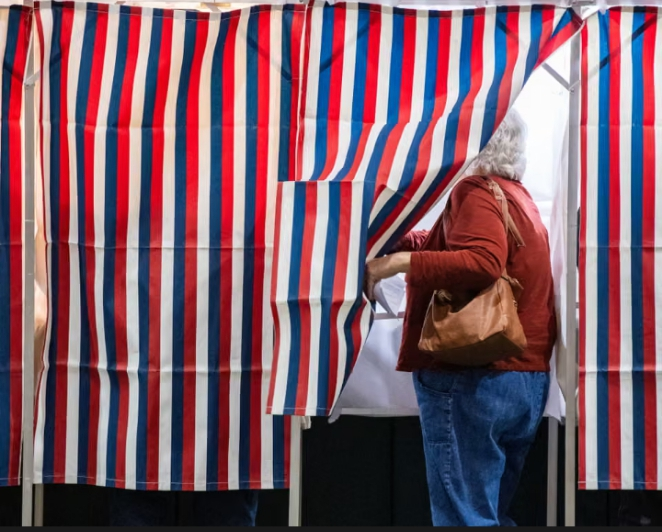
Election administrators warn that abrupt changes could disrupt voter rolls and create confusion ahead of upcoming federal contests.
Shenna Bellows, Maine’s secretary of state and a Democratic candidate for governor, questioned whether the Senate would even consider the bill.
“I’m skeptical that the Senate will vote on this bill,” Bellows said, noting that a previous version has already stalled in the upper chamber.
The House previously passed a version of the Save Act in 2024 with limited Democratic support, but the Senate did not take it up.
This year’s Save America Act, introduced by Republican representative Chip Roy of Texas, goes further than its predecessor.
Roy and fellow Republicans frame the measure as a necessary safeguard against non-citizen voting and alleged irregularities.
However, documented cases of non-citizen voting in federal elections remain rare, according to numerous studies and state-level investigations.
Gideon Cohn-Postar, a senior adviser for election infrastructure at the Institute for Responsive Government, criticized the proposal’s practical implications.
“You can describe them in a really general way, and they sound reasonable,” Cohn-Postar said of proof-of-citizenship and photo ID requirements.
“Well, actually, it is incredibly difficult to do,” he added, noting that voters already attest to their citizenship under penalty of perjury.
Advocacy groups argue that documentary proof of citizenship could pose steep barriers for millions of Americans lacking easy access to official records.
The Southern Poverty Law Center estimates that approximately 21 million Americans do not possess a birth certificate copy or valid passport.
Those individuals are disproportionately poor, elderly or members of minority communities, according to the organization.
Rebekah Caruthers, president and CEO of the Fair Elections Center, said the bill must be viewed in its broader context.
“We’ve got to look at this in its totality,” Caruthers said. “The whole point of this is to restrict who gets to vote in this country.”
Republicans reject that characterization, arguing that uniform national standards are needed to prevent fraud and strengthen safeguards.
They contend that requiring documentary proof of citizenship aligns with basic expectations for participation in federal elections.
The Save America Act also raises questions about federalism and the balance of power between states and Congress over election administration.
Historically, states have exercised broad authority in setting voting procedures, subject to constitutional protections and federal oversight.
By mandating nationwide documentation and identification standards, the bill would centralize aspects of election regulation.
Some conservative state lawmakers have signaled interest in mirroring the proposal at the state level, regardless of Senate action.
Caruthers suggested that the House vote serves as a political signal to state legislatures aligned with former President Donald Trump.
“This president is making all sorts of assertions with no data to back up his claims,” she said, criticizing lawmakers willing to advance similar bills locally.
The close 218-213 tally reflected near-unanimous Republican support, with only one Democrat, Texas representative Henry Cuellar, crossing party lines.
Cuellar’s vote highlighted the delicate politics surrounding election security in competitive districts.
Democrats broadly framed the Save America Act as a voter suppression measure dressed in the language of integrity.
They argue that existing safeguards, including signature verification, voter roll maintenance and criminal penalties, already protect elections.
Legal experts predict that, even if the Senate were to pass the bill, it would face immediate challenges in federal court.
Opponents would likely argue that strict documentation requirements violate constitutional protections and federal voting rights statutes.
Previous efforts to impose proof-of-citizenship rules at the state level have drawn intense litigation and mixed judicial outcomes.
Meanwhile, Senate leaders have given no indication that they plan to bring the Save America Act to the floor.
With Democrats holding enough seats to sustain a filibuster, the measure appears unlikely to secure the 60 votes needed to advance.
Still, the House passage marks a symbolic victory for Trump and allies prioritizing election law changes ahead of the next national campaign cycle.
Read also: Terje Rod-Larsen Epstein link Exposed: Oslo Accords architect tied to sex trafficking network
The debate over the Save America Act underscores the enduring partisan clash over voting access and election security.
As the bill stalls in the Senate, its broader impact may unfold in statehouses and courtrooms rather than on the Senate floor.
For now, the Save America Act stands as a defining marker in the ongoing battle over how Americans register, verify and cast their ballots.
About The Author