

Bangladesh student protests leader dies as confirmation emerged from Singapore that Sharif Osman Hadi succumbed to injuries sustained during a targeted shooting in Dhaka last week.
The death of Sharif Osman Hadi has intensified political tensions in Bangladesh, where memories of the 2024 student-led uprising remain fresh and emotionally charged nationwide.
Singapore’s Ministry of Foreign Affairs confirmed Hadi’s death, stating that doctors exhausted all medical options after he was transferred for advanced neurological treatment.
Hadi was flown to Singapore following emergency surgery in Dhaka, after sustaining severe head injuries during what police described as a carefully planned assassination attempt.
According to Bangladeshi media reports, the attack occurred while Hadi was travelling through the capital in a battery-powered auto-rickshaw during evening hours.
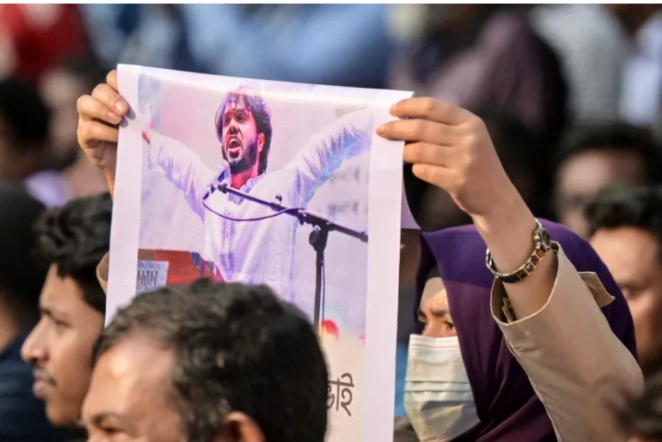
Eyewitnesses said a motorcycle approached Hadi’s vehicle, and gunfire rang out, prompting panic among bystanders in the densely populated Dhaka neighbourhood.
Hadi was rushed to Dhaka Medical College Hospital, where doctors stabilised him before recommending immediate evacuation due to critical brain stem damage.
On December 15, he was transferred to Singapore General Hospital and placed in the neurosurgical intensive care unit under constant medical supervision.
Despite initial hopes among supporters, medical sources later confirmed that Hadi’s condition deteriorated rapidly, leading to his death days after arrival.
Hadi, aged 32, was a senior leader of the student protest group Inqilab Mancha, which played a prominent role during Bangladesh’s 2024 political upheaval.
The student-led uprising eventually toppled long-serving Prime Minister Sheikh Hasina, reshaping Bangladesh’s political trajectory and empowering younger activist movements.
Hadi emerged as one of the uprising’s most recognisable faces, frequently addressing crowds and engaging international media during the months of mass demonstrations.
Supporters described him as articulate, uncompromising, and fearless, qualities that elevated his standing within both student circles and broader opposition politics.
Political analysts had recently identified Hadi as a potential independent candidate for the Dhaka-8 constituency ahead of February’s national elections.
His growing popularity reportedly unsettled powerful interests, according to allies, who claim his assassination was politically motivated and meticulously coordinated.
In a statement released on Facebook, Inqilab Mancha described Hadi as a martyr in their struggle against what they called foreign political domination.
The group’s statement framed his death as a defining moment for Bangladesh’s democratic movement, vowing to continue mobilisation despite rising risks.
Bangladesh police released photographs of two primary suspects believed to be involved in the shooting, urging the public to provide actionable information.
Authorities announced a reward of five million taka for information leading to arrests, signalling the seriousness of the ongoing nationwide manhunt.
Border guards and police units intensified operations near key transit points, amid concerns suspects may attempt to flee the country.
The Daily Star reported that at least 20 individuals connected to the attack have already been arrested, though investigators emphasised inquiries remain ongoing.
Condolences poured in from across Bangladesh’s political spectrum, highlighting Hadi’s influence beyond student activism into mainstream political discourse.
Interim government leader Muhammad Yunus described Hadi’s death as an irreparable national loss during a televised address to the nation.
Yunus insisted that fear, violence, and bloodshed would not derail Bangladesh’s democratic transition ahead of the upcoming general elections.
The interim administration announced a half-day national mourning period and special prayers across mosques following Friday congregational services.
Opposition parties, including the Bangladesh National Party, issued statements expressing grief and solidarity with Hadi’s family and supporters.
The BNP’s acting chairman acknowledged Hadi as a symbol of youthful political courage and democratic aspiration during Bangladesh’s turbulent transition.
Protests erupted almost immediately after news of Hadi’s death spread, with demonstrators gathering across Dhaka and other major cities nationwide.
Angry crowds targeted prominent media outlets, accusing them of bias and complicity amid the country’s polarised political climate.
Footage showed protesters forcing entry into newspaper offices, setting fires, and clashing verbally with security personnel stationed nearby.
Soldiers and paramilitary forces were deployed but initially refrained from dispersing crowds, drawing criticism and praise from opposing political camps.
Yunus later described the assassination as a premeditated act by a powerful network seeking to sabotage the electoral process.
He characterised the killing as symbolic, warning that destabilisation efforts aim to undermine public confidence ahead of February’s vote.
The Bangladesh student protests leader dies narrative has now become a rallying point for activists demanding accountability, transparency, and swift justice.
International observers have expressed concern that escalating violence could threaten Bangladesh’s fragile transition following years of political unrest.
Human rights groups called for an independent investigation, urging authorities to protect activists, journalists, and opposition figures from targeted violence.
Hadi’s death underscores the enduring dangers faced by political organisers in volatile environments where power struggles remain unresolved.
Read also: Morocco accused of horrific abuse as Gen Z 212 protesters face mass arrests, beatings and fear
For many young Bangladeshis, his killing represents both a tragic loss and a sobering reminder of the costs of political engagement.
As investigations continue, Bangladesh confronts a defining test of whether democratic promises can withstand intimidation, violence, and unresolved grievances.
The coming weeks will likely determine whether justice for Hadi strengthens democratic institutions or deepens the country’s political fault lines further.
About The Author


