Arsenal’s attacking balance has become one of the most talked-about themes surrounding Mikel Arteta’s side after a performance that highlighted the growing depth and tactical flexibility within the squad.
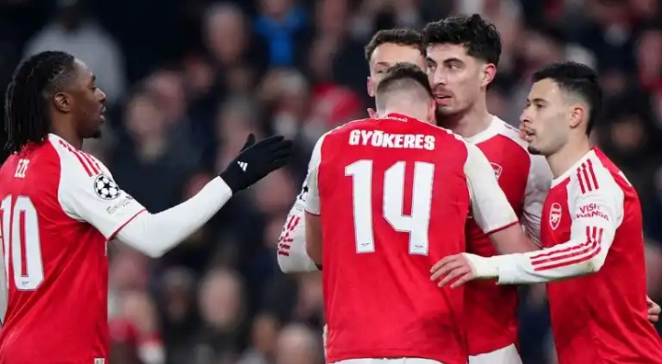
Kai Havertz and Viktor Gyokeres both got on the scoresheet as Arsenal completed a perfect Champions League league phase by beating bottom club Kairat Almaty 3-2.
The combination of Kai Havertz and Viktor Gyokeres offered a glimpse of a more fluid, unpredictable forward line, while Eberechi Eze’s influence added further weight to the argument that Arsenal’s evolution is accelerating at a crucial stage of the season.
From the opening exchanges, it was clear that Arsenal’s attacking structure looked different. Havertz’s presence higher up the pitch changed the rhythm of Arsenal’s build-up play, while Gyokeres thrived on the space and movement created around him.
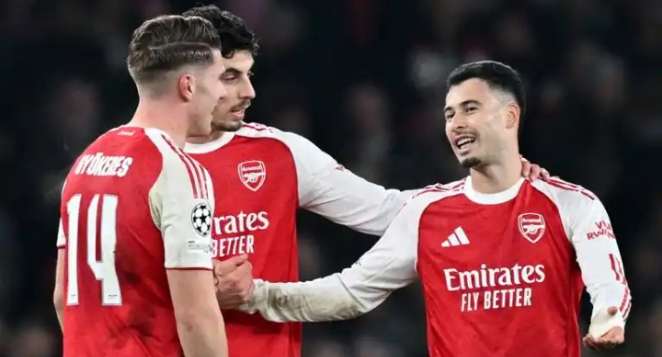
Between them, the pair registered 15 touches inside the opposition box in the first half alone, a statistic that underlined how effectively they stretched defensive lines and created constant pressure.
Gyokeres, in particular, appeared to benefit from Havertz operating close by. The Swedish forward’s strength, timing, and direct running were complemented by Havertz’s intelligent movement and ability to link play.
Rather than occupying fixed positions, the two forwards interchanged frequently, forcing defenders into uncomfortable decisions and opening passing lanes that Arsenal have sometimes struggled to create this season.
Speaking after the match, former striker Kris Boyd suggested that Havertz’s performance may have done enough to earn him a starting role in the next fixture.
“I wouldn’t be surprised if Havertz starts against Leeds,” Boyd said. “He brought something different to Arsenal’s attack, and you could see how much space that created for the players around him.”
For Havertz, the performance carried extra significance.
After waiting 358 days for an Arsenal start, the sense of urgency in his game was obvious. He pressed aggressively, made early runs into the box, and showed a willingness to occupy physical spaces that Arsenal have sometimes lacked presence in.
His next opportunity may even come as soon as Saturday, with Arteta now faced with the question of whether he can leave that performance unrewarded.
The broader implication is that Arsenal’s attacking balance is no longer reliant on one fixed formula. In recent seasons, Arteta has often leaned heavily on established combinations, but the emergence of alternative partnerships gives him the freedom to tailor his approach depending on the opponent.
Gyokeres’ physicality and Havertz’s tactical intelligence offer a different dynamic compared to Arsenal’s more technical, possession-heavy setups.
Eberechi Eze’s contribution only added to that sense of depth. While much of the focus naturally fell on the forward pairing, Eze quietly delivered one of the most complete performances on the pitch.
He created more chances than any other player, registering six key opportunities, but his work without the ball was equally impressive. Twelve ball recoveries highlighted his defensive commitment and ability to contribute to Arsenal’s overall balance.
Eze’s performance challenged the long-held perception that creative players must sacrifice defensive discipline. Instead, he demonstrated that attacking flair and tactical responsibility can coexist.
His willingness to track back, press intelligently, and recover possession allowed Arsenal to maintain control during transitional moments, preventing the opposition from exploiting gaps left behind by attacking movements.
Arteta has consistently spoken about the importance of “collective responsibility,” and Eze’s display embodied that philosophy. As one coach close to the club put it, “What impressed the staff most wasn’t just the chances he created, but how often he won the ball back. That’s what makes a player complete in this system.”
However, these strong performances inevitably raise difficult questions for the manager. Mikel Arteta has regularly stood by Martin Ødegaard, who celebrated his fifth anniversary as an Arsenal player this week. Ødegaard’s leadership, consistency, and technical quality have made him a central figure in Arteta’s project, and his influence on and off the pitch remains significant.
Yet football rarely allows sentiment to outweigh form. With other options knocking on the door, the pressure is building. Havertz offers a different physical profile, Eze provides creativity blended with defensive work, and Gyokeres adds directness and power. Arteta must now decide how long he can continue to stand by his trusted lieutenant without risking stagnation in certain areas of the pitch.
Arteta himself has previously addressed such dilemmas, saying, “Competition is essential. If players feel comfortable, that’s when standards drop. I want them pushing each other every day.”
Those words now feel particularly relevant as Arsenal approach a decisive run of fixtures.
The timing of this internal competition could hardly be more critical. With domestic and European commitments intensifying, squad rotation and tactical flexibility will play a major role in determining Arsenal’s success. The Champions League knockout stages loom large, and Arteta will need every option firing if Arsenal are to progress deep into the competition.
The upcoming European schedule adds further context to these selection debates. The Champions League knockout phase play-off draw takes place at 11am UK time on Friday, setting the stage for Arsenal’s next continental challenge.
From there, the road ahead is clearly mapped out, with the round of 16, quarter-finals, and semi-finals draw scheduled for February 27.
The knockout play-offs will be played across February 17-18 and 24-25, followed by the round of 16 on March 10-11 and 17-18. Quarter-finals are set for April 7-8 and 14-15, with the semi-finals taking place on April 28-29 and May 5-6. The final will be held on May 30 at the Puskás Aréna in Budapest, Hungary, a destination Arsenal will be desperate to reach.
In this context, the importance of Arsenal’s attacking balance becomes even clearer. European football often demands adaptability, and teams that rely on a single attacking blueprint are easier to neutralise over two-legged ties.
The versatility shown by Havertz, Gyokeres, and Eze suggests Arsenal are developing the tools needed to respond to different tactical challenges.
Former players have already begun to notice the shift. One ex-Arsenal midfielder noted, “What’s interesting now is that Arsenal can hurt you in more than one way. They can dominate possession, but they can also be direct and physical when they need to be. That wasn’t always the case.”
For Arteta, the challenge will be maintaining harmony while making tough calls. Dropping established players is never easy, particularly those who have contributed significantly to the club’s recent progress.
But elite management often comes down to timing, and the sense is growing that Arsenal are entering a phase where evolution is essential rather than optional.
As the Leeds fixture approaches, all eyes will be on Arteta’s team selection. Whether Havertz is rewarded with a start, how Gyokeres is integrated, and where Eze fits into the system will provide valuable clues about the manager’s thinking. What is clear is that Arsenal’s attacking balance is no longer a theoretical discussion—it is a practical dilemma with real consequences.
If managed correctly, this depth could propel Arsenal to sustained success across competitions. If mishandled, it risks frustration and missed opportunities.
For now, though, optimism prevails. The performances on display suggest a squad growing in confidence, variety, and ambition, precisely when it matters most.
Read also: Manchester United denied Ruben Neves swoop with Al-Hilal set to secure new deal