

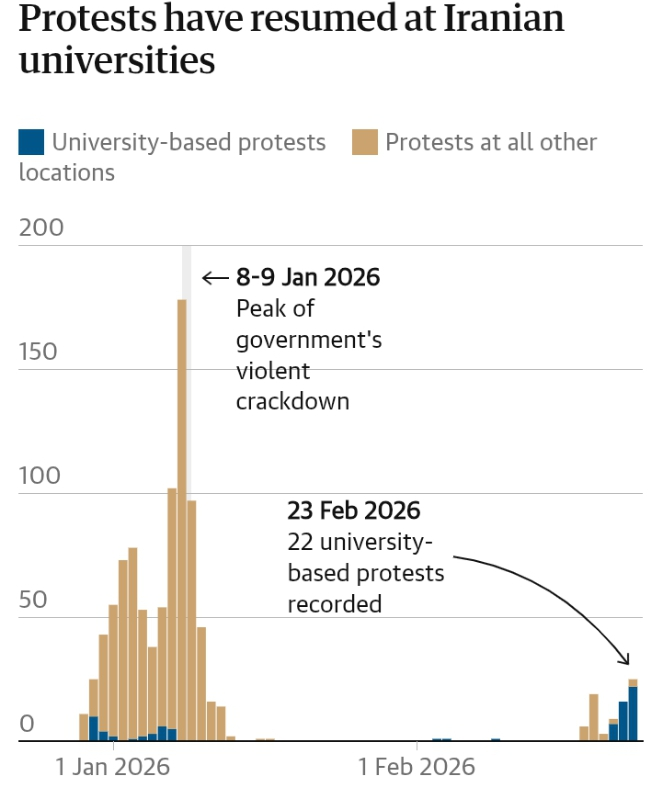
Armed police flood Iran’s universities to crush student protests, intensifying a volatile confrontation between security forces and young demonstrators across major campuses nationwide this week.
Security units, including plainclothes officers and members of the paramilitary Basij, were deployed in large numbers to universities in Tehran and other cities, seeking to quell a fourth consecutive day of unrest.
Clashes were reported at the University of Science and Technology and near the University of Tehran, where videos circulating online showed scuffles between students and security personnel.
Witnesses described pick-up trucks mounted with heavy weapons stationed outside campus gates, underscoring the authorities’ determination to prevent gatherings that could swell into larger anti-government demonstrations.
Protests also spread to Mashhad, reflecting widening frustration among students over political repression and the broader climate of fear that has followed earlier nationwide unrest.
University administrators barred entry to students previously identified in demonstrations, while many institutions shifted to virtual classes to limit opportunities for physical assemblies and organized dissent.
Nearly 80 percent of universities nationwide are reportedly operating partially or fully online, a measure critics argue is designed primarily to disrupt protest networks.
Chants captured in videos from the University of Art in Tehran called for political prisoners to be freed and denounced Supreme Leader Ali Khamenei in stark, confrontational language.
The campus unrest unfolds days before a third round of negotiations over the Iran nuclear programme scheduled in Geneva, adding pressure to an already fragile diplomatic track.
Iran’s foreign minister Abbas Araghchi is due to meet US special envoy Steve Witkoff in talks mediated by Oman.
The negotiations are seen as pivotal in determining whether tensions between Tehran and Washington escalate further or return to a negotiated framework limiting uranium enrichment.
US President Donald Trump has signalled that failure to reach a deal could result in severe consequences, warning that it would be a “very bad day” for Iran.
His remarks have been widely discussed within Iran, with some interpreting them as acknowledgment that military action would carry heavy costs for ordinary Iranians.
Reports in Washington suggested senior military officials, including Joint Chiefs chair Dan Caine, had cautioned about operational and regional risks tied to potential strikes.
Read also:Mapping Russian attacks, territorial gains across Ukraine over four years
The White House has emphasised that diplomacy remains the preferred option, though US naval and air assets have reportedly been repositioned within reach of Iranian territory.
Inside Iran, Attorney General Mohammad Mohebi Azad called for swift identification and punishment of protest organisers, accusing them of acting under foreign influence.
He argued that unrest tends to spike when Iran enters negotiations, suggesting hostile external actors aim to weaken the country’s bargaining position.
Analysts say the leadership’s rhetoric has shifted toward a more confrontational tone, drawing on Shia historical narratives emphasising resistance over compromise.
Such language resonates deeply within Iran’s political culture, reinforcing a narrative that frames external pressure as an existential struggle rather than a transactional dispute.
Human rights organisation HRANA published a report this week listing more than 7,000 people it says were killed during January’s nationwide protests.
Iranian authorities dispute that figure, acknowledging fewer deaths and attributing discrepancies to registration inconsistencies and unidentified individuals.
The scale of the reported casualties continues to fuel anger among segments of the population, particularly students who have historically played a central role in political activism.
University campuses in Iran have long served as flashpoints during periods of national tension, acting as incubators for reformist and opposition movements.
The heavy security presence has heightened fears of further violence, though protests have persisted despite closures and threats of disciplinary action.
Diplomats monitoring the Geneva talks say the domestic crackdown complicates Tehran’s negotiating posture, potentially narrowing room for compromise.
One key sticking point remains whether Iran will retain limited enrichment capacity for civilian purposes, including medical research, under any new agreement.
Hardliners within Iran argue that relinquishing enrichment rights would signal weakness, while reformist voices warn that isolation could deepen economic hardship.
The broader regional context also weighs heavily, with neighbouring states wary of escalation and global markets sensitive to disruptions in energy supplies.

As armed police flood Iran’s universities to crush student protests, the intersection of domestic unrest and high-stakes diplomacy underscores the precarious moment facing the country.
Whether the authorities succeed in silencing campus dissent or whether negotiations in Geneva yield a breakthrough may shape Iran’s trajectory in the months ahead.


