Raw materials export soars, despite push for local processing
Nigeria’s ambition to transition from a commodity-dependent economy to a value-added industrial powerhouse is facing renewed scrutiny as fresh data reveal that raw materials export soars, despite push for local processing, hitting record levels in 2025.
Latest figures released by the National Bureau of Statistics show that exports of unprocessed raw materials surged to ₦2.9 trillion in the first nine months of 2025 (9M’25), representing a 147.4 per cent increase from ₦1.174 trillion recorded in the corresponding period of 2024.
The numbers have intensified debate within policy and industrial circles, particularly as the Federal Government continues to champion backward integration, local beneficiation, and domestic manufacturing expansion.
Sharp quarterly rise
A breakdown of the statistics underscores the pace of acceleration. In Q1’25, raw materials exports stood at ₦1.045 trillion compared to ₦439.8 billion in Q1’24. Q2’25 recorded ₦819.7 billion, more than double the ₦381.7 billion achieved in Q2’24.
By Q3’25, exports climbed again to ₦1.04 trillion, dwarfing ₦352.7 billion posted in the same quarter of the previous year.
Compared to 9M’23, when exports totalled ₦564.7 billion, the 2025 performance marks a staggering 442.8 per cent increase.
Major commodities driving the surge include cocoa beans, raw cashew nuts, sesame seeds, ginger, rubber, palm kernel oil, raw lead ores, urea, and non-monetary gold. Key destinations remain India, Spain, and the Netherlands, among others.
While the spike has boosted short-term foreign exchange inflows, economists warn that the development reinforces structural weaknesses in Nigeria’s industrial base.
Policy contradiction
The surge comes at a time when policymakers are pushing aggressive reforms aimed at reducing the export of primary commodities without processing.
Institutions such as the Raw Materials Research and Development Council have championed legislative measures requiring exporters to meet minimum value-addition thresholds before shipment.
A bill currently before the National Assembly proposes a mandatory 30 per cent local value addition on all raw materials prior to export.
The proposed legislation stipulates penalties, including a 15 per cent levy on export value and possible suspension of operating certificates for non-compliance.
Proponents argue that the framework aligns with regional directives under ECOWAS promoting value addition as a condition for preferential trade benefits.
Manufacturers back value addition
The Manufacturers Association of Nigeria has thrown its weight behind the proposal, describing the current export pattern as detrimental to industrial growth.
Director-General Segun Ajayi-Kadir stated that exporting unprocessed materials reduces opportunities for job creation, limits technological development, and weakens domestic supply chains.
According to MAN, enforcing a minimum processing threshold would stimulate investments in agro-processing, mining beneficiation, and light manufacturing.
Industrial advocates maintain that domestic processing generates multiplier effects—ranging from employment expansion to improved tax revenues and foreign exchange stability.
Mixed reaction from LCCI
However, the Lagos Chamber of Commerce and Industry has described the development as a “mixed outcome.”
Director-General Dr. Chinyere Almona acknowledged that the 147.4 per cent surge reflects strong global demand and improved export logistics. Yet she cautioned that reliance on primary commodities exposes the economy to volatile global price cycles and undermines long-term industrial diversification.
Almona emphasised that backward integration objectives risk being compromised when locally sourced raw materials are exported instead of feeding domestic factories.
She warned that re-importing finished goods derived from Nigerian commodities at higher prices worsens the trade balance and weakens manufacturing competitiveness.
CPPE raises implementation concerns
In contrast, the Centre for the Promotion of Private Enterprise urged caution against rigid enforcement of value-addition mandates.
Chief Executive Officer Dr. Muda Yusuf argued that compulsory domestic processing could distort markets if adequate infrastructure and competitive processing capacity are not already in place.
He highlighted persistent structural constraints, including unstable electricity supply, port congestion, high logistics costs, and limited access to affordable financing.
According to CPPE, policy enforcement without parallel improvements in industrial infrastructure may disrupt commodity markets and penalise producers lacking immediate processing options.
The data showing that raw materials export soars, despite push for local processing, reflect deeper systemic challenges. Nigeria’s manufacturing sector continues to grapple with energy deficits, foreign exchange volatility, and high borrowing costs.
Many agro-processors operate below optimal capacity due to unreliable power supply and insufficient technology adoption.
Additionally, quality standards required in international finished-goods markets often demand significant capital outlay for compliance, certification, and packaging upgrades.
Without addressing these barriers, analysts say value-addition mandates could inadvertently encourage smuggling or shift exports through informal channels.
Economists stress that exporting raw materials provides immediate liquidity but sacrifices long-term economic gains. Processed goods typically command higher margins, generate skilled employment, and strengthen industrial ecosystems.
By exporting cocoa beans instead of processed chocolate or cashew nuts instead of packaged kernels, Nigeria captures only a fraction of the potential value chain.
Moreover, the persistent pattern contributes to currency vulnerability. Exporting low-value commodities while importing finished products denominated in stronger currencies exerts pressure on the naira and fuels imported inflation.
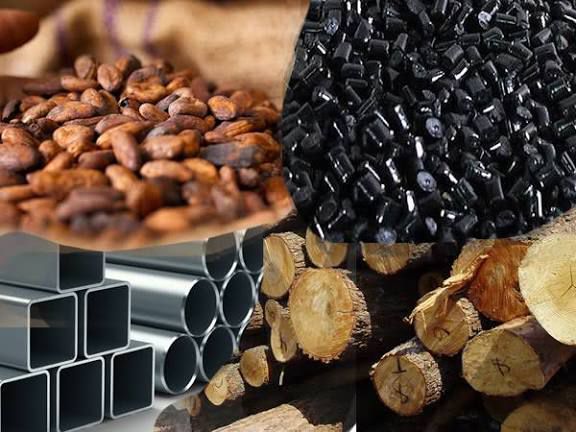
The debate over whether raw materials export soars, despite push for local processing, underscores the complexity of Nigeria’s industrial transformation agenda.
Stakeholders broadly agree on the objective: increase domestic processing, diversify exports, and build resilient manufacturing capacity. The divergence lies in execution strategy.
Experts recommend a phased approach—gradually implementing value-addition requirements while simultaneously investing in industrial clusters, power infrastructure, concessional financing schemes, and export quality certification support.
If effectively coordinated, Nigeria could shift from being primarily a supplier of raw inputs to a competitive exporter of finished and semi-finished goods.
For now, the data reveal a paradox: while policy rhetoric prioritises industrialisation, export patterns remain heavily commodity-driven. Bridging that gap will determine whether the country can convert resource wealth into sustainable economic expansion.
About The Author