US woman killed by ICE agent – The killing of a US woman by an ICE agent after she was publicly branded a domestic terrorist has ignited a nationwide debate over the misuse of security language, the limits of law enforcement authority, and the broader implications for civil liberties in the United States.
The case, involving Minneapolis resident Renee Nicole Good, has drawn sharp criticism from legal experts, civil rights advocates, and state officials who argue that the domestic terrorist label was applied prematurely and without legal basis.
The incident occurred during an Immigration and Customs Enforcement operation in Minneapolis, a city that has recently seen intensified federal immigration activity.
Renee Nicole Good, a US citizen and mother of three, was fatally shot by an ICE officer after an encounter that the Department of Homeland Security initially described as an act of domestic terrorism.
Homeland Security Secretary Kristi Noem claimed that Good refused to comply with officers’ commands, weaponised her vehicle, and attempted to run over a federal agent.
However, this account has been challenged by Minnesota officials and video evidence that appears to show Good attempting to drive away from the scene rather than deliberately targeting officers.
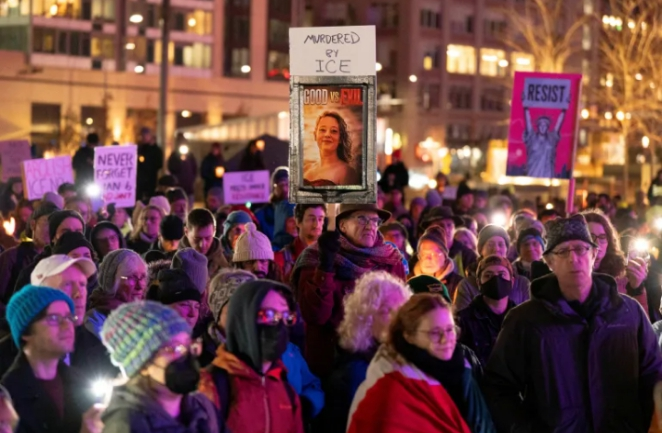
The US woman killed by ICE agent after being branded domestic terrorist quickly became the focus of protests and vigils across Minneapolis and other US cities.
Demonstrators gathered to demand accountability, transparency, and an independent investigation into the shooting, while critics accused federal authorities of using inflammatory language to justify lethal force.
Minnesota Attorney General Keith Ellison publicly rejected the characterisation of Good as a domestic terrorist, describing the label as an abuse of terminology that carries severe legal and moral weight.
Ellison argued that domestic terrorism is a narrowly defined concept under US law and should not be applied casually, particularly in the absence of evidence showing intent to intimidate civilians or coerce government policy through violence.
Good’s background further complicated the government’s narrative. According to reports, she had no criminal record, was not known to be politically active, and had just dropped her six-year-old son off at school before encountering ICE officers.
Family members described her as a poet and a devoted mother, not an activist or extremist. These details have fueled public skepticism about the decision to frame her actions within the context of domestic terrorism.
Legal experts note that while federal agencies such as the FBI and the Department of Homeland Security maintain working definitions of domestic terrorism, the United States does not have a standalone criminal charge for domestic terrorism.
Instead, prosecutors rely on a patchwork of existing statutes to address acts that may fall under the terrorism umbrella. This legal reality makes public designations especially sensitive, as they can prejudice investigations and shape public perception long before facts are fully established.
The US woman killed by ICE agent after being branded domestic terrorist has also brought renewed attention to the Trump administration’s evolving use of national security language.
In recent months, federal authorities have increasingly applied the domestic terrorism label to incidents connected to immigration enforcement, protests, and political unrest.
Critics argue that this expansion risks blurring the line between criminal behavior and constitutionally protected activities such as protest and dissent.
In a previous case cited by analysts, a US citizen was similarly labeled a domestic terrorist following a confrontation with federal agents during an immigration crackdown in Chicago.
That case ultimately saw federal charges dismissed after a judge raised concerns about inconsistencies in officers’ accounts. Legal scholars point to such outcomes as evidence that rhetoric is outpacing legal standards.
Civil liberties organisations warn that the consequences of misusing terrorism terminology extend beyond individual cases.
Labeling someone a domestic terrorist can influence media coverage, justify aggressive policing tactics, and chill free expression.
Read also: One dead, 300 structures destroyed, 350,000 hectares burned as bushfire ravaged town in Australia
It can also disproportionately affect marginalized communities, particularly in areas experiencing heightened federal enforcement operations.
Video analysis conducted by major US media outlets has played a critical role in challenging the official narrative surrounding Good’s death.
Frame-by-frame reviews suggest that while her vehicle did move toward an ICE agent, the officer was able to step aside and fire shots from the side of the car as it veered away.
Experts say this raises serious questions about whether the use of deadly force was justified and whether the encounter meets any reasonable threshold for terrorism.
The Department of Homeland Security has defended Secretary Noem’s remarks, arguing that federal officers face increasing threats during enforcement operations.
However, former Justice Department officials counter that the appropriate response to such risks is improved training, clearer rules of engagement, and accountability, not the broad application of politically charged labels.
The FBI has since taken over the investigation into the shooting, a move welcomed by state leaders seeking an independent review.
Transparency advocates stress that public trust in law enforcement depends on clear communication, adherence to legal definitions, and restraint in public statements by senior officials.
The US woman killed by ICE agent after being branded domestic terrorist case has also reignited debate over the balance between immigration enforcement and community safety.
Minneapolis, home to a large immigrant population, has seen heightened tensions following reports of fraud investigations linked to local daycare centers.
Community leaders argue that aggressive enforcement tactics risk alienating residents and undermining cooperation with authorities.
From a constitutional perspective, scholars emphasize that intent is a core component of terrorism definitions. Acts must be aimed at intimidating or coercing civilians or influencing government policy through violence.
Absent clear evidence of such intent, applying the domestic terrorism label can be misleading and legally unsound.
Stanford Law School professor Shirin Sinnar noted that while deliberately using a vehicle as a weapon for political purposes could qualify as terrorism in some contexts, available footage in this case appears to show an attempt to flee rather than attack.
She and other experts argue that framing the incident as terrorism serves more to justify the outcome than to accurately describe the conduct involved.
Beyond the courtroom, the political ramifications are significant. Critics accuse the administration of selectively emphasizing certain forms of political violence while downplaying others, raising concerns about ideological bias in enforcement priorities. Such perceptions, experts warn, can erode the legitimacy of counterterrorism efforts and deepen partisan divides.
As vigils continue and investigations proceed, the death of Renee Nicole Good stands as a flashpoint in the ongoing national conversation about law enforcement accountability, civil rights, and the power of language in shaping justice.
Whether the case results in criminal charges or policy reforms remains to be seen, but its impact on public discourse is already profound.
The US woman killed by ICE agent after being branded domestic terrorist has become more than a single tragic encounter.

It is now a symbol of broader questions facing American democracy: who gets labeled a threat, who decides, and what safeguards exist to prevent the misuse of the most severe accusations in the government’s arsenal.