Iran protests live update reports indicate rising tension across the country as Tehran warns it will retaliate against the United States and Israel if attacked, while nationwide antigovernment demonstrations driven by economic collapse and political grievances continue to intensify.
The unrest, now entering its third week, has left scores dead, crippled infrastructure in major cities, and pushed Iran into one of its most volatile moments since the 2022 protest movement.
The Iranian government, led by President Masoud Pezeshkian, has adopted a dual approach of conciliation and force.
While the president has publicly called for unity and promised sweeping economic reforms, state institutions and security forces have intensified their crackdown on protesters, citing what they describe as “foreign-backed violence” aimed at destabilising the Islamic Republic.

At the same time, Iran’s leadership has escalated its rhetoric abroad. Senior officials and the Islamic Revolutionary Guard Corps (IRGC) have accused Washington and Tel Aviv of fomenting unrest, warning that any external military action would be met with swift retaliation.
These warnings followed remarks by US President Donald Trump, who said he would consider striking Iran if protesters continued to be killed during the security crackdown.
The protests erupted in late December after the Iranian rial suffered a dramatic collapse, plunging to record lows against the US dollar.
Years of sanctions, restricted access to international markets, and frozen foreign assets have left Iran’s economy fragile, with the sudden currency crash triggering sharp inflation across essential goods. Food prices have reportedly risen by more than 70 percent year on year, while wages have failed to keep pace.
What began as demonstrations over rising living costs quickly evolved into broader political protests. Crowds gathered in Tehran, Mashhad, Isfahan, Shiraz and dozens of other cities, chanting against corruption, mismanagement and the political system itself.
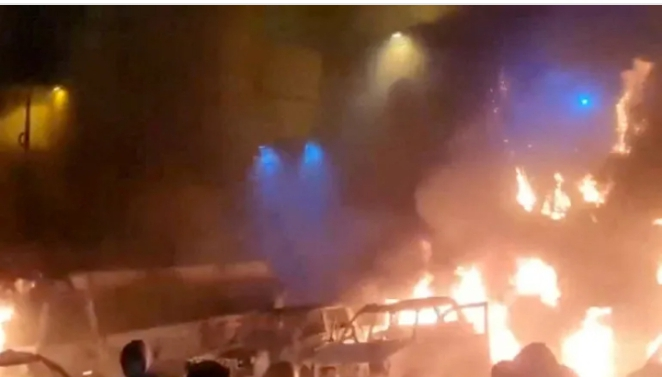
Videos circulating on social media, despite heavy internet restrictions, have shown burning vehicles, damaged public buildings and confrontations between demonstrators and security forces.
Iranian authorities say the violence has crossed a “red line”. The semiofficial Tasnim news agency reported that at least 109 security personnel have been killed since the unrest began, alleging that armed rioters attacked police stations, mosques and emergency services.
Opposition groups outside the country dispute these figures, claiming the overall death toll is far higher and includes hundreds of protesters killed by security forces.
Independent verification remains extremely difficult. Iran has imposed widespread internet blackouts, limiting journalists’ access and preventing the flow of reliable information.
Nevertheless, newsmedia has reviewed footage showing dozens of body bags outside a crowded morgue in Tehran, suggesting that fatalities may be mounting beyond official figures. The timing of the footage could not be independently confirmed.
International concern has grown rapidly. United Nations Secretary-General Antonio Guterres said he was “shocked” by reports of excessive force against protesters and urged Iranian authorities to exercise maximum restraint.
In a statement issued by his spokesperson, Guterres called on Tehran to avoid unnecessary or disproportionate violence and to respect the rights of civilians.
Despite these calls, Iran’s security establishment has doubled down. The IRGC’s intelligence organisation released a statement condemning what it described as “terrorist acts” committed during the protests and warned that continued unrest was unacceptable.
The statement asserted that the Iranian people had a legitimate right to defend themselves against insecurity, language that analysts say could be used to justify further crackdowns.
State-linked media have also reported extensive damage to infrastructure. Tasnim claimed that approximately 150 ambulances were destroyed during recent unrest, alleging that healthcare facilities were deliberately targeted.
Each ambulance was valued at tens of thousands of dollars. Al Jazeera has been unable to independently verify these claims.
The government’s narrative centres on foreign interference. Iranian officials argue that the protests are not purely spontaneous but are being exploited or directed by hostile powers seeking regime change.
According to political analysts, this belief has hardened following Iran’s recent confrontation with Israel and the United States during last year’s brief but deadly regional conflict.
Vali Nasr, a professor of international affairs and Middle East studies at Johns Hopkins University, told newsmen that Iran’s leadership genuinely believes it is under siege.
He said Tehran views the protests as part of a broader strategy by its adversaries to weaken the state internally after failing to defeat it militarily.
However, Nasr noted that even without external involvement, the depth of public anger poses a serious challenge. Years of economic decline, corruption allegations and political repression have eroded public trust.
“Blood has been shed, people are very angry,” he said, adding that the government currently lacks a credible pathway to quickly improve economic conditions or address broader grievances.
President Pezeshkian has attempted to strike a softer tone than some of his predecessors.
In a nationally televised address, he called for unity and pledged an overhaul of the sanctions-hit economy, promising reforms aimed at stabilising the currency, reducing inflation and protecting vulnerable households.
Critics, however, remain sceptical, noting that similar pledges have been made in the past with limited results.
The protests have also reignited debates over symbols of opposition. In recent demonstrations inside and outside Iran, some protesters have waved the pre-1979 Iranian flag featuring the lion and sun, a symbol closely associated with the monarchy.
Analysts say the flag’s reappearance reflects the fragmented nature of Iran’s opposition rather than a unified call for the return of the shah.
Historian Reza H Akbari has described the flag as deeply contentious, often linked to monarchist movements abroad. Reza Pahlavi, the son of Iran’s last shah, has publicly encouraged protests and offered to act as a transitional figure should the Islamic Republic fall, though many analysts doubt his ability to unite the country or command widespread support inside Iran.
The role of technology has also drawn attention. Billionaire Elon Musk weighed in earlier this month, mocking Iran’s supreme leader on social media and enabling changes to Iran’s flag emoji on his platform, X.
During previous protest waves, Musk’s Starlink satellite service provided limited internet access to Iranians, though authorities have reportedly jammed signals during the current unrest.
On the streets, the human toll continues to mount. Protesters describe shortages of food, medicine and fuel, while families mourn loved ones killed or detained.
Human rights groups report mass arrests, enforced disappearances and harsh interrogations, claims that Iranian authorities deny.
The unfolding crisis has placed Iran at a crossroads. While the government insists it retains control and accuses foreign enemies of stoking chaos, the scale and persistence of the protests underscore deep structural problems.
With economic pressure mounting and international scrutiny intensifying, analysts warn that the coming weeks could prove decisive for Iran’s political stability.
As the Iran protests live update continues to evolve, one thing remains clear: the combination of economic despair, political frustration and escalating rhetoric at home and abroad has created a volatile situation with consequences that may extend far beyond Iran’s borders.