

The US shifts North Korea deterrence responsibility toward South Korea under a new Pentagon defence strategy that signals a reduced frontline role for American forces while urging Seoul to take primary charge of countering Pyongyang’s military threat.
The policy direction, outlined in a recently released US defence strategy document, represents a notable adjustment in Washington’s approach to security on the Korean peninsula and is likely to provoke debate within South Korea’s political and defence circles.
South Korea currently hosts approximately 28,500 US troops stationed across multiple bases, forming the backbone of a long-standing combined deterrence framework aimed at preventing aggression from North Korea.
Despite the continued presence of American forces, South Korea has significantly expanded its own defence capabilities, approving a 7.5% increase in military spending for the current year as it accelerates modernisation efforts.
According to the strategy document, South Korea is now assessed as capable of assuming primary responsibility for deterring North Korea, provided it continues to receive targeted and strategic support from the United States.
The Pentagon describes this recalibration as consistent with broader efforts to update US global force posture in response to changing security priorities and emerging threats.
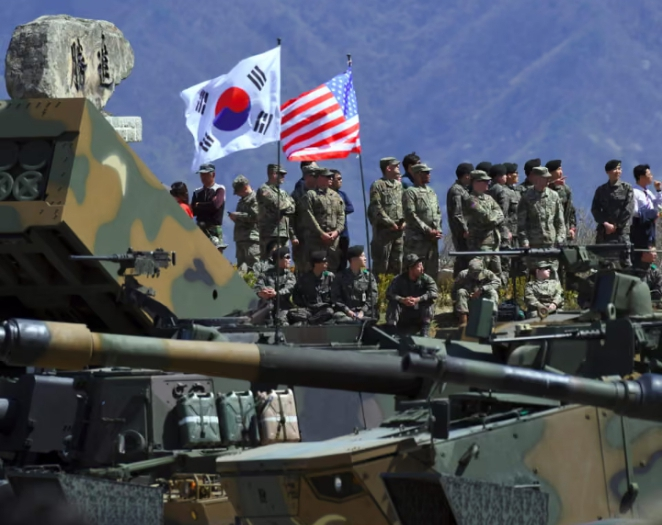
US defence officials have increasingly argued that American troops stationed overseas must be more flexible, enabling rapid redeployment to other theatres if required.
This thinking reflects growing concern in Washington about challenges posed by China, particularly in the Indo-Pacific region, where military planners are focused on preventing any single power from achieving regional dominance.
As a result, US forces in South Korea are viewed not only through the lens of peninsula defence but also as part of a wider strategic balance across East Asia.
South Korean authorities have historically opposed any reduction in the role of US troops, warning that changes to deterrence arrangements could undermine stability and embolden North Korea.
However, Seoul has simultaneously pursued long-term plans to strengthen its independent military capacity, including preparations to assume wartime operational control of combined forces.
South Korea maintains an active-duty force of around 450,000 personnel, supported by advanced air, naval, and missile defence systems designed to counter North Korean capabilities.
The strategy shift is framed as part of what Washington refers to as alliance modernisation, a concept that emphasises burden-sharing among allies rather than unilateral US commitments.
Under this approach, allies are expected to play a greater role in their own defence while the US concentrates on safeguarding its homeland and maintaining strategic balance globally.
South Korean president Lee Jae Myung has previously argued in favour of greater defence autonomy, criticising what he described as a belief that national security is impossible without foreign troops.
He has urged South Korea to rely more heavily on its own military strength while maintaining strong alliances.
Following the document’s release, South Korea’s defence ministry sought to reassure the public that US Forces Korea remain central to deterrence and alliance cooperation.
The ministry said the US commitment to deterring North Korean aggression had not changed, despite evolving roles and responsibilities.
Notably, the Pentagon document does not include language calling for the denuclearisation of the Korean peninsula, a departure from previous US policy statements.
Earlier strategies explicitly identified complete and verifiable denuclearisation as a core objective, raising questions about whether Washington is now prioritising nuclear risk management over disarmament.
Analysts suggest this shift reflects the reality that North Korea has entrenched itself as a nuclear-armed state despite decades of diplomatic pressure.
The defence strategy repeatedly underscores that the Pentagon’s foremost priority is defending the US homeland.
In the Indo-Pacific, the document highlights the need to prevent China from dominating the region or coercing US allies.
While Taiwan is not mentioned by name, the broader strategic context points to continued concern over cross-strait tensions and regional flashpoints.
China maintains its claim over Taiwan and has not ruled out the use of force, while Taiwan insists its future must be decided by its people.
For South Korea, the fact that the US shifts North Korea deterrence responsibility toward South Korea carries both opportunities and risks.
Greater autonomy could enhance military readiness and national confidence, but any perception of reduced US involvement may raise anxiety about long-term deterrence credibility.
Read also: Barron Trump FaceTime assault case heard in London Court
North Korea continues to test missiles and expand its weapons programmes, ensuring that security concerns remain acute.
How this strategic shift is implemented in practice will shape the future of the US–South Korea alliance and the stability of the Korean peninsula.
About The Author


