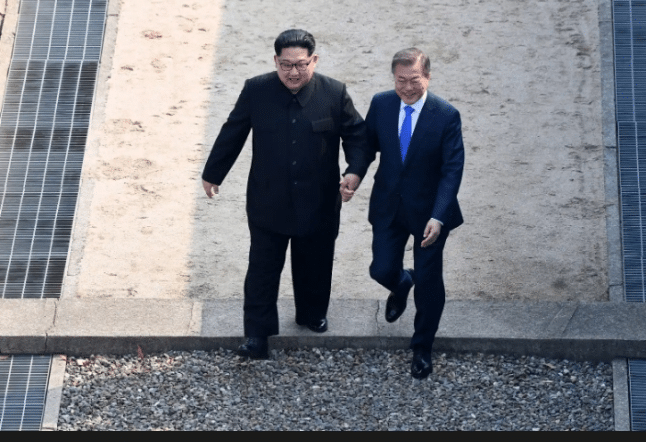
South Korea announced on Sunday that its forces detained a soldier from the North who crossed the fortified frontier, reigniting focus on fragile inter-Korean stability.
Officials confirmed the North Korean soldier defection occurred near the central section of the demarcation line dividing the peninsula. Troops observed his movement through thermal cameras before safely capturing him.
According to South Korea’s Joint Chiefs of Staff, the incident unfolded without armed conflict, though it immediately heightened regional security awareness and drew international attention.
Military authorities have launched a thorough investigation to uncover motives and assess the broader implications of this North Korean soldier defection, the first reported in more than a year.
The defector reportedly crossed under cover of early morning fog, taking advantage of gaps between surveillance zones within the mine-laden frontier stretching across the Demilitarized Zone tensions region.

Officials said he expressed his desire to defect once confronted by South Korean troops, who secured the area before escorting him for medical and psychological evaluation.
If officially confirmed, this North Korean soldier defection will add to decades of complex narratives involving individuals escaping repressive conditions within North Korea’s rigid political and military systems.
South Korea’s Yonhap News Agency cited sources saying the soldier appeared young, physically exhausted, and carrying minimal equipment, suggesting a sudden decision rather than a premeditated escape.
While the precise reasons remain unknown, analysts suggest growing hardships, fear of punishment, or disillusionment with the regime often drive such bold attempts to flee across the border.
Experts say the episode underscores lingering Demilitarized Zone tensions, which remain one of the world’s most fortified flashpoints, symbolizing unresolved hostilities from the Korean War’s uneasy armistice.
Since the 1950s, over thirty thousand North Koreans have fled the country, but direct military defections across the heavily guarded frontier remain rare and diplomatically sensitive.
The soldier’s familiarity with local terrain could have helped him navigate hidden minefields and motion sensors during the dangerous North Korean soldier defection, according to defense specialists.
Analyst Hong Min from the Korea Institute for National Unification noted that Pyongyang’s leadership will likely view the event as a serious ideological betrayal.
He warned that the soldier might provide Seoul with insights into troop deployments and communications, aggravating mistrust and complicating already fragile inter-Korean relations.
In previous years, similar incidents have sparked angry statements from Pyongyang, denouncing defectors as traitors and accusing Seoul of orchestrating propaganda campaigns.
This latest case comes amid South Korea’s shifting political climate, as President Lee Jae-myung pursues a softer diplomatic tone than his conservative predecessor Yoon Suk-yeol.
Lee’s administration has emphasized dialogue and humanitarian outreach, promising to open communication channels to reduce Demilitarized Zone tensions and pursue eventual peace negotiations with Pyongyang.
However, the Pyongyang response to such gestures has been cold. North Korea continues weapons testing, expanding its arsenal, and refusing overtures it perceives as conditional or insincere.
Observers believe the North Korean soldier defection could further sour relations, as Kim Jong Un’s regime often interprets defections as personal humiliations or intelligence vulnerabilities.
South Korea’s Defense Ministry stressed that no unusual movements had been detected on the northern side since the incident, indicating Pyongyang’s caution in addressing the matter publicly.
The United States, which maintains nearly 30,000 troops in South Korea, expressed confidence in Seoul’s handling of the case and reaffirmed its support for regional security stability.
Washington has urged both sides to avoid escalation, mindful of how minor incidents can spiral within the tense environment of border security in Korea.
In July, a North Korean civilian undertook a perilous 20-hour crossing into the South, aided by thermal imaging detection systems that prevented a fatal confrontation.
Such cases have reignited discussions about surveillance technology, troop readiness, and communication between commands responsible for maintaining the delicate balance along the demilitarized frontier.
The government said investigations will also focus on possible procedural lapses in border security in Korea, assessing whether existing deterrence systems require reinforcement.
This North Korean soldier defection is also expected to influence domestic debates over military spending, with opposition leaders demanding stricter monitoring of all potential infiltration routes.
Meanwhile, human rights groups have urged that the defector receive fair treatment and protection under international refugee standards, pending confirmation of his political status.
They argue that defectors often face trauma from years of indoctrination and isolation, requiring medical care and psychological counseling to adapt to life in the South.
The Pyongyang response is anticipated to be strongly negative, as previous defectors have been condemned on state television and accused of espionage or treachery.
Analysts suggest this development could temporarily freeze unofficial communication channels between the two Koreas, particularly military hotlines used to prevent accidental clashes.
Yet, some experts believe Seoul will use the North Korean soldier defection as an opportunity to advocate for renewed dialogue, highlighting shared security and humanitarian concerns.
The last military defector case occurred in August 2024, when another soldier crossed the frontier, prompting brief but sharp exchanges between both governments before fading diplomatically.
Since then, cross-border exchanges have diminished further, with North Korea sealing its territory tightly amid pandemic-related restrictions and ongoing economic difficulties.
The soldier’s successful escape underscores persistent cracks in Pyongyang’s internal morale, potentially revealing declining loyalty among younger conscripts, analysts say.
Meanwhile, domestic public opinion in South Korea appears divided, with conservatives warning against leniency and progressives urging compassion to improve inter-Korean relations.
The Lee administration has maintained that reconciliation must proceed cautiously, acknowledging the emotional and political sensitivities tied to every North Korean soldier defection.
Observers note that while symbolic, such incidents remind both sides that the unresolved war and divided peninsula still shape daily policy decisions and public sentiment.
Diplomatic observers hope the situation will not trigger further Pyongyang response provocations, such as missile tests or verbal assaults, which often accompany embarrassing defections.
As of Monday, officials said the soldier remained under military custody, receiving food and medical checks, while intelligence agencies assess any potential information value.
The international community will likely watch closely, viewing this North Korean soldier defection as both a human drama and a geopolitical signal amid an era of regional unpredictability.