The US pursues third oil tanker off the coast of Venezuela as Washington intensifies enforcement of sanctions targeting Caracas, escalating maritime operations and sharpening geopolitical tensions across the Caribbean region.
The operation unfolded in international waters near Venezuela, where US officials said coastguard assets remained actively pursuing a sanctioned vessel accused of evading restrictions.
According to a US official, the tanker is part of what authorities describe as Venezuela’s “dark fleet” operating beyond established monitoring and compliance systems.
The official added that the ship was allegedly sailing under a false flag and subject to an existing judicial seizure order under US sanctions law.
Reports from international news agencies indicated the vessel had not yet been boarded, noting that interceptions may include aerial surveillance or close naval manoeuvres.
US authorities declined to disclose the tanker’s precise location, citing operational sensitivity and the ongoing nature of the pursuit.
Maritime intelligence firm Vanguard identified the vessel as Bella 1, a very large crude carrier previously sanctioned by the US Treasury Department.
Treasury officials have linked Bella 1 to networks associated with Iran, alleging coordinated efforts to bypass oil export restrictions.
Data from tanker monitoring services showed the vessel was empty as it approached Venezuelan waters, suggesting preparations for a potential crude loading.
Documents from Venezuela’s state oil company PDVSA indicated Bella 1 transported Venezuelan oil to China during 2021.
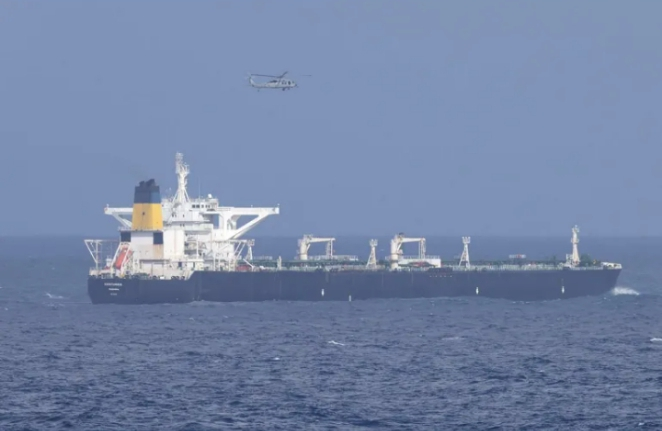
The vessel has also previously carried Iranian crude, according to ship tracking and monitoring records.
The latest pursuit follows the seizure of a second tanker just one day earlier, marking an accelerated enforcement phase.
That ship, the Panama-flagged Centuries, was intercepted by the US Coast Guard while carrying Venezuelan crude destined for China.
Officials said Centuries was transporting approximately 1.8 million barrels of Merey crude, a key Venezuelan export blend.
The seizure came under a “total and complete blockade” ordered by US President Donald Trump, targeting sanctioned tankers.
Washington argues the blockade aims to disrupt black market oil sales funding the Venezuelan government under President Nicolas Maduro.
US officials insist the measures are lawful responses to sanctions violations, not acts of aggression against Venezuela’s sovereignty.
Venezuela has sharply rejected that claim, condemning the seizures as acts of “international piracy” on the high seas.
Caracas maintains the United States lacks legal authority to confiscate foreign vessels in international waters.
Venezuelan officials accuse Washington of seeking regime change to gain control of the country’s vast oil reserves.
The country holds the world’s largest proven crude reserves, making its energy sector central to geopolitical competition.
The maritime operations coincide with a significant US military buildup across the Caribbean and Pacific regions.
US officials say the deployments support counter-narcotics missions, including dozens of strikes against alleged trafficking vessels.
Critics argue the operations blur the line between law enforcement and military escalation, raising serious legal questions.
Human rights groups say more than 100 people have been killed during recent US maritime interdictions.
Venezuela denies involvement in drug trafficking, calling the accusations a pretext for economic and political pressure.
White House officials defended the seizures, stating the confiscated ships were supplying oil to sanctioned countries.
Kevin Hassett, head of the National Economic Council, said the actions would not affect US fuel prices.
Hassett said the seized vessels were limited in number and operating entirely outside legal oil markets.
The first seized tanker, Skipper, is now docked off the Texas coast, where its crude is being offloaded.
That cargo reportedly totals about 1.9 million barrels and will be refined within the United States.
Venezuelan authorities argue this confirms accusations that the US is effectively taking control of their oil exports.
Observers noted that the Centuries itself was not directly sanctioned by the United States.
They added that Washington lacked a specific warrant for the vessel, despite claims its cargo was sanctioned oil.
The legality of confiscating oil produced by PDVSA remains a central dispute between Washington and Caracas.
The escalation has drawn criticism from within Trump’s own Republican Party in the US Congress.
Senator Rand Paul warned the seizures could provoke a broader conflict and potentially lead to war.
Paul said the US military should not act as a global police force or confiscate civilian shipping.
Analysts say rising tensions risk undermining international maritime norms and freedom of navigation principles.
Read more here: US seizes second oil tanker off Venezuela’s coast as tensions escalate over Trump blockade
Ernesto Castaneda, a Latin America affairs expert, said the US faces no direct security threat from Venezuela.
He warned that declaring war could enable sweeping domestic measures, including deportations under wartime laws.
Castaneda also noted ongoing US-Venezuela trade continues, particularly through licensed oil operations.
Most Venezuelan oil exports still head to China, underscoring the limited economic impact of individual seizures.
Despite the US pursues third oil tanker off the coast of Venezuela, analysts say most sanctioned shipments remain active.
The situation highlights deepening confrontation, with energy markets, international law, and regional stability increasingly entangled.
Meta description: The US pursues third oil tanker off the coast of Venezuela as Washington escalates sanctions enforcement, seizing vessels, provoking criticism, and heightening regional geopolitical tensions.