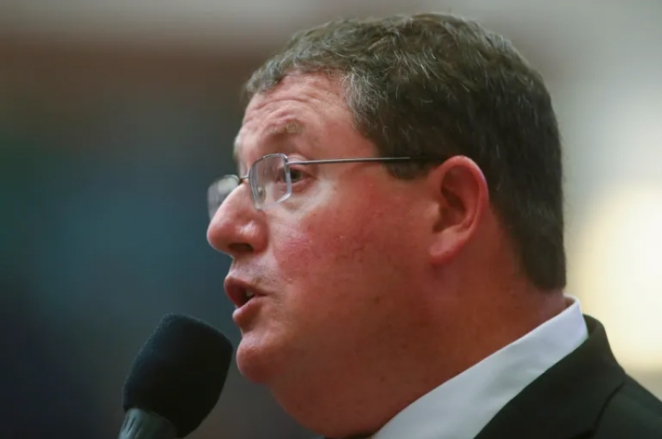
United States Congressman Randy Fine, a staunch Donald Trump ally, has ignited international condemnation after suggesting Palestinians should “be destroyed first” during a congressional hearing.
Fine, representing a Florida district, made the remarks while debating Middle East policies, openly stating he was unafraid of being labeled Islamophobic, drawing criticism from human rights groups.
During the hearing, Fine cited alleged restrictions on Israeli settlers in the West Bank, falsely framing the situation as an “apartheid” threat against Jewish citizens in Palestinian areas.
Reality contradicts Fine’s claims, as the Israeli military controls the West Bank and often restricts settlers from entering Palestinian towns for their own safety.
Despite this, armed settlers, with Israeli military protection, have repeatedly raided Palestinian villages, resulting in the deaths of at least two US citizens this year.
Fine questioned Morton Klein of the Zionist Organization of America, asking how peace could be achieved with Palestinians he claims seek Israel’s destruction, implying violent solutions.
Klein, notorious for using anti-Arab slurs and calling for Muslim profiling, suggested Islam must undergo reform and accept Israel as a Jewish state, echoing Fine’s extreme rhetoric.
Interrupting Klein, Fine stated, “I’m not afraid of that,” emphasizing his willingness to express genocidal ideas publicly without political consequences in Congress.
He continued, declaring, “I don’t know how you make peace with those who seek your destruction. I think you destroy them first,” directly invoking language consistent with genocide.
A United Nations convention defines genocide as acts intending to destroy, wholly or partially, a national, ethnic, racial, or religious group, including killings and life-threatening conditions.
Israel’s military assault on Gaza, killing nearly 70,400 Palestinians and decimating infrastructure, has been described by UN investigators and rights groups as genocidal, mirroring Fine’s rhetoric.
Abed Ayoub, executive director at the American-Arab Anti-Discrimination Committee, likened Fine to a “Temu version of Benjamin Netanyahu,” criticizing his prioritization of Israel over American interests.
Ayoub condemned Fine’s statements, saying the congressman is effectively a foreign agent advocating for policies that endanger Palestinians, while gaining political favor in Washington’s pro-Israel circles.
Fine’s history includes numerous inflammatory statements targeting Palestinians, Muslims, and other minority groups, demonstrating a consistent pattern of extreme, anti-Arab and anti-Muslim positions.
In 2021, he commented callously on a photo of a dead Palestinian child, asking how he sleeps at night, showcasing an alarming disregard for human life and ethical responsibility.
Earlier in 2025, Fine responded to reports of hunger in Gaza under Israeli blockade with “starve away,” further revealing his publicly endorsed support for lethal policies against Palestinians.
He also praised the killing of Aysenur Ezgi Eygi, a US activist in the West Bank, on social media, writing, “Throw rocks, get shot. One less #MuslimTerrorist. #FireAway.”
Fine previously wrote that fear of Muslims is warranted, framing radicalism as a justification for discrimination and violence, reflecting the extreme Islamophobic ideology he frequently promotes.
Despite his rhetoric, Fine has appeared on mainstream media, including CNN, where his statements have often gone unchallenged, raising questions about accountability in US media coverage.
Hatem Abudayyeh, US Palestinian Community Network chair, condemned Republicans and Trump for failing to denounce Fine, highlighting the normalization of hateful speech in American politics.
Abudayyeh described Fine as a “sickening Zionist apologist for genocide,” emphasizing how such unopposed statements embolden further extremist rhetoric and influence foreign policy decisions.
Critics argue that Fine’s repeated calls for violence against Palestinians mirror longstanding US complicity in the Israeli-Palestinian conflict, where political rhetoric often aligns with militarized interventions.
Fine’s comments also underscore the increasing mainstreaming of Islamophobia in US political discourse, with elected officials openly advocating policies targeting entire ethnic and religious groups.
The congressman’s public embrace of genocidal language not only threatens Palestinians abroad but also contributes to domestic hate, potentially inciting violence against Muslim and Arab communities within the US.
Many observers note that Fine’s rhetoric serves political purposes, appealing to far-right and pro-Israel constituencies, particularly amid ongoing electoral campaigns and congressional power struggles.
His statements highlight broader tensions in US foreign policy, where partisan allegiances and lobbying influence policy decisions, often at the expense of human rights and international law.
International human rights organizations have condemned Fine, warning that rhetoric encouraging genocide can constitute a violation of international law, including the UN Convention on the Prevention and Punishment of Genocide.
Experts note that congressional hearings should promote accountability, yet Fine’s remarks demonstrate a troubling lack of ethical oversight, enabling extremist voices to shape US foreign policy narratives.
Legal scholars suggest that public officials advocating the destruction of a people could face scrutiny under both international and domestic legal frameworks, though political protections often shield them.
Humanitarian groups argue that Fine’s rhetoric further endangers Palestinians already suffering from Israeli military operations, economic blockades, and displacement, worsening the region’s humanitarian crisis.
The comments also spark alarm about political discourse in the US, as hate speech increasingly intersects with policy-making, threatening democratic norms and civil rights protections domestically.
Civil society organizations have mobilized to condemn Fine, calling on Congress and the Biden administration to explicitly denounce such statements and reaffirm commitments to human rights.
Analysts argue that Fine’s continued presence in mainstream political debates reflects systemic failures in holding elected officials accountable for extremist and Islamophobic rhetoric.
Meanwhile, Palestinians and human rights defenders fear that unchecked advocacy for violence by US officials emboldens Israeli policies that continue to oppress and target civilian populations in Gaza and the West Bank.
Social media responses highlight widespread outrage, with hashtags calling out Fine’s anti-Palestinian remarks, demonstrating the role of digital activism in exposing extremist positions of lawmakers.
International reactions have been swift, with UN officials reiterating that calls for destruction of an ethnic or religious group constitute clear violations of global human rights norms.
The controversy also renews debate over US financial and military support to Israel, questioning whether Congressional allegiances to foreign interests compromise the ethical responsibilities of American lawmakers.
Critics emphasize that US citizens have a responsibility to challenge elected officials like Fine, whose rhetoric not only incites violence but undermines the country’s moral standing internationally.
Amid the backlash, Fine has shown no indication of retracting his statements, further polarizing the political landscape and raising concerns about normalized extremist discourse in US politics.
The incident underscores the intersection of domestic politics and international human rights, illustrating how rhetoric from a single lawmaker can reverberate globally, influencing policy and public perception.
Legal and ethical scholars continue to debate the implications of Fine’s statements, particularly in light of existing US and international statutes against incitement to violence and genocide.
Observers note that Fine’s language mirrors historical patterns where elected officials exploit fear and prejudice to mobilize political support, often at the expense of marginalized groups.
The Florida congressman’s comments are emblematic of a broader trend in which US politicians leverage incendiary language for political gain while disregarding humanitarian consequences abroad.
Civil rights advocates argue that political accountability mechanisms must evolve to address elected officials who openly endorse violence against ethnic and religious communities, emphasizing legal remedies.
Fine’s rhetoric has drawn comparisons to other extremist political figures globally, illustrating the dangers of unbridled hate speech entering legislative arenas with significant policy influence.
Read more:Storm Byron puts hundreds of thousands in Gaza at extreme risk as flooding worsens
The controversy also prompts reflection on the responsibility of US political institutions to balance freedom of speech with ethical governance and protection of human rights domestically and internationally.
Randy Fine’s public call to “destroy” Palestinians has ignited domestic and international outrage, underscoring a dangerous fusion of Islamophobia, political opportunism, and disregard for human life in US politics.
About The Author