

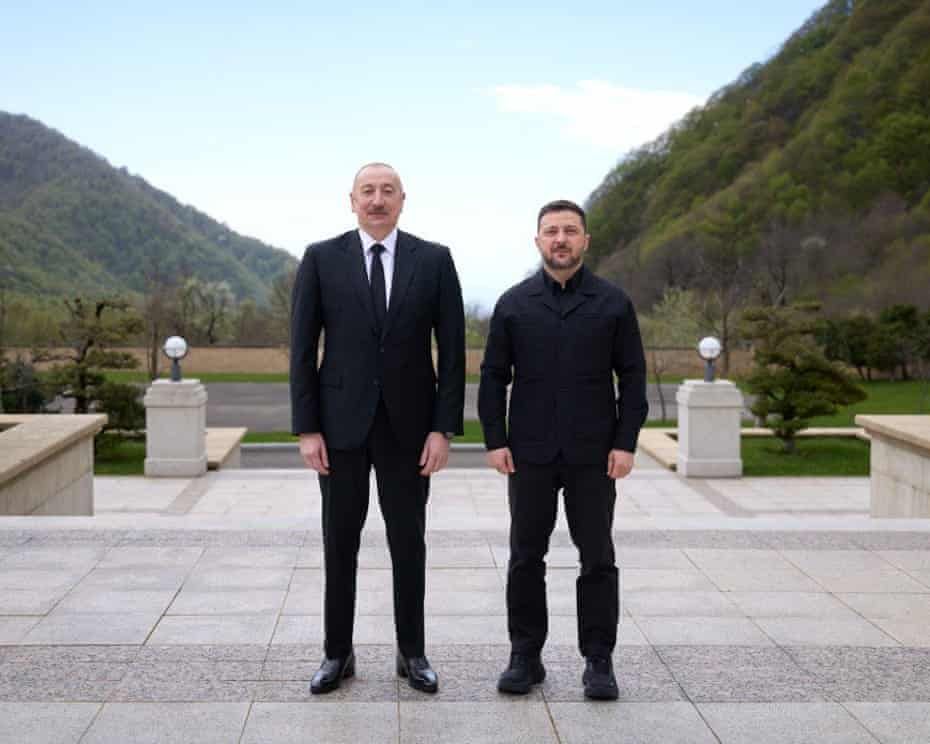
Ukraine war briefing: The Ukraine war briefing highlights escalating battlefield violence and shifting diplomatic alignments as Ukrainian President Volodymyr Zelenskyy signed a new defence cooperation agreement with Azerbaijan while Russian strikes across Ukraine killed at least ten people in fresh attacks.
The developments come as Kyiv continues to strengthen international partnerships and expand military-industrial cooperation amid sustained pressure from Moscow’s ongoing war effort.
According to The Guardian, Zelenskyy confirmed that the agreement signed in Baku focuses on security, energy collaboration and defence production, marking a deepening of ties between Ukraine and Azerbaijan.
Zelenskyy said the partnership reflects Ukraine’s growing role in air defence expertise, particularly in countering drone warfare tactics that have intensified across multiple conflict zones.
Russian attacks intensify as civilian toll rises
At least ten people were killed in renewed Russian strikes on Dnipro and surrounding regions, underscoring the continued intensity of the war more than four years after the full-scale invasion began.
Regional officials said eight people died and dozens were injured after waves of missile and drone strikes hit residential areas across the city.
“For more than 20 frightening hours, the Russians attacked Dnipro in waves,” regional governor Oleksandr Hanzha said, adding that strikes were deliberately aimed at civilian areas.
The Russia Ukraine war update also included additional casualties in northern Ukraine, bringing the total confirmed deaths in the latest wave of attacks to ten.
According to Reuters, Ukrainian officials said the strikes involved coordinated missile and drone operations, reflecting the continued evolution of hybrid aerial warfare targeting both infrastructure and populated areas.
A resident in Dnipro described the night as relentless, saying repeated explosions forced families into shelters while emergency crews struggled to respond across multiple impact zones.
Diplomatic shifts and regional security realignment
Alongside the violence, Zelenskyy’s visit to Azerbaijan signals Kyiv’s broader strategy of expanding alliances beyond traditional Western partners.
The Zelenskyy Azerbaijan deal includes provisions for defence cooperation and potential joint production of military equipment, according to Ukrainian officials.
Azerbaijan’s President Ilham Aliyev described the agreement as having wide-ranging perspectives, although he did not publicly confirm all specific terms.
Zelenskyy also raised the possibility of future peace talks with Russia being hosted in Azerbaijan, stating that Kyiv remains open to renewed diplomacy if Moscow shows willingness to engage.
He said, “We are ready for the next talks in Azerbaijan if Russia will be ready for diplomacy,” signalling conditional openness to negotiations.
Drone warfare and expanding conflict impact
The war’s technological dimension continues to intensify, with Ukraine increasingly relying on drone warfare expertise both domestically and through international cooperation.
Officials in Kyiv say Ukraine’s experience in countering long-range drone systems has become a key component of its military partnerships with other states facing similar threats.
At the same time, Russian drone and missile strikes continue across multiple fronts, with increasing reports of spillover incidents affecting neighbouring countries.
In a separate case, a drone incident in Romania caused damage after crossing from Ukrainian airspace, prompting evacuations and renewed NATO monitoring along the border region.
Romanian authorities confirmed debris fell in a populated area, marking one of the most serious cross-border spillover incidents since the war began.
Expert analysis: escalation and strategic positioning
Security analysts say the latest developments reflect both escalation on the battlefield and strategic repositioning by all sides involved in the conflict.
A defence analyst said the war is now operating on two parallel tracks, intensified military strikes and expanding diplomatic realignments designed to reshape long-term leverage.
The expert noted that Ukraine’s growing partnerships with non-Western states such as Azerbaijan indicate an effort to diversify military supply chains and strengthen resilience under sustained pressure.
Meanwhile, Russian forces continue heavy reliance on long-range strikes aimed at exhausting Ukrainian air defences and disrupting civilian infrastructure networks.
Read also:Trump correspondents dinner shooting: President evacuated after gunfire
Human impact and ongoing pressure
On the ground, the humanitarian toll continues to rise as repeated strikes place significant pressure on emergency services and local communities.
Survivors in Dnipro described widespread destruction, with residential buildings damaged, vehicles burned, and rescue teams working through the night to locate survivors.
One resident said, “We don’t know when it will stop. Every night feels the same,” reflecting growing exhaustion among civilians living under constant threat.
The Russia Ukraine war update underscores how civilians remain at the centre of the conflict’s most severe consequences despite ongoing diplomatic activity.
Uncertain path forward
As Ukraine strengthens defence partnerships and Russia continues sustained aerial assaults, the conflict shows no immediate sign of de-escalation.
International observers warn that both military escalation and geopolitical realignment are likely to define the next phase of the war.
The combination of intensified drone warfare, regional spillover incidents and shifting alliances suggests a conflict that is expanding in both scope and complexity.
For now, Ukraine continues balancing military resistance with diplomatic outreach while facing some of the most sustained attacks since the war began.
The coming weeks are expected to test both Ukraine’s defensive capacity and the strength of its emerging international partnerships as the war enters another volatile phase.
Read more: Ireport247news.com