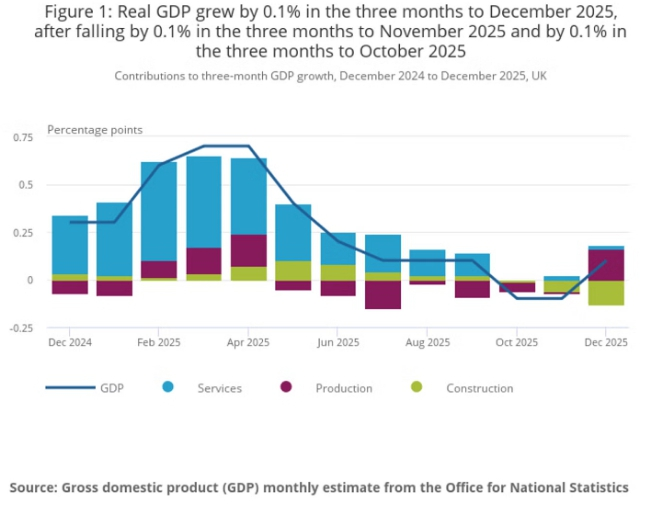
The UK economy growth showed a modest improvement in the final quarter of 2025, according to figures released by the Office for National Statistics (ONS). Gross domestic product (GDP) increased by 0.1 per cent between October and December, matching the growth seen in the previous quarter.
Economists had anticipated that stronger activity in November, coupled with clarity after the autumn Budget, could have resulted in slightly higher expansion.
“The UK economy continued to grow slowly in the last three months of 2025, with the growth rate unchanged from the previous quarter,” said Liz McKeown, ONS director of economic statistics.
“The services sector, which often dominates, showed no growth, while manufacturing provided the main driver. Construction, meanwhile, experienced its weakest performance in over four years.”
Prime Minister Keir Starmer commented on the figures, writing on X/Twitter: “I know there’s more to do, but we are heading in the right direction.” His remarks suggest cautious optimism, even as challenges like inflation and high unemployment remain.

Earlier ONS data indicated that the UK economy contracted by 0.1 per cent in October before rebounding by 0.2 per cent in November, revised down from 0.3 per cent.
Manufacturing benefited from recovering production at Jaguar Land Rover after the company had been affected by a major cyber attack, highlighting the sector’s resilience in supporting overall UK economy growth.
The Bank of England recently lowered its growth forecast for 2026 from 1.2 per cent to 0.9 per cent and for 2027 from 1.6 per cent to 1.5 per cent, reflecting ongoing uncertainty in consumer demand, persistent inflation, and global economic pressures.
A spokesperson for the Bank of England said: “The outlook remains challenging, and growth is unlikely to accelerate significantly without sustained reductions in inflation and improvements in confidence among businesses and consumers.”
Economists expect the first quarter of 2026 to show some improvement. Sandra Horsfield, senior economist at Investec, said: “The UK economy has defied gloomy predictions in 2025, achieving GDP growth of 1.4 per cent for the full year, compared to the consensus forecast of 1.2 per cent.
We anticipate continued resilience in 2026, particularly as utilities investment and housebuilding gain momentum.”
Victoria Scholar, head of investment at Interactive Investor, emphasized that post-Budget clarity likely helped economic activity.
“Consumers increased spending on retail, hospitality, and leisure during the festive season once uncertainty subsided. This seasonal boost supports modest growth in early 2026,” she said.
Political and policy uncertainty remains a key risk for sustained UK economy growth. Thomas Pugh, chief economist at RMS UK, warned: “Noisy leadership and policy instability could reverse some of the recent gains. A prolonged leadership contest or speculation about new taxes could undermine consumer and business confidence.”
The British Chambers of Commerce (BCC) urged the government to take tangible action to support businesses. David Bharier, BCC head of research, said: “Improving the economic outlook now depends on restoring business dynamism.
The government must move from strategy to delivery—backing infrastructure projects, speeding up planning approvals, addressing skills gaps, and strengthening export support—so firms can invest, export, and grow.”
The Trades Union Congress (TUC) noted that, while annual growth reached 1.3 per cent—the highest in three years—many households have yet to see any financial benefit.
General secretary Paul Nowak said: “Many working families have no disposable income left to spend on goods and services that keep our economy moving. Ministers must stay laser-focused on reducing household costs and improving living standards. The Bank of England must act swiftly with interest-rate cuts to stimulate spending.”
ONS data showed that manufacturing was the main contributor to growth in Q4, offsetting stagnation in services and weakness in construction.
McKeown added: “Across 2025 as a whole, growth improved slightly compared to the previous year, with all main sectors showing some positive movement.Manufacturing, in particular, proved resilient, recovering quickly from supply chain disruptions.”
Economists forecast that growth could accelerate to around 0.5 per cent in the first quarter of 2026 as previous interest-rate cuts and falling inflation begin to boost consumer spending. Scholar said: “Economic fundamentals are improving, and we should see stronger household consumption later in the year.”
Despite positive signs, the cost-of-living crisis continues to affect working families. Nowak said: “We need to end the doom loop of stagnant wages and rising costs. Without support for households, the recovery risks being uneven and fragile.”
Horsfield emphasized that the UK economy growth in 2025 demonstrated resilience against negative forecasts. “Despite modest quarterly growth, underlying performance in manufacturing and utilities was stronger than expected. If interest rates continue to fall and investment in housing and infrastructure picks up, 2026 could see further growth exceeding consensus expectations,” she said.
The Bank of England remains vigilant. A spokesperson stated: “Monetary policy continues to play a crucial role in sustaining economic recovery. We are committed to ensuring the economy has the support it needs as uncertainty fades and consumer confidence returns.”
In summary, the UK economy growth ended 2025 on a cautiously positive note.
GDP expanded by 0.1 per cent in the final quarter, with manufacturing driving growth while services remained flat and construction underperformed. Analysts stress that sustained recovery depends on government action, falling inflation, and continued consumer and business confidence.
Looking forward, economists anticipate UK economy growth to strengthen throughout 2026, supported by rate cuts, infrastructure investment, and renewed consumer spending.
Read also:Canadian Police identify Tumbler Ridge school shooting suspect after nine killed
However, political and leadership uncertainty, alongside cost-of-living pressures, remain key challenges. As Horsfield noted: “The UK economy has shown it can outperform expectations, but careful management and policy clarity are essential to maintain momentum.”
About The Author