French authorities have arrested two suspects in connection with the audacious Louvre jewel heist, an €88 million robbery that stunned Paris and embarrassed museum security officials.
The Paris museum robbery unfolded last Sunday when four masked men disguised as maintenance workers carried out one of France’s most daring cultural thefts in modern history.
French prosecutors confirmed the arrests late Saturday, saying the French police investigation had tracked the suspects for days before apprehending them in separate operations in the capital and its outskirts.
Prosecutor Laure Beccuau said one suspect was detained during a Charles de Gaulle airport arrest at around 10pm, just before he attempted to board a flight to Algeria.
Authorities identified both suspects as men in their thirties from the Paris suburb of Seine-Saint-Denis, known to police for previous organized theft and criminal conspiracy activities.
The French police investigation remains ongoing, with officers from the organized crime squad coordinating forensic teams and intelligence units to trace the rest of the gang involved in the Louvre jewel heist.
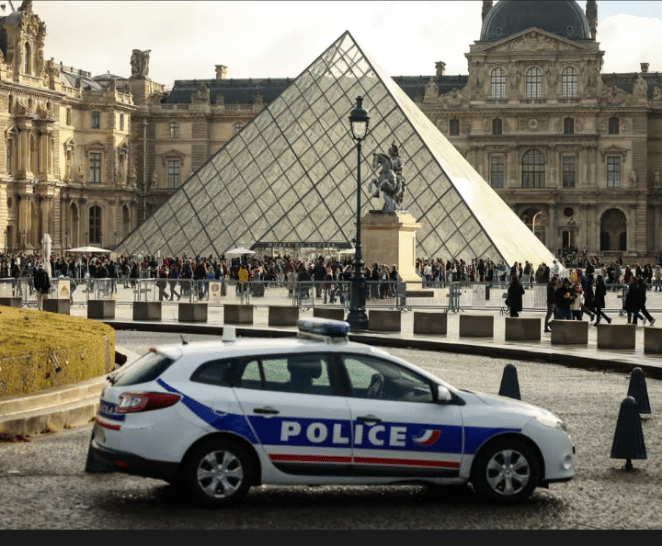
Officials have described the case as one of the most complex cultural crimes in French history, involving meticulous planning, advanced equipment, and intimate knowledge of the museum’s security system.
The robbers arrived in a stolen furniture truck fitted with an extending ladder and lift, tools that allowed them to access the Louvre’s first-floor Apollo Gallery undetected.
Once inside, two of the men wearing high-visibility vests smashed through an unsecured window and used industrial disc cutters to open two display cases containing stolen crown jewels.
According to initial reports, the thieves spent less than four minutes inside the gallery before escaping with priceless imperial artifacts, including diamonds and emeralds from Napoleon-era collections.
French Interior Minister Laurent Nuñez praised investigators for their “extraordinary dedication,” but urged restraint in releasing premature information that might jeopardize the French police investigation.
He also reminded the media that over one hundred officers and forensic experts were still deployed, analyzing DNA, fingerprints, and electronic traces linked to the Louvre jewel heist.
Laure Beccuau expressed regret over media leaks, emphasizing that the ongoing Paris museum robbery inquiry required confidentiality to ensure all perpetrators were captured and the jewels recovered intact.
Under French law, suspects in serious cases such as the Louvre jewel heist can be held in custody for up to 96 hours before being formally charged in court.
Forensic analysts have already recovered helmets, gloves, a hi-vis vest, and angle grinders left behind by the robbers, items now being examined for fingerprints and genetic material.
Authorities confirmed that more than 150 DNA samples have been processed across multiple laboratories in and around Paris as part of the sweeping French police investigation.
Sources close to the case said investigators were “optimistic” about identifying all four men involved, thanks to security footage and trace evidence recovered from the crime scene.
The Louvre jewel heist targeted the museum’s Apollo Gallery, home to treasures once belonging to Empress Eugénie, wife of Napoleon III, and Marie Louise, Napoleon I’s second wife.
Among the stolen crown jewels was an emerald and diamond necklace gifted by Napoleon I to Marie Louise, and a diadem set with 212 pearls and nearly 2,000 diamonds.
Experts say the collection’s historical significance makes the Paris museum robbery a devastating cultural loss, even if financial insurers eventually compensate the Louvre for the material value.
The four thieves reportedly coordinated the operation with near-military precision, relying on radio communication and pre-scouted escape routes through central Paris.
After the break-in, the two men who entered the museum descended via a mechanical lift back into the truck before fleeing on waiting motorbikes driven by their accomplices.
Police believe the group ditched the truck shortly after leaving the area, switching to secondary vehicles to confuse pursuit and minimize traceable digital or physical footprints.
Surveillance images captured fragments of the Louvre jewel heist, though the robbers’ faces were obscured by helmets, complicating early stages of the French police investigation.
Nevertheless, the Charles de Gaulle airport arrest proved a major breakthrough, offering key leads about potential fences and intermediaries tasked with smuggling the jewels abroad.
Investigators suspect an international criminal network may have been involved, possibly coordinating logistics for moving the stolen crown jewels across European or North African borders.
Authorities are now liaising with Interpol and customs agencies across the Mediterranean to block potential export or sale of the Louvre jewel heist artifacts.
Art crime experts say that high-profile jewels like these are nearly impossible to sell openly, forcing thieves either to dismantle them or approach black-market collectors.
Professor Étienne Moreau, an art security specialist at the Sorbonne, said the heist highlighted vulnerabilities in museum protocols that had not been updated in over a decade.
“Disguising themselves as workers allowed them to bypass early detection systems,” he said. “It was an embarrassingly simple yet devastating breach of the Louvre’s defences.”
Public outrage has mounted across France as details of the Paris museum robbery emerged, with critics demanding the resignation of top Louvre security officials.
Museum director Laurence des Cars issued a brief statement expressing “deep shock” at the loss and promising a full review of museum safety procedures following the Louvre jewel heist.
In response, the French culture ministry has called for enhanced surveillance systems across all national museums to prevent another Paris museum robbery of this magnitude.
Authorities are also examining whether the gang received inside assistance, possibly from contractors familiar with Louvre renovation work or security camera blind spots.

Local media reported that detectives are re-interviewing staff and cross-checking entry logs from the days preceding the Louvre jewel heist to detect suspicious activity.
Meanwhile, the Charles de Gaulle airport arrest suspect is said to be cooperating partially, though police have not confirmed whether he has provided details about the missing jewels.
Both arrested men are being held under high security at a facility in the Paris region while judicial police continue interrogations tied to the French police investigation.
For now, the whereabouts of the stolen crown jewels remain unknown, though officials have urged the public to report any suspicious attempts to sell antique gemstones.
Art recovery specialists caution that the jewels may be broken apart or reset into new pieces to disguise their provenance, a common tactic following high-value thefts like the Louvre jewel heist.
French authorities have contacted museums and auction houses worldwide, alerting them to the risk of forged provenance documents and doctored gems entering the market.
The Louvre, still reeling from the Paris museum robbery, reopened its Apollo Gallery this weekend with enhanced security but without the missing exhibits, now replaced by photographs.
Tourists gathered at the cordoned-off area to view the damaged display cases, a stark reminder of how swiftly the Louvre jewel heist unfolded inside the famed museum.
Officials say the investigation may take months, but the arrests have injected new momentum into the French police investigation and boosted hopes of recovering the priceless treasures.
As Paris awakens to tighter security and renewed vigilance, the Louvre jewel heist serves as both a cautionary tale and a rallying call for cultural protection worldwide.
French media have vowed to continue coverage, insisting that justice must be served and that the legacy of France’s royal jewels be restored to the nation’s greatest museum.