The Louvre jewel heist that stunned France has taken another twist after new footage showed the thieves’ slow-motion escape, deepening questions about the museum’s security failures.
The 36-second clip, verified by Le Parisien, captures two men descending a furniture lift with stolen French crown jewels worth €88m, an image almost cinematic in precision.
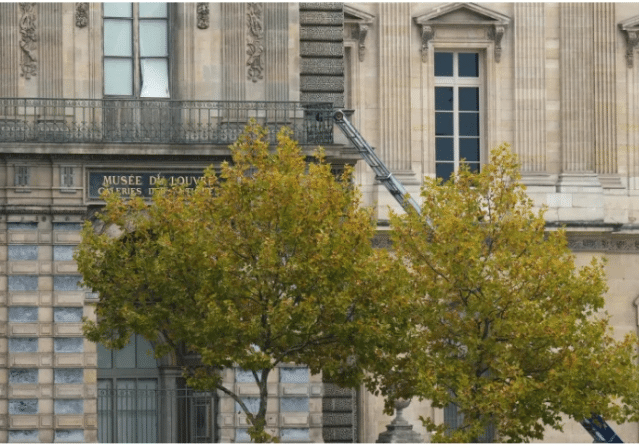
Witnesses reportedly filmed the escape from a nearby window overlooking the Quai François Mitterrand, where a stolen truck with a 30-metre ladder had been positioned for the daring exit.
“They’re leaving, they’re leaving,” a voice is heard in the recording, apparently that of a security guard communicating via walkie-talkie as the men vanish on scooters.
The Louvre jewel heist occurred in broad daylight on Sunday morning, with the thieves slipping into the museum’s Apollo gallery less than an hour after it opened to visitors.
French investigators say the Paris museum robbery was executed with chilling efficiency — a reminder that even the most fortified cultural landmarks remain vulnerable to human error.
According to Le Parisien, two members of a four-man gang smashed an unsecured window before using disc cutters to open display cases containing priceless imperial jewels.
The stolen French crown jewels included a diamond and emerald necklace once gifted by Napoleon I to Marie Louise, and a diadem that belonged to Empress Eugénie.
Security sources confirmed that the burglars were inside the gallery for just under four minutes — “an operation so brief it felt rehearsed,” said one police official.
Footage from the Louvre jewel heist shows the pair descending calmly, as if unaware of the scale of their crime, using a lift usually meant for moving furniture.
“This was not a chaotic getaway,” remarked criminologist Alain Bauer. “It was slow, deliberate, and eerily composed — like a heist from a classic French thriller.”

The Paris museum robbery has triggered intense scrutiny of security at one of the world’s most visited cultural sites, attracting over 8 million visitors annually.
Laurence des Cars, the museum’s director, told French senators the event represented a “terrible failure,” admitting to “highly insufficient” camera coverage on exterior walls.
“The Louvre’s prestige makes it both a treasure chest and a target,” Des Cars said, promising a full security audit after what many called the Louvre security failure.
Interior minister Laurent Nuñez confirmed that more than 100 investigators, including specialists in international art crime, are now working on the case.
He described the operation as “meticulously planned,” hinting that the thieves might have had inside information about museum layouts and staff routines.
Experts believe the Louvre jewel heist may have been motivated more by material value than historical significance, as similar jewels often disappear into private black markets.
“These items could be dismantled, their stones sold separately,” said art historian Hélène Marchand. “Their cultural value may never be recovered — that’s the true tragedy.”
The Paris museum robbery also exposed systemic weaknesses in France’s museum security network, long criticised for outdated technology and underfunded maintenance contracts.
A report last year by the national auditors’ office warned of “uneven protection levels” across major French cultural institutions, including the Musée d’Orsay and Versailles.
Critics now demand resignations, calling the Louvre security failure emblematic of broader governmental neglect toward national heritage preservation.
Opposition senator Jean-Pierre Mignot told reporters: “We are not just losing jewels; we are losing confidence in our ability to protect the symbols of France.”
The French government faces rising public anger, with the Louvre jewel heist dominating national headlines and prompting renewed debate over museum privatisation and funding.
Paris mayor Anne Hidalgo called the robbery “an insult to French artistry,” urging the government to “treat cultural security as a matter of national importance.”
Meanwhile, on social media, the footage of the Paris museum robbery has gone viral — millions sharing clips of the thieves’ calm descent as if it were performance art.
A German firm whose lift model was used in the escape even launched a marketing campaign with the tagline: “Quiet as a whisper — even in Paris.”
That campaign drew outrage, with culture minister Rachida Dati condemning it as “a disgraceful exploitation of France’s humiliation for commercial gain.”
Investigators have traced the stolen truck to a rental depot in northern Paris, where CCTV shows two men wearing identical helmets used in the Louvre jewel heist.
Authorities suspect links to Balkan and North African art crime networks, some of which have targeted European museums since the early 2000s.

Interpol has been notified, and several European customs agencies are monitoring ports and airports for shipments matching the jewels’ description.
The stolen French crown jewels include emerald brooches, diamond earrings, and a rare sapphire pendant once displayed at Napoleon’s coronation anniversary exhibition.
Jewellery experts estimate the gems’ resale value could exceed €40m once broken down, though any public sale would be nearly impossible due to their recognisability.
“Art thieves rarely keep the items intact,” said former investigator Marc Lenoir. “They fragment them — it’s the only way to erase their history and traceability.”
The Louvre jewel heist has reignited comparisons with the 2019 Dresden Green Vault robbery in Germany, where €113m in royal treasures were stolen in minutes.
That case also involved disciplined timing, precise tools, and minimal violence — hallmarks of a new generation of highly skilled European art criminals.
Security consultant Nathalie Cottin told France 24: “This robbery shows criminal professionalism that rivals military planning. It’s not impulse — it’s orchestration.”
The Paris museum robbery continues to embarrass the French government, which only last year unveiled a €50m upgrade plan for heritage site protection.
Yet the Louvre’s outdated CCTV coverage and lack of alarm coordination made it an easy mark for thieves, exposing flaws in bureaucratic oversight.
Des Cars confirmed that only one guard was stationed near the Apollo gallery at the time — “an inexcusable lapse,” according to heritage union leader Jérôme Thibaut.
“The Louvre security failure wasn’t just technical,” Thibaut said. “It was cultural — a mindset that assumes greatness protects itself. It doesn’t.”
Police now believe a fourth suspect, possibly the operation’s coordinator, remains in France, monitoring the investigation through encrypted online channels.
Forensic teams recovered traces of industrial lubricant and glass powder, suggesting the gang rehearsed the Louvre jewel heist using similar display materials elsewhere.
Despite international attention, no ransom or communication has been received from the perpetrators, increasing fears that the jewels are already dismantled.
“This is not just a loss of property,” said Culture Minister Dati. “It’s a wound to the soul of France — and a warning to every museum in Europe.”
The stolen French crown jewels are insured, but officials say compensation cannot cover their historical and sentimental worth.
For now, the Louvre’s broken window, still cordoned off, has become an eerie tourist attraction — visitors taking photos of the damage rather than the art.
In an ironic twist, local guides now refer to the shattered pane as “Paris’s new Mona Lisa,” mocking how tragedy has become spectacle.
The Louvre jewel heist remains a powerful symbol of vulnerability in an era where even national treasures can vanish before the world’s eyes — in slow motion.
About The Author