

David Lammy says Trump has no right to choose Iran’s next leader, warning that the decision over who succeeds Iran’s supreme leader should be made by the Iranian people rather than foreign powers.
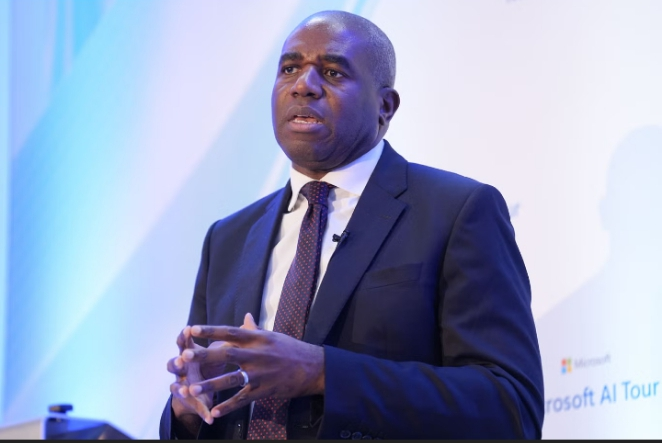
The UK deputy prime minister made the remarks after Donald Trump suggested he believed the United States should play a role in determining who replaces Ali Khamenei if a succession process begins. Speaking publicly about the issue, David Lammy stressed that decisions about Iran’s leadership should remain entirely in the hands of its citizens.
Lammy’s intervention highlights growing differences between the United Kingdom and the United States over how to approach the escalating tensions involving Iran. While Washington has adopted a more aggressive strategy toward Tehran, the British government has continued to emphasise diplomacy and international law as the preferred path forward.
According to Lammy, democratic principles demand that the future leadership of Iran must be determined internally rather than influenced by external governments. He said that even close allies like the United States should respect the sovereignty of other nations when it comes to leadership decisions.
The comments followed Trump’s remarks suggesting that the US should have influence over Iran’s future political direction if the current leadership structure changes.
Those comments have drawn criticism from several political figures in Europe who fear that such statements risk escalating an already volatile situation in the Middle East.
Lammy argued that attempts to impose political change from outside a country rarely succeed, particularly when they involve military pressure or conflict.
He said historical experience has shown that regime change carried out through external intervention often leads to instability rather than long-term democratic outcomes.
The deputy prime minister’s position also reflects the cautious stance adopted by the government of Keir Starmer since tensions between the United States and Iran intensified.
Britain has chosen not to participate in offensive military operations conducted by Washington, citing legal concerns and the belief that diplomatic avenues had not yet been fully exhausted.
Lammy made clear that while the UK continues to value its long-standing alliance with the United States, disagreements between allies are not unusual in international politics. He noted that Britain and the US have frequently taken different positions during major global crises in the past.
To illustrate this point, Lammy referenced the relationship between Winston Churchill and Franklin D. Roosevelt during the Second World War. Although the two leaders worked closely together against Nazi Germany, they disagreed on several issues, including how to manage relations with Joseph Stalin.
Lammy said those disagreements did not weaken the alliance between Britain and the United States but instead reflected the reality that even the closest partners can hold different perspectives on international affairs.
He also cited disagreements between later leaders as further examples. During the 1960s, British prime minister Harold Wilson declined to send British troops to support the United States in the Vietnam War despite strong pressure from Washington.
Similarly, tensions emerged in the 1980s when Margaret Thatcher criticised the decision by Ronald Reagan to launch a military invasion of Grenada without prior consultation with London.
By highlighting these historical precedents, Lammy suggested that disagreements over Iran should not be viewed as a breakdown in the so-called “special relationship” between the UK and the United States.
Instead, they demonstrate that independent foreign policy decisions remain possible even within strong alliances.
The current dispute revolves partly around the question of Iran’s future leadership. Ayatollah Ali Khamenei has served as Iran’s supreme leader since 1989 and holds ultimate authority within the country’s political and religious system.
The selection of his eventual successor is expected to be one of the most significant political developments in Iran’s modern history.
Under Iran’s constitution, the responsibility for choosing the supreme leader lies with the Assembly of Experts, a body of senior clerics elected by the Iranian public.
While the process is complex and influenced by internal political dynamics, it is fundamentally designed to be an internal decision rather than one influenced by foreign governments.
Lammy emphasised that principle during his remarks, arguing that external attempts to shape the process could undermine the legitimacy of any future leader.
He said that if Western governments genuinely support democratic values, they must respect the right of the Iranian people to determine their own political future.
The deputy prime minister also addressed the broader military confrontation between the United States and Iran, which has intensified in recent weeks. Washington has carried out a series of strikes against Iranian-linked targets, citing security threats and regional instability.
Britain has taken a more cautious approach. Although it remains a close ally of the United States within organisations such as NATO, the UK government has avoided direct involvement in offensive operations against Iran.
Lammy explained that the decision not to participate was based largely on legal considerations. British officials have indicated that the government did not believe there was a sufficiently clear legal basis for military action at the time the strikes were launched.
He also suggested that diplomatic efforts had still been underway before the escalation occurred. According to Lammy, negotiations and diplomatic engagement between Washington and Tehran had not yet been fully exhausted, meaning that military action risked undermining those efforts.
During interviews, Lammy was asked whether Starmer had personally told Trump that Britain believed the conflict lacked clear objectives. The deputy prime minister declined to reveal details of private conversations between the two leaders but indicated that discussions had taken place.
“I know the answer,” Lammy said when pressed by journalists, before adding that he could not share the contents of those conversations publicly.
The comments have drawn attention because they appear to signal a rare public disagreement between London and Washington at a time when geopolitical tensions are already high.
Analysts say that while policy differences between the two countries are not unusual, they are often handled quietly through diplomatic channels rather than public statements.

Nevertheless, Lammy emphasised that the broader alliance between the United Kingdom and the United States remains strong. He said both countries share deep historical ties and continue to cooperate closely on security, intelligence, and economic issues.
At the same time, he argued that maintaining an independent foreign policy is essential for Britain’s credibility on the international stage. According to Lammy, allies must sometimes be willing to voice disagreement when they believe a different approach would better serve global stability.
The debate over Iran’s future leadership and the role of external powers is likely to remain a major issue in international politics. As tensions continue to unfold, governments around the world are closely watching developments in Tehran and Washington.
For now, Lammy’s message has been clear: the question of who leads Iran in the future should be decided within Iran itself, not by political leaders in other countries.
His remarks underline a broader principle that Britain says it wants to uphold in global affairs — respect for national sovereignty and the belief that political change must ultimately come from the people directly affected by it.
Whether that position will influence the evolving debate over Iran remains uncertain, but it highlights the complex diplomatic balancing act facing Western governments as they navigate one of the most sensitive geopolitical crises of the moment.
About The Author


