

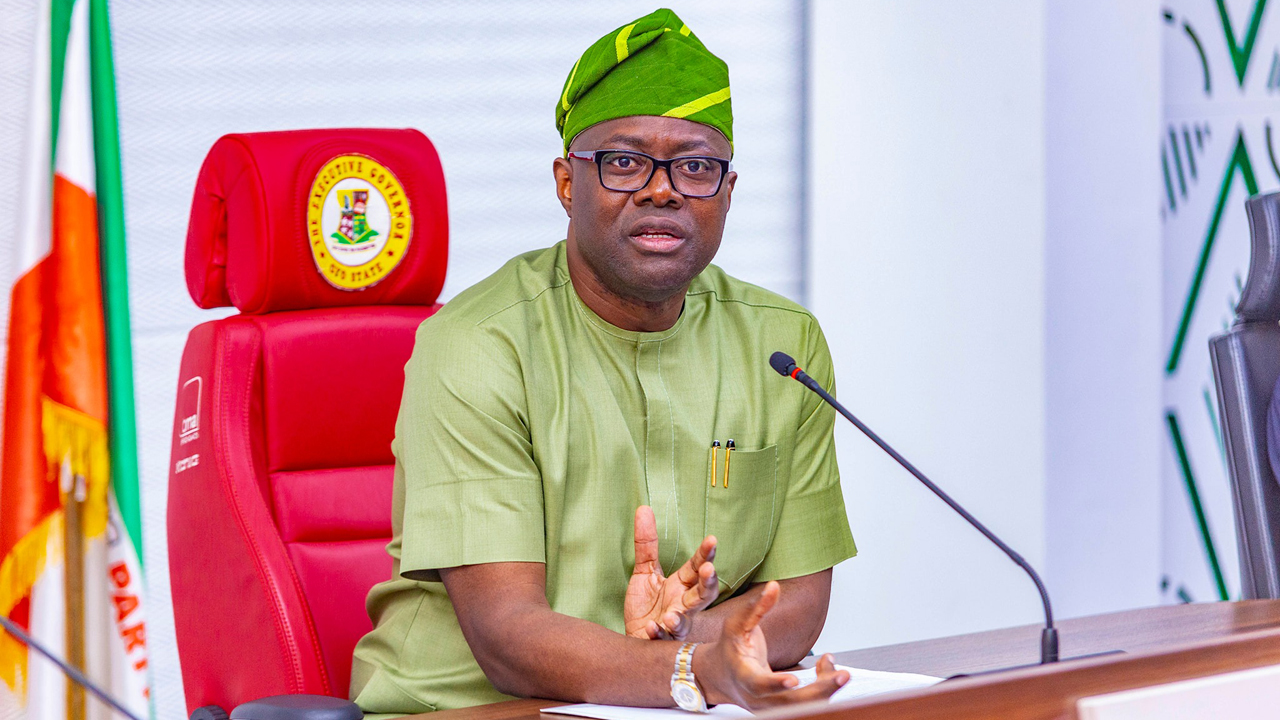
Oyo State Governor, Seyi Makinde, has disclosed that President Bola Ahmed Tinubu would not be considered for a role in his proposed government of national unity if he wins the 2027 presidential election, citing an alleged failure by the president to honour a political agreement reached before the 2023 general election.
Makinde, who is seeking the presidency on the platform of the Action Peoples Movement (APM), said his decision was informed by his previous political dealings with Tinubu, particularly the understanding that an inclusive administration would be established after the 2023 election.
Although he ruled out working with Tinubu in that capacity, the governor made it clear that his proposed administration would not shut its doors against members of the ruling All Progressives Congress (APC). He argued that the country has capable individuals across different political parties whose experience could be useful in addressing Nigeria’s numerous challenges.
The governor made these remarks during an appearance on The Rooftop Podcast, where he was asked about the possibility of bringing influential political figures, including former Vice-President Atiku Abubakar, Labour Party’s Peter Obi and Tinubu, into his government if elected president.
In his response, Makinde suggested that while Tinubu would not be part of his proposed arrangement, qualified Nigerians within the APC would still have opportunities to serve.
“Perhaps not President Tinubu, but there are still decent people in APC as well. I’ll tap them and they are Nigerians,” he said.
His response prompted a follow-up question about whether he considered the president undeserving of such an opportunity. Makinde explained that his position was connected to the experience he had working with Tinubu during the political arrangements that preceded the 2023 presidential election.
According to him, there was an understanding that the government formed after the election would accommodate Nigerians from different political backgrounds rather than operate primarily as an administration for the party that secured victory.
The governor maintained that the proposed arrangement was among the expectations of the PDP G5 governors, who disagreed with the national leadership of the Peoples Democratic Party before the 2023 election.
The G5, comprising five governors elected on the PDP platform, became a major political force during the election period after openly challenging the party’s leadership over internal disagreements. One of their major demands centred on fairness and balance within the party, particularly the issue of the PDP national chairmanship following its decision to field a presidential candidate from the northern part of the country.
Makinde said the group’s position was also informed by the need for a broader political arrangement that would bring capable Nigerians together, irrespective of their party membership.
He recalled that the expectation was for the incoming administration to identify individuals with the necessary knowledge, experience and ability from every part of the country.
“We came from the PDP as G5 and we said, ‘Look, this is not going to be a government of APC. It should be a government where you tap people from all across the country. Go to every corner of the country, pick and choose people that can help you know to sort some of this out,'” he explained.
For Makinde, a government of national unity should go beyond political slogans and reflect a deliberate effort to accommodate different interests and perspectives in the administration of the country.
He argued that Nigeria’s problems require contributions from people with different experiences and political orientations, rather than an arrangement that concentrates government opportunities within a particular political circle.
To strengthen his argument, the APM candidate referred to events following the annulment of the June 12, 1993 presidential election, when former military Head of State, General Sani Abacha, assumed power.
Makinde cited the appointments of prominent Nigerians, including former Lagos State governor, Lateef Jakande, and businessman Alex Ibru, into Abacha’s administration as examples of how individuals outside a narrow political circle could be brought into government.
He said the appointments were part of efforts to reduce political tension and reach out to Nigerians who were dissatisfied with developments following the controversial annulment of the election widely believed to have been won by the late Chief MKO Abiola.
According to Makinde, bringing influential personalities into government was intended to create a wider sense of participation and calm an atmosphere of political uncertainty.
“And it’s been done before. After the annulment of the June 12, 1993 elections, and General Abacha came into government, they went and tapped Alhaji Jakande, Alex Ibru, all of those were geared towards bringing down the temperature in the country and ensuring that where there are angry people, they are being pacified,” he said.
However, Makinde accused Tinubu of failing to adopt a similar approach after becoming president in 2023.
He claimed that the president’s appointments reflected a preference for people within his political network instead of a broader national selection process that would give qualified Nigerians from different backgrounds an opportunity to contribute to governance.
The Oyo governor specifically described Tinubu’s appointments as being concentrated around his political associates, using Bourdillon, a reference to the president’s well-known Lagos political base, to make his criticism.
“Tinubu didn’t do that at all. All his appointees are from Bourdillon,” Makinde alleged.
The accusation forms the basis of Makinde’s decision to exclude the president from the government arrangement he hopes to establish if elected in 2027.
Nevertheless, his comments suggest that his proposed administration would not necessarily be defined by hostility towards the APC as a political organisation. Rather, he appears to distinguish between the president and other members of the ruling party whom he believes could contribute positively to national development.
Under the arrangement he described, political affiliation would not automatically qualify or disqualify anyone for public office. Instead, competence, experience and the ability to deliver results would be important considerations in selecting individuals for government positions.
Makinde’s declaration also places his political relationship with Tinubu under renewed scrutiny as preparations gradually intensify ahead of the 2027 general election.
The governor’s latest remarks indicate that the disagreement surrounding the alleged 2023 understanding remains a significant issue in his assessment of the president, even as he presents himself as an advocate of a more inclusive approach to national leadership.
With the next presidential contest approaching, his proposal for a government that draws qualified Nigerians from different political camps is likely to become one of the issues surrounding his campaign and broader political engagement.
For now, Makinde has made his position clear: while he is prepared to consider capable APC members and other Nigerians for appointments, he does not envisage Tinubu being part of his proposed government if he secures the presidency in 2027.
About The Author
