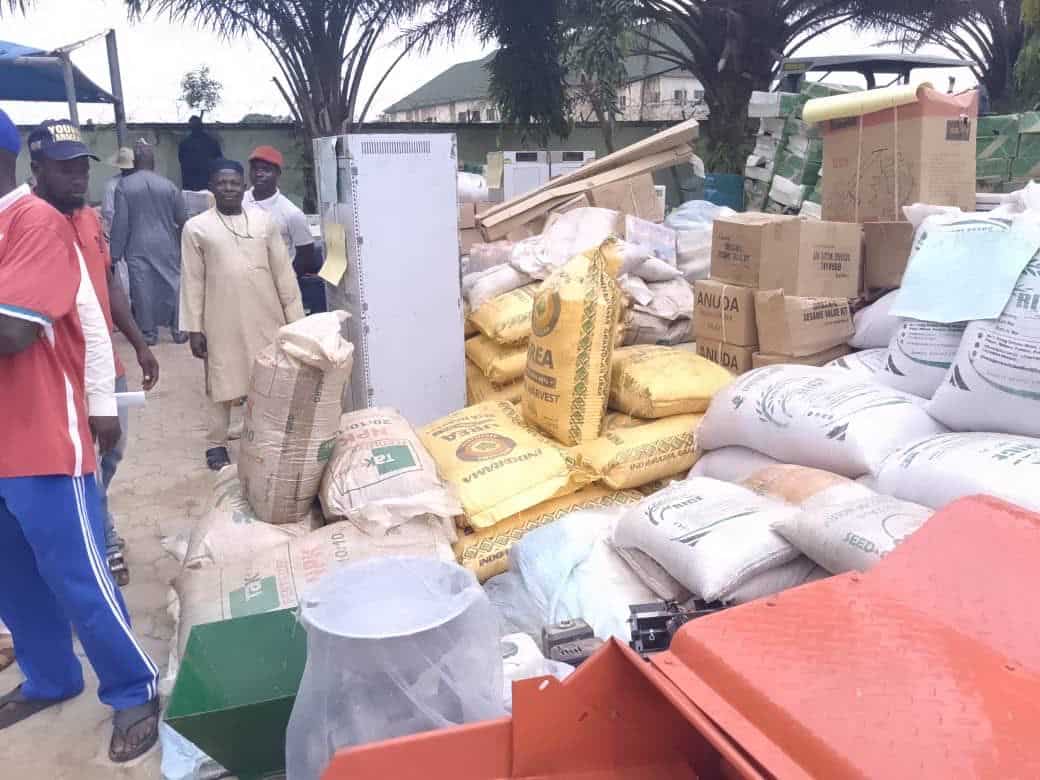

Taraba food security gets a lift as IFAD VCDP delivers seeds, fertilisers, and training to cassava farmers, driving productivity and rural prosperity.
Taraba State has reinforced its commitment to improving food production and ensuring Taraba food security by warning farmers against selling agricultural inputs meant for smallholder use.
The government emphasized that anyone found misusing items from the International Fund for Agricultural Development (IFAD)’s Value Chain Development Programme (VCDP) would face strict sanctions.
This measure reflects the state’s determination to protect resources intended to enhance agricultural productivity and rural livelihoods.
The warning coincided with the flag-off of IFAD’s VCDP input distribution for the 2025 wet season cassava farmers.
Over 2,500 farmers across 12 local government areas (LGAs) are expected to benefit from the initiative, receiving high-quality seeds, fertilisers, and other agro-inputs essential for increasing cassava production.

Cassava, a staple food crop in Taraba, plays a critical role in both food availability and local income generation, making its cultivation vital for Taraba food security.
During the flag-off ceremony, the State Commissioner of Agriculture and Food Security, Nicholas Namessan, urged beneficiaries to utilize the inputs correctly to maximize yields.
Represented by the ministry’s Permanent Secretary, Salah Ali, he emphasized that proper application would directly contribute to both individual farm productivity and broader agricultural growth across the state.
“These inputs are meant to empower you, not for sale. Responsible use ensures higher yields and a better future for your communities,” Ali remarked on the commissioner’s behalf.
Irimiya Musa, the VCDP State Programme Coordinator (SPC), highlighted the strategic goals of the programme.
Represented by Bedu Wiza, Musa explained that the initiative is designed to enhance agricultural productivity, promote value addition, and improve the livelihoods of rural smallholder farmers.
He noted that improved seeds and fertilisers, combined with training on modern agricultural techniques, are key to achieving higher cassava yields.
Proper use of these inputs is expected to significantly strengthen Taraba food security while fostering rural economic development.
Musa praised Governor Agbu Kefas for ensuring the timely release of counterpart funding, describing it as a major boost for smallholder farmers.
He also commended the Commissioner of Agriculture and other stakeholders for their consistent support.
“The VCDP, a partnership between IFAD, the Federal Government, and Taraba State, is among the most impactful programmes for rural communities in recent years,” he said.
Several beneficiaries expressed optimism about the programme’s potential impact.
Amina Musa, a cassava farmer from Jalingo, said, “These improved seeds and fertilisers will help me grow enough to feed my family and sell surplus at the market. It gives us hope for a better livelihood.”
Similarly, Peter Adamu from Wukari added, “With proper guidance and these inputs, we can increase our cassava output and secure a steady income for our households.”
The VCDP programme is part of a broader effort to modernize rural agriculture and reduce dependency on imported food.
By focusing on cassava, the initiative addresses both food availability and income generation.
Improved seeds and fertilisers enhance yields, while training in processing and value addition enables farmers to convert raw cassava into marketable products such as garri, flour, and starch.
These interventions are crucial not only for food production but also for economic empowerment and rural prosperity in Taraba.
Beyond distributing inputs, the programme provides technical guidance, monitoring, and continuous support.
This ensures that farmers apply resources correctly, minimizing waste and maximizing output.
Additionally, the programme educates farmers on soil fertility, pest management, and sustainable farming practices—ensuring long-term benefits and contributing to ongoing Taraba food security.
The state government’s strict stance against input misuse stems from lessons learned in previous agricultural initiatives.
When critical resources are diverted or sold, the objectives of food security and rural development are undermined.
By enforcing accountability, the government aims to instill responsibility among beneficiaries and guarantee that the programme achieves its intended impact.
Pilot implementations have already demonstrated promising results. Farmers in selected LGAs reported 25–30% higher cassava yields compared to previous seasons.
With improved seeds, fertilisers, and proper technical support, smallholder farmers are seeing tangible improvements in both production and income.
Success stories are motivating other communities to engage actively with the programme, highlighting the potential of coordinated agricultural interventions to transform rural livelihoods.
Governor Agbu Kefas praised the programme’s progress, reaffirming the state’s commitment to supporting smallholder farmers.
He noted that initiatives like the VCDP are central to achieving long-term food security and economic empowerment.
“When our farmers succeed, our communities succeed. This programme ensures that Taraba not only produces enough food but also thrives economically,” the governor said.
In conclusion, the IFAD VCDP input distribution is a landmark initiative for Taraba food security.
By providing high-quality seeds, fertilisers, and technical support, the programme empowers farmers, encourages sustainable practices, and fosters economic growth in rural areas.
Combined with strong government oversight and community engagement, the initiative is transforming cassava farming into a reliable engine of food security and rural prosperity.
With continued support and proper utilization of resources, Taraba State is poised to achieve unprecedented improvements in agricultural output, rural livelihoods, and long-term food security.
The collaboration between IFAD, the Federal Government, and the Taraba State Government ensures that smallholder farmers are equipped to meet both present and future challenges, securing a brighter, more prosperous future for all communities.