The Sudan food aid crisis is approaching a critical breaking point as the United Nations warns that emergency food supplies for millions of people could run out within months unless urgent funding is secured.
With Sudan’s civil war now stretching beyond 1,000 days, humanitarian agencies say the country is facing the world’s most severe hunger and displacement emergency, driven by relentless fighting, economic collapse and dwindling international support.
The UN’s World Food Programme has issued an urgent appeal for $700 million, warning that without immediate contributions, food assistance for large parts of Sudan may grind to a halt before the end of March.
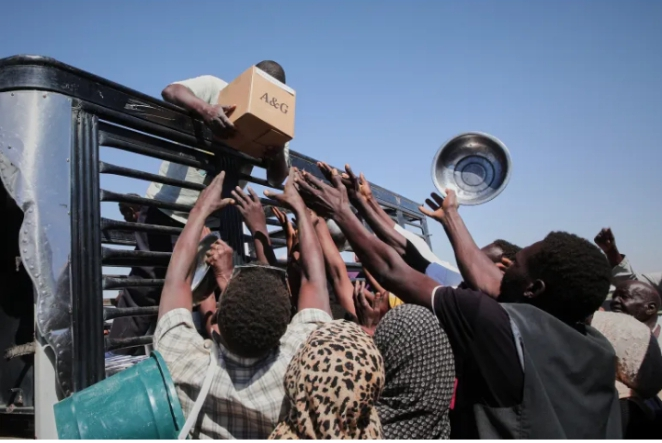
Aid officials say the funding is essential to keep life-saving operations running through at least June, at a time when nearly half of Sudan’s population is struggling to find enough food to survive.
Sudan has been gripped by a brutal conflict since April 2023, when fighting erupted between the country’s military leadership and the paramilitary Rapid Support Forces.
What began as a power struggle has spiralled into a nationwide catastrophe, devastating cities, destroying livelihoods and forcing millions from their homes.
The conflict has killed tens of thousands of people and displaced more than 14 million, creating one of the largest humanitarian emergencies in the world.
As the war drags on, the Sudan food aid crisis has worsened dramatically.
The World Food Programme says more than 21 million people are now facing acute hunger, with famine conditions confirmed in several hard-to-reach areas where months of intense fighting have cut off access for aid workers.
Entire communities have been left isolated, with markets destroyed, farms abandoned and supply routes blocked by insecurity.
Humanitarian agencies warn that food stocks are already being stretched to their absolute limits.
To cope with the funding shortfall, the World Food Programme has been forced to reduce rations to what it describes as the bare minimum needed for survival. Aid officials say that even these reduced distributions may soon become impossible if fresh funding is not secured within weeks.
According to the UN, the current funding gap is being driven by a sharp global decline in humanitarian donations, compounded by competing crises around the world.
Conflicts in Gaza, Ukraine and elsewhere have diverted attention and resources, while political shifts in major donor countries have further constrained aid budgets.
The result, aid groups say, is that Sudan’s crisis risks being forgotten despite its scale and severity.
UN officials have warned that the consequences of running out of food aid would be catastrophic. Millions of people who already depend entirely on humanitarian assistance could be left with no support at all, pushing families deeper into starvation and forcing more people to flee in search of food and safety.
Aid agencies say this would likely trigger new waves of displacement, both within Sudan and across its borders, placing further strain on neighbouring countries.
The situation on the ground remains dire.
In many parts of Sudan, basic services such as healthcare, water and electricity have collapsed. Hospitals have been damaged or destroyed, while outbreaks of disease are spreading in overcrowded displacement camps where malnutrition is widespread.
Aid workers report that children, pregnant women and the elderly are among the most vulnerable, with severe malnutrition rates rising sharply in several regions.
The Sudan food aid crisis has been exacerbated by continued fighting, which has made humanitarian access increasingly difficult.
Both sides in the conflict have been accused of obstructing aid deliveries, while insecurity has forced relief agencies to suspend or scale back operations in some of the worst-affected areas. Aid convoys have been looted, staff have been attacked and entire regions have become effectively unreachable.
The Rapid Support Forces, in particular, have been accused of carrying out widespread atrocities during their operations, especially in the western region of Darfur and parts of central Sudan.
Human rights groups have documented allegations of indiscriminate killings, sexual violence and the destruction of villages, which have driven thousands of civilians from their homes.
The violence has further complicated efforts to deliver food and medical aid to those in need.
International efforts to end the conflict have so far failed to produce results. Repeated attempts to broker a ceasefire, led by the United States and regional powers including Egypt, Saudi Arabia and the United Arab Emirates, have stalled amid deep mistrust between the warring parties.
Diplomatic initiatives have struggled to gain traction as fighting continues across multiple fronts.
Recent talks involving regional and international actors have sought to revive peace efforts, but progress has been slow.
Accusations and counter-accusations between the Sudanese government and the Rapid Support Forces have further undermined confidence, while allegations of external interference have complicated mediation efforts. For civilians caught in the middle, the lack of a political solution means continued suffering and uncertainty.
UN officials say that while a political settlement is essential, immediate humanitarian action is equally critical. During a visit to northern Sudan, the UN High Commissioner for Human Rights called for a renewed global effort to support aid agencies working in the country. He urged the international community to act decisively to prevent the Sudan food aid crisis from spiralling into an even greater tragedy.
Read also:Russian attack destroys Kharkiv energy facility as Ukraine faces deepening winter energy crisis
Aid groups stress that the requested $700 million represents a lifeline for millions of people and a fraction of the cost of allowing the crisis to worsen unchecked. Without sustained food assistance, they warn, gains made in preventing famine in some areas could quickly be reversed, leading to widespread loss of life.
As Sudan’s war enters its fourth year, the country stands at a crossroads. Continued neglect and underfunding could push one of the world’s poorest nations into a full-scale famine, with consequences that would reverberate far beyond its borders.
Humanitarian agencies say the choice facing the international community is stark: act now to support food aid and save lives, or risk allowing the Sudan food aid crisis to become one of the deadliest humanitarian failures in recent history.
About The Author