President Yoweri Museveni has taken a strong early lead in the Uganda election count, according to official results released by the country’s Electoral Commission, as tensions rise following voting marked by allegations of fraud, violence, and widespread restrictions on civil liberties.
With tallies from nearly half of polling stations counted, the commission said Museveni had secured 76.25 percent of the vote, placing him far ahead of his closest rival and positioning the long-serving leader for what would be a seventh term in office.
The preliminary results showed Museveni’s main challenger, opposition leader and musician-turned-politician Bobi Wine, trailing with 19.85 percent of the vote. The remaining ballots were split among six other candidates who collectively accounted for a small share of support.
While the figures suggested a decisive advantage for the incumbent, opposition parties and rights groups questioned the credibility of the process, citing reports of voter suppression, intimidation, and an unprecedented internet blackout during polling.
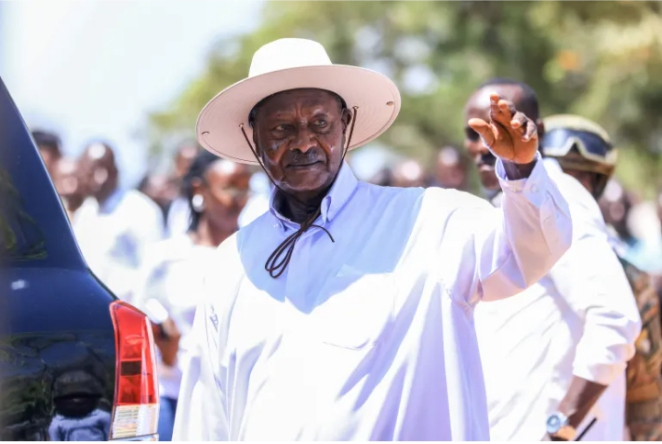
Museveni, who has ruled Uganda since 1986, cast his ballot in his rural home area of Rwakitura and told reporters he expected to win with 80 percent of the vote if the election was conducted fairly.
The 81-year-old leader, a former rebel who seized power after a guerrilla war, has steadily consolidated authority over four decades, amending the constitution to remove presidential term limits and age caps that once stood in the way of extended rule.
Bobi Wine, whose real name is Robert Kyagulanyi, emerged as Museveni’s most prominent challenger by mobilising young voters frustrated by unemployment, rising living costs, and long-standing political stagnation.
His campaign repeatedly accused the government of using security forces to disrupt rallies, intimidate supporters, and restrict opposition organising in the run-up to the vote. On election day, Wine alleged that the process was marred by massive fraud and manipulation.
Tensions escalated after Wine’s National Unity Platform party said the military and police had surrounded his home in the capital, Kampala, effectively placing him under house arrest.
The party shared the claim on social media, saying the move was intended to prevent him from addressing supporters or challenging the results.
A police spokesperson later told Reuters that he was not aware of Wine being placed under house arrest, highlighting conflicting accounts from authorities and the opposition.
The election took place amid an internet blackout imposed by the government, cutting off access to social media platforms and limiting the flow of information.
Officials said the shutdown was necessary for security reasons, but critics argued it was designed to prevent the opposition from mobilising supporters and documenting irregularities. International observers and rights organisations condemned the blackout as a serious blow to transparency and democratic accountability.
The United Nations human rights office said ahead of the vote that the election was being held in an environment characterised by widespread repression and intimidation.
According to the UN, opposition candidates and their supporters faced harassment, arrests, and excessive use of force by security agencies throughout the campaign period.
The government rejected the criticism, insisting that security forces were responding to unlawful behaviour and maintaining public order.
Reports of violence emerged both during and after voting, deepening concerns about stability. While polling hours passed without large-scale demonstrations, clashes were reported overnight in several areas, including the town of Butambala, about 55 kilometres southwest of Kampala.
Human rights activists said opposition supporters had gathered to follow early results when security forces intervened.
Agather Atuhaire, a prominent Ugandan human rights activist, claimed that soldiers and police killed at least 10 opposition supporters during the incident in Butambala.
She said the group had assembled peacefully at the home of opposition lawmaker Muwanga Kivumbi before security forces opened fire.
Police strongly disputed that account, telling Reuters that opposition “goons” organised by Kivumbi had attacked a police station armed with machetes, axes, and boxes of matches. According to police, officers fired in self-defence, resulting in deaths and injuries.
Conflicting versions of events underscored the highly polarised atmosphere surrounding the Uganda election. Independent verification of incidents proved difficult due to restricted access to affected areas and the ongoing internet shutdown, which limited the ability of journalists and observers to gather real-time information.
The voting process itself was also disrupted by logistical problems. The Electoral Commission acknowledged widespread delays, with some polling stations opening up to four hours late because of what officials described as technical challenges.
Voters in affected areas waited for extended periods, raising fears that delays could discourage turnout or disproportionately affect opposition strongholds.
Uganda has not experienced a peaceful transfer of presidential power since gaining independence from British colonial rule more than six decades ago.
Each election cycle under Museveni has been accompanied by allegations of manipulation, violence, and repression, with opposition figures frequently detained or sidelined.
The 2026 election unfolded against a backdrop of heightened regional instability, with recent political violence in neighbouring Kenya and Tanzania fuelling fears of unrest spreading across borders.
Museveni’s continued dominance has drawn both domestic and international criticism, particularly given Uganda’s demographic profile. Around 70 percent of the population is under the age of 35, a generation with little memory of alternative leadership.
Many young Ugandans face chronic unemployment and limited economic opportunities, conditions that have helped fuel support for opposition movements like Bobi Wine’s.
Despite the tense environment, Museveni’s supporters credit him with maintaining relative stability in a region historically plagued by conflict.
They point to infrastructure development, expanded access to education, and Uganda’s role in regional security operations as evidence of his leadership credentials.
The president’s allies argue that opposition protests and rallies often turn violent, justifying the heavy-handed response by security forces.
International reactions to the Uganda election have been cautious. While some foreign governments and institutions called for calm and restraint, others expressed concern about the conduct of the polls and the treatment of opposition figures.
Observers said the final assessment of the election would depend not only on the outcome but also on how authorities respond to post-election challenges and grievances.
Read also: María Corina Machado presents Trump with her Nobel peace prize medal
As vote counting continues, the Electoral Commission has urged patience, saying full results would be announced once tallies from all polling stations are verified.
Opposition leaders, however, remain sceptical, warning that the announced figures may not reflect the will of the people. Bobi Wine called on his supporters to remain vigilant and peaceful while documenting any irregularities they encounter.
The coming days are expected to be critical for Uganda’s political future. A confirmed victory for Museveni would further entrench his four-decade rule, while protests or legal challenges by the opposition could test the government’s tolerance for dissent.
Analysts warn that excessive force or prolonged restrictions on communication could inflame tensions rather than restore order.
For many Ugandans, the election represents a defining moment in a long struggle between continuity and change.
Supporters of the incumbent see stability and experience as essential in uncertain times, while critics argue that genuine democracy requires a peaceful transfer of power and respect for civil liberties.
As the Uganda election count progresses, the country stands at a crossroads, with its political trajectory likely to shape regional perceptions of governance and democracy in East Africa for years to come.