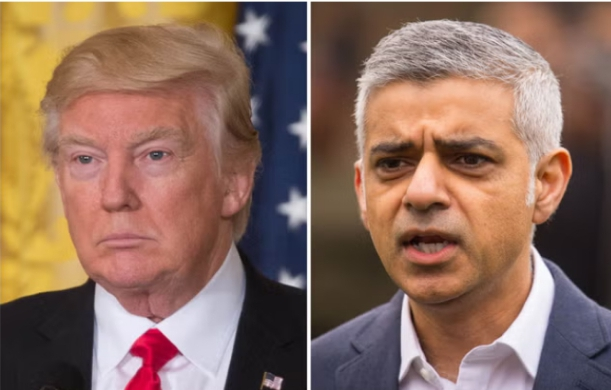
Sir Keir Starmer has stepped into the fray, defending London Mayor Sadiq Khan after US President Donald Trump described him as “horrible, vicious, disgusting,” reigniting tensions.
Trump’s latest criticism accused Sir Sadiq of being a “disaster” for London, claiming the mayor has done a “terrible job” overseeing the city’s management and public services.
The US president also suggested that the London mayor’s election was influenced by migration, stating that incoming communities had contributed to his political support base.

In a delayed response, Downing Street initially avoided direct comment on Trump’s remarks, describing Starmer’s relationship with the mayor and the US president as “strong but complex.”
A day later, the prime minister’s office clarified the UK stance, stating Trump’s comments were “wrong” and praising Khan’s record in London as exemplary.
“The mayor of London is delivering free school meals, expanding council housing, and improving air quality with the world’s largest clean air zone,” said Starmer’s spokesperson.
Culture Secretary Lisa Nandy also rejected Trump’s criticism, affirming Khan’s leadership and describing him as “doing a really good job” across the capital’s communities.
Foreign Secretary Yvette Cooper echoed the support, emphasizing that the mayor’s achievements had benefitted all Londoners, challenging Trump’s narrative directly on public platforms.
This feud is not new. Trump has repeatedly attacked Khan since 2015, after the mayor criticized the then-presidential hopeful’s suggestion of a Muslim travel ban to the US.
In September, Trump called Khan “one of the worst mayors in the world” and suggested London was leaning toward Sharia law under his leadership.
Khan responded, condemning the comments as racist, sexist, misogynistic, and Islamophobic, highlighting the broader implications of international political attacks on UK leadership.
In July, Trump again targeted Khan as a “nasty person,” prompting Starmer to publicly affirm his friendship and respect for the mayor, breaking a period of silence.
Starmer’s intervention underscores his commitment to defending UK political figures from foreign attacks, balancing diplomacy with domestic political solidarity and public perception management.
The prime minister’s office highlighted that Khan has overseen record numbers of council homes, promoted public health initiatives, and strengthened local infrastructure projects.
Supporters argue that Trump’s criticisms ignore these achievements, reducing Khan’s governance to exaggerated personal attacks with international political overtones.
Experts suggest that repeated attacks from Trump risk influencing international perceptions of London, potentially impacting tourism, investment, and bilateral relations with the United States.
Khan has continued to focus on city priorities, including expanding green spaces, improving transport networks, and enhancing safety measures across diverse communities.
While Trump’s rhetoric remains combative, UK officials stress the importance of separating inflammatory commentary from factual assessment of city management and political performance.
Observers note that Starmer’s public defense may signal a more assertive approach to protecting UK leaders from external political interference in domestic matters.
The episode also highlights the ongoing tension between populist international figures and UK political leadership, with Khan often a central target due to his high-profile mayoralty.
Khan’s supporters argue that his inclusive policies, progressive reforms, and advocacy for marginalized communities contrast sharply with Trump’s characterizations and criticism.
Despite the attacks, polls suggest that Khan retains strong support among London residents, who recognize tangible improvements in public services and city governance under his leadership.
Political analysts suggest that Starmer’s defense could strengthen Labour’s positioning ahead of future local and national elections, emphasizing party unity and resilience.
The debate also raises questions about the influence of social media and international commentary on domestic politics, with Khan frequently responding through public statements.
Starmer’s intervention reinforces a broader UK stance: defending national figures against unfounded attacks while continuing to uphold commitments to effective city governance.
The London mayor’s office welcomed Starmer’s support, reiterating a focus on long-term projects benefiting the capital, from housing development to public health initiatives.
In sum, the dispute underscores ongoing friction between high-profile political figures internationally, but Starmer’s defense of Khan marks a clear statement of principle and solidarity.