

Keir Starmer has praised Donald Trump’s role in the Gaza ceasefire agreement but declined to endorse him for a Nobel peace prize, reflecting the careful balance of stern diplomacy.
Speaking in Mumbai at the close of his trade mission to India, the prime minister said the ceasefire deal would not have been possible without Trump’s leadership and political weight.
However, he repeatedly stopped short of joining allies in suggesting the former US president should be considered for the Nobel peace prize, warning that true peace is still far from guaranteed.
Starmer described the agreement as “a relief to the world,” adding that Britain had also played a critical role behind the scenes alongside the United States and regional negotiators.
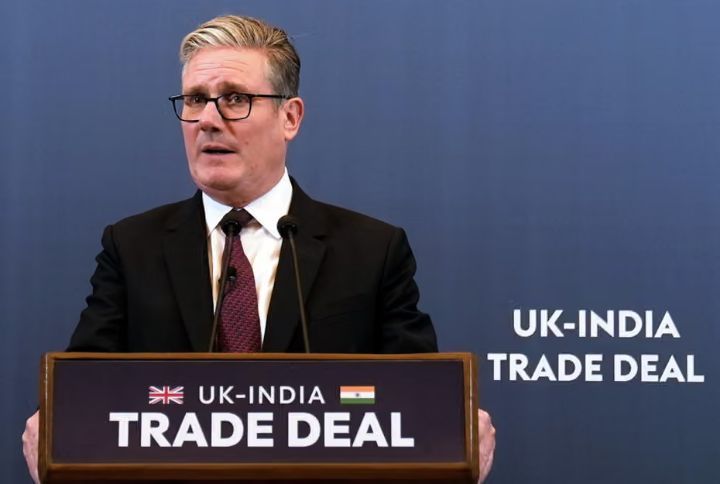
His message was unmistakably cautious. He underlined that the ceasefire “must now be implemented in full, without delay” and demanded the immediate removal of restrictions on humanitarian aid for Gaza.
When pressed directly on whether the Nobel committee should recognise Trump’s efforts, Starmer shifted focus, stressing that implementation mattered more than international accolades or premature declarations of success.
“What matters now is pressing on, moving from this fragile stage to a lasting framework, and ensuring this agreement delivers real peace for the people,” Starmer told reporters in Mumbai.
The prime minister’s remarks have drawn global attention because they reflect both the recognition of Trump’s influence and the refusal to validate his controversial push for Nobel recognition.
His words came during an official trade visit to India where he signed major agreements, showcased British business, and attempted to strengthen diplomatic bonds with Narendra Modi’s government.
The trip, marked by the signing of a new UK-India free trade agreement, was accompanied by major announcements, including £350m in defence contracts for British missile systems bound for India’s army.
Thousands of posters featuring Starmer’s face lined the streets of Mumbai, while Modi publicly welcomed him as “a friend” and praised him for unblocking stalled negotiations on trade.
British officials also revealed a host of new cultural and financial collaborations, including the establishment of university campuses, fintech partnerships, and agreements for three Bollywood films to be produced in the UK.
Starmer has also spent time exploring India’s widely adopted digital ID system, meeting experts and noting how the programme has revolutionised access to payments, welfare, and essential services for millions.
He suggested the UK could follow similar voluntary reforms, potentially expanding digital ID into banking, mortgage applications, and education access, while emphasising efficiency and personal choice.
“This has been taken up on a voluntary basis in India at huge scale because of the real benefits,” Starmer said, pointing to faster access to money and services for ordinary citizens.
His openness to adopting India’s model reflects his wider theme during the visit: presenting Britain as outward-looking, learning from others, and prepared to reshape policies for a changing world.
At the same time, Starmer acknowledged that digital ID reforms remain unpopular at home, urging the public to recognise the benefits and calling for a new national debate on modernisation.
Beyond trade and technology, the prime minister addressed sensitive issues with his Indian counterpart, including human rights concerns, Russia’s war in Ukraine, and the detention of British activist Jagtar Singh Johal.
He confirmed he raised the case of Johal, who has spent nearly eight years in an Indian prison without trial, but admitted progress appeared minimal despite renewed diplomatic pressure.
Starmer also said he raised concerns about India’s continued purchase of Russian oil, a policy at odds with Western sanctions and one that has frustrated UK and EU partners.
“For prime minister Modi and myself the focus was ending conflict and building energy resilience,” Starmer explained, describing discussions as “wide-ranging but necessarily difficult.”
Despite his restrained approach on Trump, Starmer’s comments underline the UK’s attempt to stay aligned with Washington while avoiding unnecessary entanglement in Trump’s political ambitions.
Some analysts argue his words were deliberately careful: praising Trump enough to show cooperation but refusing endorsement that could later backfire if peace efforts collapse.
Labour critics have warned that Trump’s push for a Nobel peace prize risks overshadowing the fragile reality on the ground in Gaza, where previous ceasefires have repeatedly broken down.
Humanitarian groups stress that conditions in Gaza remain dire, with food shortages, destroyed infrastructure, and widespread displacement, meaning the ceasefire is only the beginning of an uncertain process.
Starmer echoed those concerns by highlighting that humanitarian aid must flow immediately and that restrictions strangling Gaza’s survival must be lifted if peace is to have credibility.
The diplomatic dance reflects the challenges of dealing with Trump, whose influence remains polarising globally, yet whose intervention undeniably shaped the latest ceasefire outcome.
Starmer’s caution may also be aimed at avoiding a domestic political backlash, where support for Trump is controversial and overt praise could alienate Labour’s base.
Nevertheless, his remarks drew criticism from Conservative opponents who accused him of failing to “show leadership” by refusing to unequivocally back Trump’s recognition on the world stage.
Starmer’s allies insist his position is pragmatic: acknowledge the American role while focusing on Britain’s constructive contribution and avoiding distractions over individual accolades.
Back in London, officials suggested that Starmer’s restraint highlights his long-term strategy of measured diplomacy, preferring credibility over flamboyant gestures that could unravel in future crises.
The broader question now is whether the ceasefire can hold. Israel and Hamas remain deeply divided, while regional tensions threaten to undermine the tentative progress reached through Trump’s mediation.
For Starmer, the message remains clear: Britain supports peace, insists on humanitarian relief, and avoids being drawn into personality politics that could weaken its international standing.
Observers say this is consistent with Starmer’s style since entering office—cautious, lawyerly, and determined to prioritise practical results over symbolic rhetoric.
It also reflects his vision of Britain’s foreign policy: align with allies, maintain independence, and pursue economic and diplomatic opportunities in emerging powers such as India and China.
Starmer confirmed he intends to make a similar trip to China next year, though he ruled out any immediate trade deal, citing unresolved security concerns and the collapsed spy case scandal.
He reiterated the UK’s approach toward Beijing: “cooperate where we can, challenge where we must,” underscoring his determination to tread carefully in complex international relationships.
As he left Mumbai, Starmer declared the UK-India trade deal as “historic,” presenting it as a foundation for a modern partnership shaped by shared history, cultural ties, and forward-looking economic collaboration.
Yet, despite the fanfare of trade agreements, his remarks on Gaza and Trump continue to dominate headlines, symbolising the unavoidable overlap between diplomacy, conflict, and political caution.
Starmer’s praise of Trump, coupled with his refusal to back Nobel recognition, demonstrates both a recognition of reality and a refusal to be drawn into premature celebration.
For Britain, this moment underscores the limits of influence but also highlights the careful balance required when navigating a turbulent international order shaped by powerful personalities.
Ultimately, the message from Mumbai was clear: the Gaza ceasefire is welcome, Trump’s role is undeniable, but Nobel endorsements must wait until genuine peace takes hold.
About The Author


