Peruvian lawmakers voted decisively to remove President Dina Boluarte, citing widespread protests, corruption scandals, and rising gang violence. Boluarte’s leadership was increasingly questioned across political and public spheres.
“She has failed to protect citizens from escalating crime,” said opposition lawmaker Mariana Castillo. “Her moral incapacity is clear, and Peru deserves competent governance.”
Boluarte, who assumed office in December 2022 after Pedro Castillo’s impeachment, skipped an overnight congressional hearing, prompting lawmakers to initiate formal proceedings for her removal.
At 11:30 pm, Congress summoned Boluarte to respond to charges of permanent moral incapacity, but she refused to appear. Lawmakers interpreted her absence as defiance and neglect of duty.
A total of 118 legislators voted in favor of Dina Boluarte impeachment, officially ending her turbulent presidency. Congress leader José Jerí immediately assumed interim leadership.
“Today, I humbly assume the presidency to install and lead a transitional government,” Jerí stated after taking office, promising stability and preparation for the April 2026 elections.
Boluarte’s presidency had been defined by repeated protests and allegations of corruption, including her failure to address organized crime, which experts say had grown worse during her term.

“The gangs operate with impunity,” remarked human rights activist Jorge Mendoza. “The government’s response has been inadequate, leaving ordinary citizens exposed to violence and extortion.”
Recent protests erupted over a September law requiring young Peruvians to contribute to private pension funds, despite job insecurity and an informal employment rate above seventy percent.
Boluarte further angered citizens by granting herself a large salary increase in July. “This was a slap in the face to struggling Peruvians,” said labor leader Carla Huerta.
She is also under investigation for the “Rolexgate” scandal, concerning her alleged failure to declare luxury gifts, including watches and jewelry, further eroding public trust in her administration.
“The president’s priorities have been wrong from the start,” said political analyst Ricardo Luna. “She has focused on personal gains rather than the security of her people.”
Gang-related violence has intensified over the past six months, with extortion, armed robberies, and murders targeting communities, particularly in Lima, Arequipa, and Trujillo.
Peru has had six presidents in roughly nine years. Boluarte’s removal reflects broader political instability and the challenge of governing amid chronic corruption and social unrest.
She inherited Castillo’s legacy, including protests and government crackdowns that killed at least fifty people, leaving her administration to grapple with entrenched social tensions.
Her approval ratings fell sharply as public dissatisfaction grew over crime, corruption, and failure to act decisively, prompting repeated calls for resignation from citizens and lawmakers alike.
The latest effort cited her “permanent moral incapacity” to govern. “We cannot allow a leader who ignores public outrage to continue,” said Congressman Javier Tello, emphasizing accountability.
Boluarte’s removal illustrates a broader South American trend, where political volatility often triggers abrupt leadership changes, leaving citizens wary of democratic institutions.
Jerí’s transitional government is expected to restore public confidence, tackle organized crime, and prepare Peru for free elections in April 2026. “Stability must come first,” Jerí emphasized.
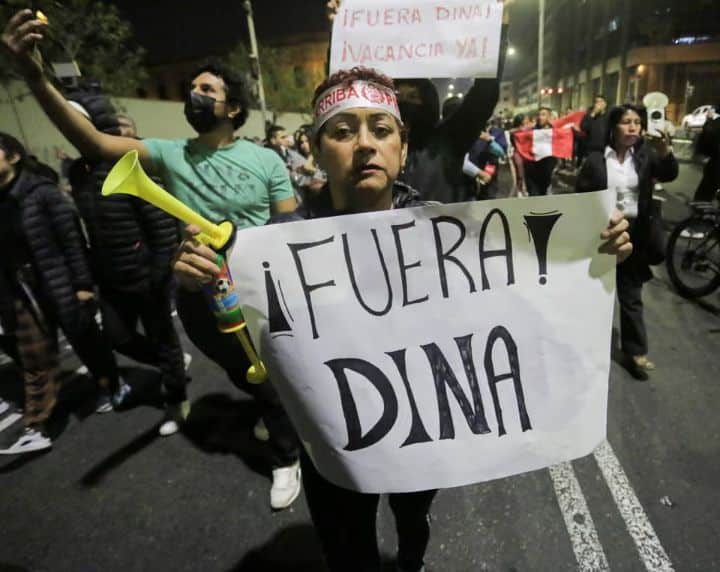
Protesters immediately gathered outside Congress, waving signs calling for Boluarte’s resignation. “Dina out! Enough corruption!” shouted demonstrators, underscoring societal frustration and anger.
International observers expressed concern over Peru’s fragility, warning that political instability could affect economic growth, increase crime, and deter foreign investment if unresolved.
Organized crime surged during Boluarte’s term, with gangs executing extortion, targeted killings, and armed robberies, prompting widespread fear in urban and rural communities.
The pension law sparked protests among youth facing insecure employment. “We are being forced to contribute while we barely survive,” said young protester Luis Arce in Lima.
Boluarte’s administration was criticized for failing to respond effectively to gang violence. Citizens reported law enforcement inaction and inadequate security measures, amplifying public frustration and distrust.
Despite multiple scandals and declining approval, Boluarte survived previous impeachment attempts, highlighting Peru’s fragmented Congress and political polarization.
Her ultimate removal, however, was decisive. “We have acted in the country’s best interest,” said legislator Teresa Rojas, emphasizing moral and political responsibility in voting for impeachment.
Jerí’s priority is restoring stability and ensuring effective governance. “We will address crime and corruption while preparing Peru for democratic elections,” he told a press conference after assuming office.
The international community, particularly regional partners, will monitor Peru closely, concerned about potential unrest spilling into neighboring countries and affecting diplomatic relations and trade.
Ongoing investigations into Boluarte’s administration are likely to dominate political discourse, with scrutiny focused on corruption, mismanagement, and human rights violations during her tenure.
As Peru approaches the 2026 elections, the transitional government faces immense pressure to enact reforms, reduce crime, and rebuild public confidence in democratic institutions.
The impeachment vote and protests underscore Peru’s fragile political system, highlighting the urgent need for structural reform to prevent repeated instability and public unrest.
The country now enters a critical phase, balancing immediate security needs against long-term political and economic reform requirements to stabilize governance and society.
Boluarte’s departure may temporarily reduce political tension, but systemic issues, including corruption and gang influence, remain unresolved and will test Jerí’s transitional administration.
Peru’s recent history of presidential turnover, protests, and crime demonstrates the high stakes of governance in a divided society, requiring decisive leadership and institutional reform.
Observers stress that sustainable stability will require tackling organized crime, strengthening public institutions, and rebuilding citizens’ confidence in democratic processes and rule of law.
The transitional government’s credibility will depend on combining political negotiation with action against crime, corruption, and social unrest to reassure citizens ahead of elections.
Boluarte’s impeachment demonstrates the consequences of mismanagement, disconnect from public sentiment, and failure to address national security, serving as a warning to regional leaders.
Peru now faces a pivotal period of political, economic, and social adjustment, navigating leadership change, heightened crime, and preparations for the next democratic transition.
Jerí’s interim administration must prioritize transparency, accountability, and effective law enforcement while reassuring citizens that public grievances are being addressed and reforms implemented.
About The Author