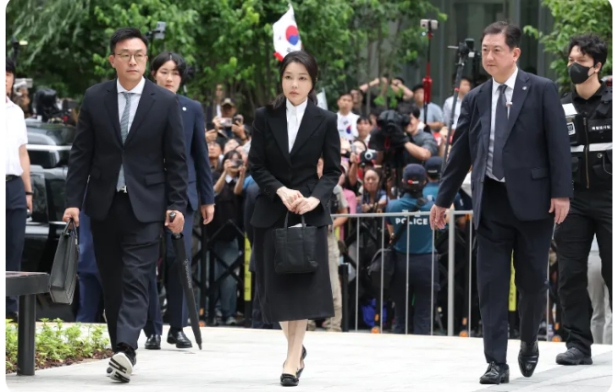
South Korea former first lady jailed after a Seoul court sentenced Kim Keon Hee to one year and eight months in prison for accepting bribes linked to the Unification Church, marking a significant milestone in South Korea’s ongoing political corruption crisis.
The ruling comes amid a broader legal reckoning for senior figures associated with the administration of her husband, former President Yoon Suk Yeol, who was removed from office following a failed declaration of martial law in December 2024.
The Seoul Central District Court found Kim, who served as first lady from 2022 until her husband’s impeachment, guilty of accepting financial gifts and luxury items from business leaders and religious organisations, including the Unification Church, in exchange for political influence.
Prosecutors said the total value of the bribes exceeded $200,000, encompassing items such as Chanel handbags, diamond jewellery, and expensive watches. The court’s decision highlights the degree to which personal gain and influence had infiltrated the highest levels of the South Korean political system.
Kim was acquitted of additional charges related to stock manipulation and violations of the political funds act, as judges determined there was insufficient evidence to prove her involvement beyond a reasonable doubt.
Nevertheless, her conviction on bribery charges sends a strong signal about the government’s commitment to tackling corruption at the top.
During the trial, prosecutors portrayed Kim as a central figure in a network that blurred the boundaries between private interests, religious organisations, and state power.
“The defendant stood above the law for years, using her position as first lady to facilitate and profit from illegal activities,” lead prosecutor Min Joong-ki told the court.
He added that her actions had “severely undermined the integrity of national institutions” and threatened democratic norms in South Korea.
Kim consistently denied wrongdoing throughout the proceedings. In her final statement, she said the allegations were “deeply unjust” but also offered a partial apology for the political turmoil her actions had caused.
“When I consider my responsibilities and the trust placed in me, it is clear that I have made serious mistakes,” she said, expressing regret for the public controversy surrounding her conduct.
Her statement reflected a rare admission of error from a figure at the centre of South Korea’s political scandals.
The conviction also casts a long shadow over Kim’s husband, former President Yoon Suk Yeol. Yoon was ousted from office last year and sentenced to five years in prison for his actions during the brief and controversial declaration of martial law in December 2024.
He faces additional charges in a separate case, where prosecutors have indicated they may seek the death penalty. Analysts say that the legal outcomes for Kim and Yoon reflect the unprecedented scale of accountability being applied to South Korea’s former leadership.
Public scrutiny of Kim’s actions intensified in 2023, when hidden camera footage surfaced showing her accepting a luxury handbag, in what became widely known as the “Dior bag scandal.”
The footage, initially released by investigative journalists, amplified criticism of Yoon’s presidency and eroded public trust in his administration. The scandal contributed to a heavy defeat for Yoon’s party in the April 2024 general elections, preventing them from regaining a parliamentary majority.
The allegations against Kim included not only material gifts but also accusations that she colluded with the Unification Church to influence political appointments and policy decisions.
Prosecutors argued that she violated the constitutional principle of the separation of religion and state by acting as a conduit for the church’s efforts to gain sway over government decisions. Han Hak-ja, leader of the Unification Church, has also been indicted and is currently on trial for orchestrating the bribery scheme.
The legal and political crisis surrounding the former first lady and her husband has drawn international attention. Observers note that South Korea, traditionally seen as a stable democracy in East Asia, is undergoing one of its most serious periods of institutional scrutiny in recent decades.
Read also: Democrats call to fire Kristi Noem as impeachment threat escalates
Analysts highlight that these prosecutions may serve as a deterrent to future abuses of power, demonstrating that even those closest to the presidency are not beyond the reach of the law.
The Kim Keon Hee case forms part of a broader wave of accountability sweeping through South Korea’s political elite. Former Prime Minister Han Duck-soo was recently sentenced to 23 years in prison for aiding and abetting Yoon’s suspension of civilian rule, highlighting the systemic nature of the abuses under the short-lived martial law period.
Legal experts say the sentences are unusually severe, signalling the judiciary’s determination to reinforce democratic norms and restore public confidence.
While Kim’s conviction focuses on bribery, the broader ramifications of the scandal continue to unfold. Investigations into the financial dealings of the former first lady, her husband, and their political allies remain ongoing, with authorities scrutinising both domestic and foreign connections to ensure no additional illicit influence remains unchecked.
Experts predict that the ramifications will continue to shape South Korean politics and governance in the coming years, particularly as political parties adjust their strategies to restore credibility with voters.
Throughout the trial, media coverage emphasised not only the legal dimensions of the case but also the symbolic weight of the first lady’s conviction.
Observers suggest that Kim’s sentencing could redefine public expectations of accountability for figures associated with the presidency, reinforcing the principle that ceremonial or non-elected officials can be held responsible for corruption and influence-peddling.
Kim’s sentencing also raises questions about how South Korea’s institutions might respond to similar crises in the future. Policymakers and legal analysts are debating whether additional reforms are needed to strengthen checks on executive power, particularly in the context of potential interference from private or religious interests.
The ruling arrives at a critical juncture in South Korea’s political history. Following the collapse of the Yoon administration, the country faces heightened public scrutiny over government transparency, judicial independence, and political ethics.
Analysts warn that the outcomes of cases like Kim’s will influence not only public trust but also the broader stability of democratic governance in South Korea.
The jailing of South Korea former first lady reflects both a legal and symbolic turning point. The conviction underscores the judiciary’s determination to hold high-ranking figures accountable and signals a broader effort to combat corruption in the highest echelons of power.
With ongoing investigations and additional trials likely, the political and social impact of Kim Keon Hee’s conviction will continue to reverberate across the nation.
About The Author