

Borno APC event raises concern as VP Shettima’s photo missing, sparking debate about party unity, political interests, and the North-East leadership role.
The Speaker of the Borno State House of Assembly, Hon. Abdulkarim Lawan, has raised concerns over the absence of Vice President Kashim Shettima’s photograph on a banner displayed during a recent All Progressives Congress (APC) meeting in Maiduguri.
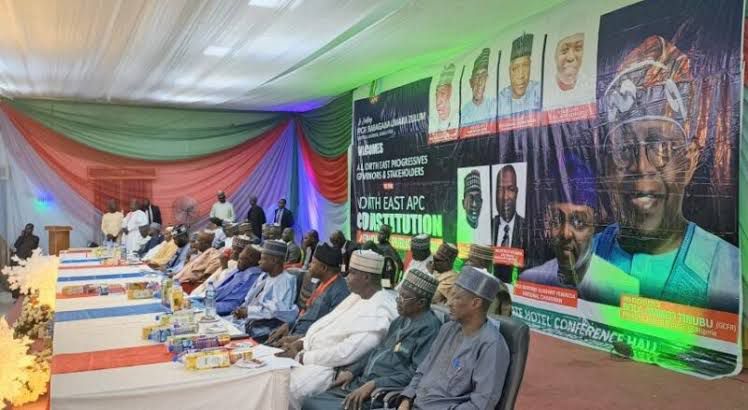
The banner featured President Bola Tinubu, APC governors, and other key party stakeholders from the North-East, but notably excluded the vice president, triggering discussions about party inclusiveness and unity.
The APC meeting, held at the Borno State Hotel, was part of a constitutional amendment committee session and public hearing involving governors and stakeholders from across the North-East zone.
While none of the pictured governors were physically present, the banner prominently displayed images of President Tinubu, APC National Chairman Prof. Nentawe Yilwatda, Governor Babagana Zulum of Borno, Governor Mai Mala Buni of Yobe, Governor Inuwa Yahaya of Gombe, Governor Kefas Agbu of Taraba, and the party’s National Legal Adviser, Barr. Murtala Aliyu Kankia.
Hon. Abdulkarim Lawan noted that the absence of Shettima’s photo is not just symbolic but carries political undertones.
He recalled that last year, a similar scenario unfolded during an APC zonal meeting in Gombe, where only President Tinubu’s endorsement was highlighted, excluding the vice president.
“This is what triggered the protests at the party’s zonal meeting in Gombe last year,” Lawan said, adding that the repeated sidelining of Shettima raised concerns about the continued Muslim-Muslim ticket for the 2027 elections.
Lawan emphasized the political significance of Shettima, stating, “The Vice President is a party leader and a most-revered son of the zone; yet his photo is absent on the banner showing the president and other key personalities of the party.”
His remarks were met with audible approval and applause from attendees, indicating broad support among local APC stakeholders for the vice president’s inclusion in party activities.
The incident has sparked renewed debate about internal party politics and the perception of favoritism within the APC hierarchy.
While President Tinubu’s leadership is widely recognized, the omission of Shettima from banners and endorsements has led to speculations about potential replacements or marginalization of the vice president in future political plans.
Political observers note that such exclusions could have broader implications for party unity, especially in the North-East, where Shettima’s influence is substantial.
Efforts to seek comment from key APC figures, including Deputy National Chairman (North) Hon. Ali Dalori and National Vice Chairman (North-East) Dr. Mustapha Salihu, were unsuccessful as neither responded to calls or messages at the time of reporting.
The lack of immediate clarification from senior party officials has only fueled speculation in political circles.
Meanwhile, the APC Youth Parliament, through its chairman Kabiru Garba Kobi, sought to downplay the controversy, describing the speculation as an attempt to sow discord.
Speaking to journalists in Bauchi, Kobi said, “Those behind these rumors are pursuing personal and external political interests rather than focusing on the unity and stability of the APC.”
He urged party members and the public to maintain confidence in the leadership of both President Tinubu and Vice President Shettima, highlighting that the APC’s internal cohesion remains strong.
Political analysts argue that the recurring omission of Shettima in official party events could impact public perception of the APC’s commitment to inclusiveness.
In a multi-ethnic and multi-religious country like Nigeria, symbolism matters significantly in politics.
Read: Tinubu’s running mate to be announced after party nomination
The vice president’s absence from banners at high-profile meetings may inadvertently suggest internal divisions, regardless of whether any deliberate marginalization exists.
Observers also note that APC’s public image and internal unity are crucial ahead of the 2027 general elections.
The party’s leadership in the North-East, particularly in states like Borno, Yobe, and Gombe, relies heavily on Shettima’s political network and influence.
Ensuring that all key figures are visibly represented in party activities may prevent misunderstandings and help maintain cohesion among stakeholders.
The Borno State House of Assembly Speaker’s intervention underscores the importance of recognizing all leaders within the APC framework.
It serves as a reminder to party organizers to carefully consider symbolism in banners, endorsements, and public communications.
While the incident may appear minor to outsiders, within party ranks, it signals the need for consistent inclusivity and respect for leadership roles across all zones.
About The Author


